Tuesday, January 4, 2022

THE GREAT ALASKAN MYSTERY (1944)


PHENOMENALITY: *marvelous*
MYTHICITY: *poor*
FRYEAN MYTHOS: *adventure*
CAMPBELLIAN FUNCTION: *sociological*


THE GREAT ALASKAN MYSTERY is an amiable spin on the old "good guys and bad guys pursue super-weapon" chestnut. But though it takes place at a time when the United States was still enmeshed in WWII, the serial never really seems set securely in that era. Often the script includes only fleeting allusions to the martial action, as in the first episode, where it's explained that the young hero Jim Hudson (Milburn Stone) isn't currently serving in the military because he was honorably discharged for an injury, albeit one that never interferes with his adventurous activities. But the strangest aspect of ALASKAN is that Hudson and his allies are quite easily infiltrated by a clandestine villain with the very German name of Hauss (Martin Kosleck), and who speaks with a fairly obvious German accent. In some ways, ALASKAN feels something like a throwback to the sort of apolitical serials Universal was producing back in the 1930s.

The super-weapon, given the vaguely Greek sounding name of "the Peratron," is invented by Professor Miller (Ralph Morgan) in order to transmit matter from place to place in aid of the war effort. However, the ray-projector needs a rare form of quartz to power it, and the search for this power-source leads the discharged Hudson-- who's dating Miller's daughter Ruth (Marjorie Weaver)-- to help Miller and Ruth journey to a mine in Alaska where the quartz can be found-- a mine that just happens to be owned and managed by Hudson's father and his aide "Bosun" (the serial's comedy relief, played by renowned comedian Edgar Kennedy). But spies for the Axis try to sabotage the expedition, both on the way to Alaska and after the heroes arrive at their destination. Thus the majority of the serial is devoted to peril in the frozen wastes, as the bad guys keep trying to obtain the Peratron-- which also doubles as a disintegrator ray. In contrast to some more dilatory serials, the evil spies do gain custody of the weapon for the space of a couple of episodes-- though the most bracing scene of physical peril involves a villain setting loose a huge cylindrical log from its bonds, so as to let it roll down and crush two of the good guys.

Though the plot is hoary, the dialogue is a little more naturalistic than in many serials, partly because of the potential familial connections between Hudson, his father, Ruth, and her father. Stone is not quite as dynamic as he proves in his second starring serial, 1945's THE MASTER KEY, but he, Morgan, Kosleck and Kennedy all acquit themselves very well. Of all the main characters, though, I liked Marjorie Weaver's Ruth best, in that she plays a clever heroine with a strong will to help the hero conquer the nasty spies. Her abilities as a pilot put me in mind of the lead heroine from a Universal serial of the 1930s, THE PHANTOM OF THE AIR.


Monday, January 3, 2022

DOCTOR JEKYLL AND MISTER HYDE (1931)


PHENOMENALITY: *marvelous*
MYTHICITY: *good*
FRYEAN MYTHOS: *drama*
CAMPBELLIAN FUNCTION: *psychological, sociological*


I don't know whether or not Robert Louis Stevenson had, at the time he composed his famous novelette, read Mary Shelley's FRANKENSTEIN. But there's a strong similarity in the motivations of both Frankenstein and Jekyll, who spawn monsters because they share some basic insecurities about their role in society.

By coincidence I read one of Abraham Maslow's works, TOWARD A PSYCHOLOGY OF BEING, around the same time I watched the 1931 film. I wrote:

Maslow argues that human beings are doubly motivated by their responses to "deficiency" or to "growth" (which Maslow later terms "being," though this term is actually less clear than the earlier one IMO). Deficiency motivations are fueled by the perception that one can only be happy if one can satisfy one's appetite for wealth, food, love, or some similar commodity. Growth motivations are fueled by the perception that one can overcome all boundaries through a process that Maslow termed "self-actualization." 

Shelley's Frankenstein and Stevenson's Jekyll both create their scientific innovations out of what Maslow calls "deficiency motivations;" they become fixated upon some project as if its completion will exemplify their worth. Yet sound cinema's first great version of Jekyll displays the opposite form of motivation, "growth motivation," albeit one that creates the sin of hubris due to the scientist's shattering of psychological barriers.

I speculate that the dominant influence for Rouben Mamoulian's Paramount film was the Thomas Sullivan stage play, which debuted the year after the sensational publication of the Stevenson work. In Sullivan, Jekyll becomes not a misanthrope, but a do-gooder, seeking to find some way to nullify the power of evil within the aspirational ethos of Victorian England, and in this respect the script for HYDE follows the play's model. 

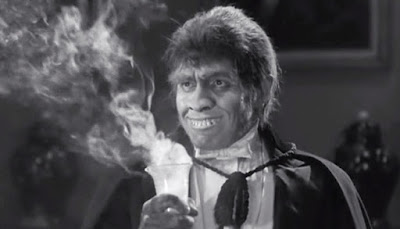
For the first half-hour of HYDE, Jekyll , as played by Frederic March in his Oscar winning performance, seems to be the sort of guy who's on top of the world. He's a respected doctor, and though the theories he puts forth in his public lectures are not popular with conservative physicians, no one ridicules Jekyll. Indeed, younger doctors, even if they don't prize Jekyll's theories, go out of their way to watch him rip apart stultified thinking. Jekyll's friends Lanyon and Utterson-- both very loose adaptations of Stevenson characters-- don't know what to make of the man, but what few censures they make of him are mild. The stage play was apparently the first adaptation to give Jekyll a romantic interest-- here, it's his rich fiancee Muriel (Miriam Hopkins)-- but the 1931 film also creates a parallel character, bar-hostess Ivy (Rose Hobart), who appears early in the film, seeking to tempt the righteous doctor into sin. 

However, Muriel's conservative father, Danvers Carew, proves to be the one real fly in Jekyll's ointment. While Jekyll and Muriel are eager to be married-- evincing a healthy pre-Code lust for one another, if only in implicit terms-- Danvers sets down the arbitrary notion that he wants them to wait and be married on the same day he Danvers married Muriel's mother. This capricious commandment is never really justified in terms of the rich man's character, but there's little doubt that Mamoulian and his writers conceived that the frustrated scientist then channels his ardor into a quest to eradicate evil. In one lecture Jekyll speaks as if the evil in man's soul can not only be separated from the higher self, it can then be "left to do its will and then be forgotten." 

The balance of the film is then devoted to illustrating just how terribly wrong Jekyll is. One may speculate that when the scientist tests his soul-separation potion on himself, he might wish to be rid of the part of his soul that resents the way "heavy father" Danvers keeps him away from Muriel. Instead, Jekyll unleashes what many horror-fans deem the archetypal image of the Evil Self: an ape-like humanoid who looks even more incongruous for being going around London garbed in top hat and evening wear. (Stevenson does use the word "troglodytic" once to describe his version of Hyde, though the literary Hyde is smaller and more repulsive than powerful.)

Even though Jekyll was too much of a man of rectitude to be tempted by Ivy, Hyde remembers the temptation and seeks out the temptress. The scenes between Hyde and Ivy, as he intimidates her into becoming his de facto mistress, suggest a different vein of horror than what most films mine. Mamoulian never shows Hyde brutalize Ivy in the early part of their relationship, but he dominates her with his leering sadism, less like a man-- even an extraordinarily ugly man-- seeking to woo a woman than like a predator fixating on his prey. Ivy, though no masochist, becomes submissive to Hyde's will, only resisting once by seeking out kindly Doctor Jekyll for help-- by which action she dooms herself, since Hyde knows everything Jekyll knows.

However, Hyde's ability to create the illusion of being Jekyll's confidante soon falls apart when Lanyon holds Hyde at gunpoint for information on the missing physician. In contrast to the novelette, Lanyon gets the distinction of being the only named character in the story who witnesses the transformation in real time, though Lanyon doesn't act upon the knowledge.

Next to the slow torture of Ivy, Hyde's impulsive murder of Danvers Carew is merely a plot-device that functions to move the plot in the direction of Jekyll's own demise. Danvers' death sets the police on Hyde's trail, and though the malefactor jumps about like an ape he's soon gunned down, allowing the constables to witness his final reversion as well. Mamoulian ends the film on the image of a pot boiling over-- which I originally thought of as a metaphor for the Freudian idea of the contained "id." But now I tend to think that the boiling pot symbolizes Jekyll's over-confidence in his own brilliance, the superfluity of his own mastery of science-- all of which is no match for the hidden power of base desires.


Thursday, December 30, 2021

SPIDER-MAN: NO WAY HOME (2021)


PHENOMENALITY: *marvelous*
MYTHICITY: *good*
FRYEAN MYTHOS: *adventure*
CAMPBELLIAN FUNCTION: *cosmological, metaphysical, psychological*

Do I dare
Disturb the universe?
In a minute there is time

For decisions and revisions which a minute will reverse.

--T.S. Eliot, THE LOVE SONG OF J. ALFRED PRUFROCK

I was only moderately entertained by the first two MCU/Sony collaborations on the SPIDER-MAN franchise, and I had no reason to think that Number Three would be any different. When I heard that advance sales were breaking records, I tended to put it down to a lack of competition in U.S. theaters. But I started hearing positive reviews from sources I respected, so, despite having boycotted ETERNALS and SHANG-CHI among others, I queued up and bought my ticket. SPOILERS apply throughout, naturally.

One review asserted that the Sony people may have been more in control of the script than the MCU/Disney people. That alone might be one reason as to why WAY provides a massive crossover of all three live-action movie versions of Spider-Man-- Tobey Maguire from the Sam Raimi trilogy, Andrew Garfield from the Marc Webb duology, and Tom Holland from the Jon Watts neo-trilogy. In addition to bringing together all three versions of Spider-Man-- in what might be considered a GOOD version of SPIDER-MAN: INTO THE SPIDER-VERSE-- WAY also brings together five villains from the earlier franchises: the Lizard (Ryan Ifans), Electro (Jamie Foxx), Sandman (Thomas Haden Church), Doctor Octopus (Alfred Molina), and the Green Goblin (Willem Dafoe). The effect is that the Holland-verse gets a much needed infusion of Classic Spider-continuity, though since all five villains come from other heroic universes, they probably won't come back for encores right away.

The means by which the continuities become interwoven is probably partly derived from MCU's concept of "rewriting reality" in AVENGERS: INFINITY WAR, and partly from the ending of the first IRON MAN, in which Tony Stark impulsively reveals his superhero identity to the public, in marked contrast to the comic book series. It's arguable that the entire arc of the previous MCU film, FAR FROM HOME, existed to set up this Big Reveal, in which the villainous Mysterio, dying from self-inflicted wounds, unveils Spider-Man's secret identity to the world and attempts to frame the hero for murder.

The second part of Mysterio's plan doesn't have the slightest effect upon Peter Parker's life, and this major plot-hole is one of the things that most reminds me of an MCU film. The viewer never knows why none of the legal agencies ever show the slightest interest in investigating the alleged murder. There's a sequence in which a government agency arrests Parker, his girlfriend, his best friend and his Aunt May, but their only concern is whether or not the four of them had anything to do with appropriating government-tech-- and that concern evaporates with ridiculous ease because it would have interfered with the important part of the story.

Even when the law-dogs lay off, Parker's life turns to crap because everyone knows of his double identity, and it also affects the lives of his high-school buddies. Since Parker doesn't have the resources of a Tony Stark, who could insulate himself from the public with his money, he eventually gets the idea of "rebooting" his reality, since he saw it done twice in his AVENGERS films. He seeks out help from Doctor Strange (Benedict Cumberbatch), who tells him that it's a stupid idea. Then Strange comes up with an idea almost as stupid: to cast a massive forgetfulness spell designed to eradicate the public's knowledge of Parker's identity. (One wonders if the spell had the ability to erase Mysterio's original broadcast and the multitudinous recordings of news broadcasts resulting from the Spider-Reveal.) But in another display of MCU goofiness, Strange and Parker manage to muck up the spell by not preparing the parameters in advance. This scene is almost like a Laurel and Hardy routine, though it's somewhat saved by the opposition of Holland's nerdiness with Cumberbatch's waspish hauteur. 

The accidental side-effect of the botched spell is that it penetrates into alternate universes and spirits into the Holland-verse other characters who know of Parker's double identity-- which means the aforementioned five villains and, later on, the other two Spideys. (There were early plans to have Kirsten Dunst show up as the first Mary Jane, though this didn't work out.) Doctor Strange collaborates with Spidey and his two friends to capture the five villains and send them back to their own universes-- which, as far as it goes, sounds like any number of routine "get rid of the illegal aliens" trope.

But the script then takes a radical new turn. The Holland Spidey has been represented as somewhat more innocent than either the Maguire or the Garfield versions, and even the spell-mucking scene draws upon that concept, since Holland-Parker messes things up due to not wanting to lose his connections with the people he values. Once Parker learns that all of the otherworldly villains became corrupted by their mutations, he gets the idea that he ought to give them all a "second chance" by curing them of their respective manias before sending them back. Doctor Strange disagrees, but Spidey manages to trap the magician in another dimension following a suitably mystic contretemps between the two classic Lee-Ditko characters. 

Parker briefly manages to convince the five villains to let themselves be cured, though Electro and the Goblin seem to be high-risk types. In fact, moments after Parker and his friends manage to cure Doc Ock, the other villains rebel, resulting in a chaotic melee in which Aunt May perishes, and then all of them flee. It's only after that Parker's buddy Ned accidentally summons Maguire-Parker and Garfield-Parker into the Holland-verse, and all three Parkers unite in the mission to give the villains their "second chance"-- including the Goblin, who was responsible for May's death-- which means that there has to be a ton of hero-villain battles at the conclusion before the universe can be stabilized. And on top of all this, Holland-Parker not only loses his aunt and his new "brothers," everyone in the Holland-verse does indeed forget the true identity of Spider-Man.

And at last I can reveal my reason for quoting Eliot at the start of this review. Other Spider-Man films, particularly the first SPIDER-MAN, correctly translated the sense of the original comic:


... the script for SPIDER-MAN seems acutely aware that Peter Parker’s seemingly accidental acquisition of spider-powers functions in the story as a Gift from Above. He abuses that gift by not using his power in the public interest—i.e., to prevent a criminal from escaping the law—and he pays for his neglect when the same crook murders Parker’s beloved Uncle Ben. In both the comic and the movie, Parker is chastened by this development, but goes further by taking on the role of a crusading superhero. The role is not without its perks—Parker even out of costume becomes more appealing to girls, and he continues to enjoy the thrills of spider-powered athleticism. But his great power doesn’t just create a sense of responsibility. The costume sometimes becomes more of a hair-shirt, as bad luck frequently dogs his steps, often making him think of his abilities as an ongoing curse.

However, one thing that WAY does that other Spider-flicks don't is to suggest that Parker's psychological struggle to redeem himself is also a search for a "way" to act properly in a world where even the best intentions can lead one to perdition. Prufrock asks if he dares to disturb the universe, and that's the dilemma with which Holland-Parker struggles when he considers the possibility of giving a second chance to men who largely don't seem to deserve it. I've seen my share of superhero films in which heroes jump through hoops to redeem characters I didn't particularly like, ranging from the Ghost in the MCU's ANT MAN AND THE WASP and the Asian kid in DEADPOOL 2. But in NO WAY HOME, the viewer is obliged to contemplate whether the act of villain-redemption is worth it when it has so many negative consequences. But WAY does have a more substantial reason for having the hero suffer from his hair-shirt: he purges himself of his own negative nature and embraces his fate as a redemptive hero. The worst thing about WAY is that I really don't know where the series can go from this, since further iterations may start to seem like "It's a Wonderful Life, Part 2."

Wednesday, December 29, 2021

RAW FORCE (1982)


PHENOMENALITY: *marvelous*
MYTHICITY: *poor*
FRYEAN MYTHOS: *adventure*
CAMPBELLIAN FUNCTION: *metaphysical*


Although all the parameters for RAW FORCE-- phenomenality, mythicity, mythos-type and function-- are exactly the same as for the previous review BEASTMASTER 3, the 1982 cheeseball flick is far more entertaining in terms of its kinetic appeal. While BEASTMASTER 3 plays it safe, FORCE matches its name by throwing kitchen sinks galore at the sensation-hungry viewer.

The "metaphysical" content is even the same as the one in the other flick, for in FORCE there's a whole cult of vaguely Asian sorcerers who sacrifice people to gain immortality. But the immortality belongs to a bunch of long-dead martial artists, buried on some Caribbean island and deemed to have disgraced themselves in the eyes of decent martial artists, whoever they might be. The cultists pay a Hitler-lookalike go-between, name of Speer, to transport lots of nubile naked girls to the cultist's island, and whenever the girls are sacrificed-- which always happens offscreen-- the dead martial artists come to life as zombies. I'm not sure what the cultists get out of this, but being able to summon zombies to fight good martial artists comes in handy.

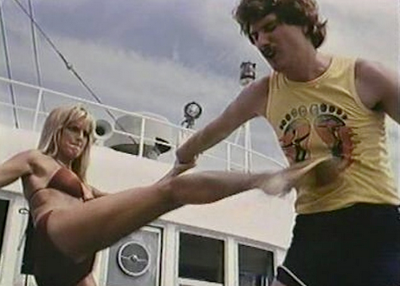
The good martial artists are a bunch of American amateur competitors, most of whom belong to the hilariously named "Burbank Martial Arts Club." They take a Caribbean tour on a ship commanded by boozy Captain Dodds (Cameron Mitchell), and on their way the tourists learn the legend of the forbidden island. One might expect the foolish Americans to trespass on the island and get in trouble, but instead the ex-Nazi Speer sends some of his henchmen to abduct the tourists for future sacrifice. 

Though the action isn't especially well choreographed, and the violence is rather muted for an eighties zombie film, writer-director Edward D. Murphy keeps up a steady stream of boobs and battles. In addition to the generally pleasing Mitchell, FORCE also boasts two other luminaries of junk-entertainment: karate-kicking Jillian Kesner, who in the year previous had made an excellent kung-fu revenge-flick, FIRECRACKER, and Vic Diaz, a perennial presence in low-budget Filipino-made trash-films. FORCE is not even a minor junk classic, but in terms of holding the attention of thrill-hungry viewers, it more than fulfills its modest goals.


BEASTMASTER 3: THE EYE OF BRAXUS (1996)


PHENOMENALITY: *marvelous*
MYTHICITY: *poor*
FRYEAN MYTHOS: *adventure*
CAMPBELLIAN FUNCTION: *metaphysical*


Long after the 1982 BEASTMASTER, directed by Don "Phantasm" Coscarelli, debuted in theaters, the saga of the barbarian Dar, who fought for justice in his fantasy-otherworld, got a couple of sequels. As I remember, the 1991 BEASTMASTER 2 was at least watchable, despite cutting costs by letting Dar wander into a time portal that took him into 1990s Los Angeles.

The second and last sequel is not improved by keeping the hero on his own turf. Though writer David Wise had distinguished himself with some decent scripts for American animated teleshows like the seventies STAR TREK and the nineties BATMAN, EYE OF BRAXUS is a lazy, by-the-numbers example of a sword-and-sorcery tale. There are a couple of other S &S movies that are even worse than BRAXUS, but maybe no more than a half dozen.

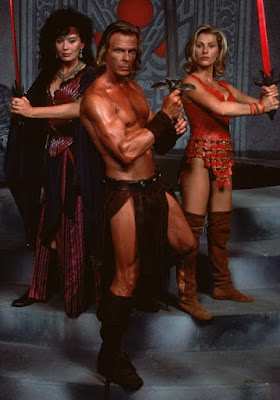
Dar (Marc Singer), now accompanied by a lion rather than his standard tiger, accepts a mission from his king-brother Tal (seen in the first film, though here he's played by Casper Van Dien). Dar must seek out the evil sorcerer Lord Agon (David Warner), who sacrifices innocents to prolong his life, and who plans to release the evil god Braxus from his prison in a mystic gem. On his way to take down Agon-- whose name is Greek for "contest"-- Dar picks up a handful of helpers, played by such familiar faces as Tony Todd, Sandra Hess and Lesley Anne Down. And that's pretty much the whole plot.

I might not have objected to such a formulaic scenario had director Gabrielle Beaumont, who'd been directing TV episodes since 1974, had given the fight-scenes any heft, given that this is what S&S fans particularly want to see in the genre. But all of the brawls are low-energy, even from Sandra Hess, who distinguished herself not only in more expensive productions like MORTAL KOMBAT: ANNHILATION but also minor B-movies like the 1994 ENDANGERED. 

Lesley Ann Down tries to add a little humor as a wisecracking sorceress, but her jokes just underscore that everyone in this fantasy-world talks like their last residence was in Encino. Aside from star-spotting, pretty much a total waste of time.

Tuesday, December 28, 2021

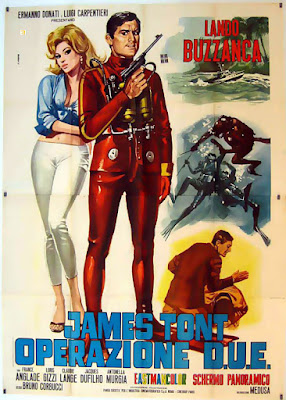
JAMES TONT: OPERATION UNO/ OPERATION DUE (1965/1966)


PHENOMENALITY: *marvelous*
MYTHICITY: *fair*
FRYEAN MYTHOS: *comedy*
CAMPBELLIAN FUNCTION: *sociological*


The many James Bond knockoffs often get deemed "cartoonish" even when they're not intended as comedies. However, I doubt if any of the knockoffs embrace the total craziness of animated cartoon shorts. 

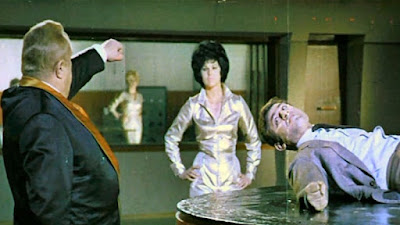
JAMES TONT OPERATION UNO (the hero's name references the Italian word for dumb, "tonto") starts off with the sort of sitcom absurdity seen in the GET SMART teleseries. After an early encounter with "Eric Goldsinger," the film's spoof of the Bond-villain Auric Goldfinger, Tont (Lando Buzzanca) chats up a pretty young thing and gets her to meet him in his hotel room. In contrast to the everlasting cool of the Connery Bond, Tont acts like a loon with his hunger to get laid. This makes it easy for the girl, who is one of Goldsinger's agents, to dope him and cover him in gold paint. The only thing that saves Tont is that the girl runs out of paint and doesn't manage to cover all of his pores.

So far, just like GET SMART. But a little later, as Tont pursues the villain in an effort to learn his plans for "Operation April Fool," Goldsinger (Loris Gizzi, a close physical match for Gert Frobe) traps the agent in a room with a ceiling designed to descend and crush him. Tont is saved by the intervention of a talking mouse who leads him to safety. When he expresses incredulity about this event to fellow agent Barbara (Evi Marandi), she explains that the mouse didn't really talk; she was just a ventriloquist-- as if that made the matter more logical.

Though UNO is certainly never subtle, it does manage to spoof a lot of the superspy-tropes at least as well as GET SMART. In the inevitable "briefing with the weapons maker" scene, the film's version of Bond's Q-- called "Z," of course-- happens to be a ramrod-stiff Prussian whose weapons-tests keep killing off his assistants. Tont fares better than the lab guys with some of the weapons he takes into the field, such as a car that drives underwater (with the goofy spy singing to the "fishies" as he goes along). But as soon as Tont returns to land, he's captured by a dozen or so bikini-banes with machine guns as well as by "Kayo," the film's version of Oddjob. 

Like most Bond-imitations, this one is slackly plotted, as Tont veers from one episodic peril to another (though the film does give us a comic version of GOLDFINGER's "no, Mister Bond, I expect you to die" scene). Director Bruno Corbucci and Giovanni Grimaldi (also the scripters) don't make Tont much of a fighter, even within a comedy context, but he does qualify as a combative figure thanks to his use of super-science weapons like a teargas gun and rockets that launch him into the sky. In fact, his aide Barbara outshines him in physical power, albeit once again in cartoony fashion. Not only does she knock out the powerful Kayo with a half dozen karate chops-- Kayo, who impassively endured a couple dozen blows from Tont earlier-- Barbara even gets a stalled plane to get moving by pushing it along the tarmac (with one hand, yet).

Operation April Fool proves to be a plot to destroy the United Nations with a vinyl record that emits deadly sonic waves. Tont performs his best feat here, flinging the record up so high that it blows up the helicopter in which Goldsinger is overseeing his operation. This too gets a cartoony cutaway, as Barbara pictures Tont in the costume of a discus-thrower. The movie ends with another appearance of the talking mouse.


The second and last Tont exploit was only available to me in the Italian language, even though many years ago I saw an English-language version entitled THE WACKY WORLD OF JAMES TONT. However, from what I call tell, the "anything can happen" aesthetic of the second entry, based on both THUNDERBALL and YOU ONLY LIVE TWICE, remains in force. Buzzanca returns as Tont, while Loris Gizzi, who was Goldsinger in the first film, essays the role of a villain who's compared to THUNDERBALL's Emilio Largo. None of the characters from the first film appear, and in place of the Prussian weapons-maker "Z," the bad guys have a scientist who's code-named "Y." Cartoony events include a man being flattened to a papery image of himself by a mechanical presser, two grown people being carried into the air by a small balloon, and Tont helping his new girlfriend escape her prison by gnawing through the metal bars with a pair of beaver-teeth inserted into his mouth.

I give both flicks a mythicity rating of "fair" because they do a decent job of taking the "straight" tropes of the original Fleming stories and playing them for lunacy.


Monday, December 20, 2021

GHOULIES IV (1994)


PHENOMENALITY: *marvelous*
MYTHICITY: *poor*
FRYEAN MYTHOS: *comedy*
CAMPBELLIAN FUNCTION: *metaphysical, psychological*


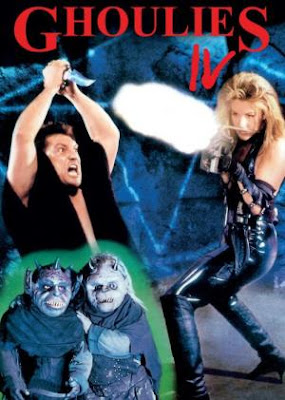
GHOULIES IV, the last in the series, remains in the same comedy-mythos as the third flick. Yet strangely, director Jim Wynorski and writer Mark Sevi mold the flick to resemble the first film in many respects, which as I said in my review had largely borrowed its plot from Lovecraft's THE CASE OF CHARLES DEXTER WARD. This partial fidelity may come from Sevi, who from the years 1992 to 1995 worked on SEVEN sequel-flicks in addition to this one.

I argued that the first GHOULIES emphasized the magician (Michael Des Barres) who summoned the titular demons as part of a plan to possess his grown son (Peter Liapis) for a power-enhancing ritual. The daddy-magician is never directly referenced, though a couple of archival shots of the Des Barres character are included, and the specific circumstances of the Liapis character, Jonathan Graves, are altered in many respects. Thus the guy who almost got possessed by the spirit of his dead father is now a guy who mucked around with occultism in earlier years, partly because both he and his then-girlfriend Alexandra (Stacie Randall) were both into it. But in a barely coherent backstory, somehow they unleash an evil version of Jonathan from the same other-dimension where the Ghoulies live. Alexandra likes Evil Jonathan better, has sex with the evil double, and then is sent to an asylum when she tries to kill Good Jonathan.

All this is revealed toward the end, as if Sevi didn't really want to bother with such details. When the film opens, Alexandra, dressed in sexy bondage-wear, has escaped the asylum and is seeking to make possible the rebirth of Evil Jonathan, who for some vague reason has taken the classical name "Faust." (A subliminal reference to "the Great Fausto" in GHOULIES II, maybe?) In order to revive Faust, Alexandra sacrifices a bunch of innocent victims, but she can only bring Faust into the human world with the help of an amulet, the Jewel of Knowledge. She tries to do so, and bungles the ritual, losing the amulet and also bringing two benign Ghoulies into her world. The two demons, this time played by little people actors, just want to go home, and they go looking for Jonathan for help.

Jonathan by this time has hung up his horned hat for a badge. He's also much more of a stud than the first version, for he's broken up with hot policewoman Kate (Barbara Alyn Woods), who is now his superior on the force, and he currently dates a hot prostitute. While investigating the recent deaths, he stumbles across Alexandra but doesn't immediately reveal that she's an asylum escapee. He and Kate argue about procedure while Jonathan investigates the murders on his own. Alexandra ambushes Jonathan with a mesmerized cop, and Jonathan reveals that he hasn't forgotten his occult past, since he shoots rays from his fingers and banishes the possessed cop to the otherworld.

There's a lot of aimless episodic stuff that happens before Jonathan somehow intuits that Alexandra, having recovered the amulet, is going back to her old asylum to perform a ritual for summoning Faust, Kate, still in love with Jonathan, follows. Jonathan and Kate dole out some good fisticuffs, but Alexandra still manages to allow Faust to possess Jonathan's body. Oh, and the Ghoulies putz around for a while before making a slight contribution to the happy ending. There's also a sequel hook at the very end, which happily did not lead to any more entries. 

The script is without doubt cheesy, but thanks to the pulchritude, the fight-scenes and a (very few) funny lines, it's more palatable cheese than GHOULIES III. My only other observation is that whereas Jonathan Graves got sidelined to the evil magician in the first movie, this time he's the main character, inconsistent as he is.