Showing posts with label enthralling hypnotism and illusionism (u). Show all posts

Saturday, November 29, 2025

THE HYPNOTIC EYE (1960)


PHENOMENALITY: *uncanny* 
MYTHICITY: *good*
FRYEAN MYTHOS: *drama*
CAMPBELLIAN FUNCTION: *psychological, sociological*

Someone said that artists are like sorcerers who can be bound by their own spells. Certainly this is true of those creators who become so enraptured by certain themes that they repeat them obsessively. That said, obviously there are also creators to whom spell-casting is just a job, and they use magic after the fashion of Mickey Mouse’s junior magician in FANTASIA. -- THE CURSE OF THE MUMMY'S TOMB review.

Look, I told you the history [laughs]-- I had an idea, a wacko idea about the line, then instead of making a film for 45 bucks with a line in a loop and a voiceover, we're into 365,000 bucks. It was cast badly, and it wasn't a very good movie by any stretch of the imagination [laughs]. I went on to do better things. This was an early, quick effort. I must tell you, I never took it very seriously, it was all just sort of a lark.-- ASTONISHING B-MONSTER interview with HYPNOTIC EYE screenwriter William Read Woodfield. 

It's easy for a critic to wax philosophical about the complexities of a famous filmmaker like, say, Alfred Hitchcock. Not only was Hitchcock embraced, due to his superb directorial skills, by major film-companies, he was one of those creators who came back to favorite themes over and over. Hitchcock gave interviews that repeatedly testified as to his personal erudition. Thus, if a critic noticed that a character in an original script written for AH was named "Justine," the critic might feel himself justified in asking Hitchcock if this was a calculated reference to the most famous literary character by that name, the one created by the Marquis De Sade.


I don't know how educated William Read Woodfield, the architect of THE HYPNOTIC EYE, was at the time he wrote the movie with his wife (who has no other writing-credits on IMDB). Woodfield was known principally as a Hollywood photographer, and IMDB only testifies to his having written two episodes of the TV show SEA HUNT before he wrote EYE. In the excerpt above, Woodfield claims to have gone on to "better things," by which he presumably meant high-prestige TV shows like COLUMBO and MISSION IMPOSSIBLE (and not so much for his scripts for TIME TUNNEL and LOST IN SPACE). 

I can't discount Woodfield making light of his work on EYE. At the same time, the Woodfield giving the interview is not necessarily identical with the Woodfield of 1960. Who can say that the writer didn't tap some deeper part of his consciousness back then, when he was desperate to be something better than a writer on SEA HUNT? He claims in the interview not to have been aware of William Castle's theatrical gimmicks, but any film boasting the fake come-on of a non-existent process called "Hypno-Magic" makes that claim pretty dubious. Similarly, was a guy trying to break into the world of low-budget horror-films, if only temporarily, necessarily ignorant of trends in the genre? The late 1950s are marked by an escalation of the violence in horror movies, and EYE certainly fits that trend as well.          


Further, one need not assume that 1960 Woodfield followed the same critic-approved creative process as Alfred Hitchcock. Woodfield may have testified to his own process as being loosely associative in nature, through the barely necessary EYE character Philip Hecht, a police psychologist of some sort. We first meet Hecht showing off the way his mind works by tossing darts at a bunch of newspaper clippings on the wall, constructing a "sentence" out of his having hit, in succession, Sigmund Freud, a Valentine's Day card, and the derriere of Jayne Mansfield. That sort of process resembles the way Woodfield talks about putting EYE together out of his fascination with stage hypnosis acts.

But EYE isn't really all about sex, as per Freud's own obsessions; it's first and foremost about violence. Like this famous scene:


Within the film's first ten minutes, we see this scene and learn from dimwit cop Dave Kennedy (Joe Patridge) that the girl who sets her own hair on fire is just one of many curious self-mutilations that have been taking place in recent times. Possibly they've all occurred on Dave's beat, since he's been assigned to divine what seems to be a serial-assailant mystery with no assailant evident. Yet Dave, though he seems too dumb to know how to spell "psychology," finds his way to the mystery's solution by random association, for he tells Hecht that he and his girlfriend Marcia (Marcia Henderson) plan to take in a new hypnotist act that night. 


 The film-viewer will solve the mystery long before Dave does, once said viewer sees the Great Desmond (Jacques Bergerac) working his magic on stage. Oddly, we first see Desmond tormenting four seated men with illusions of being extremely hot or cold, etc. But once he calls three pretty young women up on the stage for a routine, the viewer easily deduces the hypnotist's complicity in the unsolved acts of violence.


 To be sure, there's the strong suggestion that the women in the audience are very anxious to have the charming Desmond exert his power over them. Marcia almost volunteers to be one of the hypnotist's subjects, but her friend Dodie takes Marcia's place as Sacrificial Lamb. Later, Dodie is the next self-mutilation victim. Does Dave start to suspect Desmond then? No, but Marcia does, and then she puts herself in harm's way, dating Desmond in order to learn his secret.


But Woodfield has a twist on the usual formula of the sexually-repressed male serial killer-- one of whom. Norman Bates, would make his cinematic debut that same year. Desmond's stage assistant Justine (Allison Hayes) might wear the costume of The Pretty Girl who's supposed to distract audiences from an illusionist's tricks, but she's the one in control of everything Desmond does. She's also evidently his superior in hypnotism, in that she personally commands Marcia to enter a scalding shower and almost succeeds in another mutilation except for Dave's timely arrival on the scene.    

The unexpected appearance of Justine somehow triggers Dave into doing actual police work, like interviewing all the mutilation victims (which one would have thought he'd have already done). Admittedly, this time he's seeking to learn if any of them encountered Desmond before. Hecht helps Dave figure out that all of the victims, including Dodie, have been hypnotically commanded to forget their encounters with Desmond. To be sure, none of this detective-work proves relevant. A post-hypnotic command forces Marcia to return to the theater, where Desmond is using his powers (enhanced by a mechanical strobe-light eye held in one hand) to enthrall his entire audience. Dave and Hecht arrive on the scene, Marcia is saved, and the two evil hypnotists die.

I don't know if Woodfield ever read anything about Sigmund Freud outside of some Sunday-supplement article, and I don't know if he was aware that the name Justine is attached to a character created by Sade-- though in fairness, that character was a victim of sadism, not a perpetrator. Woodfield may not have thought that much about his twist on the male-predator trope. He may have been thinking of famous folk tales about feminine jealousy like SNOW WHITE. Another model that comes even closer to EYE's plot is one version of the Medusa story. In this iteration, Medusa starts out as a gorgeous mortal woman. She's pursued by the god Poseidon, and despite her taking shelter in the temple of Athena, he rapes her there. Then, to add injury to injury, Athena (who apparently has no power to curse Poseidon) avenges the pollution to her honor by cursing the mortal woman to become the grotesque Gorgon with the petrifying visage.

There's no way to know precisely what 1960 William Woodfield had on his mind when he (and maybe his wife with him) wrote EYE. But even if he later thought of the movie as junk, he didn't write it as indifferently as most junk of the time was written. The movie is lurid, but it's preoccupied not with a male predator killing women as a sex-substitute (paging Norman again), but with a ruthless queen determined to make sure no mortal woman could outshine her without suffering for it. Even a last-minute "motivation" for Justine's actions-- she whips off a facemask to reveal that she too is scarred like her later victims-- bears some resemblance to the way the Greek goddess Athena carried around the image of a Gorgon's head, either on her shield or her clothing, with which to terrify her enemies. I think it's eminently possible that Woodfield, thinking more in terms of free association than in terms of studied metaphors, formulated a story in which women lose their beauty due to feminine jealousy-- and at the risk of sounding misogynist, that just might be a theme to which female horror-fans might warm more than would males of that species.                             

Saturday, October 5, 2024

DELINQUENT SCHOOLGIRLS (1975)


PHENOMENALITY: *uncanny*
MYTHICITY: *fair*
FRYEAN MYTHOS: *comedy*
CAMPBELLIAN FUNCTION: *psychological, sociological*

One online review of this 1975 sleaze-fest was that it offered viewers a sampling of different erotic fantasies. But as it happens, writer-director Greg Corarito made one male fantasy constant to almost all of those presented here: the fantasy of hot women being not just as horny as men, but just as indiscriminate.

I haven't seen three of the five films Corarito directed in his short career, but SCHOOLGIRLS seems to recycle, and expand upon, an incident in 1969's WANDA THE SADISTIC HYPNOTIST. That psuedo-arty grindhouse item concerned two rich lesbians who had the habit of capturing wayward men and using hypnotism to subject them to various indignities. As I noted in my review, there's a very brief "male revolt" in that an escapee from an asylum invades the lesbians' mansion and gets the upper hand-- although the revolt is short-lived and the film ends with the women back in control of their project.

SCHOOLGIRLS centers upon three "psychotics" who escape from a madhouse, which is where the film gets its alternate title of CARNAL MADNESS. However, since the film's theme concerns the aforementioned fantasy of female concupiscence, SCHOOLGIRLS remains the better title. A lot of films depict helpless women being held captive by marauding males, but these schoolgirls are in their way just as dangerous as the mesmerizing lesbians of WANDA.

The school in question is a correctional institution for wayward young women, where the majority of enrollees are about to leave the campus for an unspecified holiday. But about fifteen or so hot young women are not allowed to leave due to "delinquent" behavior, and those fifteen-- though only about six have speaking roles-- continue to have classes with a skeleton crew of instructors. Not all of the young ladies are horny, though the least lust-filled, Greta the Ardent Feminist (XXX actress Sharon Kelly), ends up serving the male audience by persuading other females not to wear their bras. Penny is the most man-hungry, while naive young Betsy forms a curious attachment to her fifty-something sex-ed teacher Mister Miller, because she says he reminds her of her uncle. (Insert "bad uncle joke" here.) Though the institution seems to be secular, often the girls are seen in approximations of Catholic schoolgirl outfits.

Into this largely feminine domain, where only two male professionals are in attendance, barge the three wild and crazy guys. The de facto leader is Carl (Michael Pataki), who does celebrity impressions at the drop of a hat. The second fellow is Bruce (Steven Stucker), a swishy homosexual. The third is Dick (Bob Minor), a randy guy who ends up pulling the other two into his desires for satisfaction. That satisfaction could potentially allow for rape, though the three malcontents are such goofs that it's impossible to take them seriously.

After escaping the nuthouse, the dumbbells stumble across a farmhouse, occupied by a grizzled farmer and his frustrated young wife. The trio pick up a couple of weapons here, while Dick gets to vent his passion on a woman who only pretends "maidenly resistance."

Then the threesome stop at the school, raiding the kitchen for food. Two busty female cooks catch them, but do the two young women run to get the authorities? No, they attack the three guys with such weapons as rolls of salami, so of course the ladies get overwhelmed pretty quickly. But probably they don't suffer anything more than a little groping, since they're later seen playing cards with the goofs. (Aren't the guys supposed to be trying to escape the law as expeditiously as possible?)

Slightly before the advent of the nutsies, Betsy visited her secret crush Mister Miller. It turned out that he's got a thing for her too, but he has a weird way of showing it, that of putting her under full hypnosis (more on this later). During Betsy's second visit to Miller, all unaware of what he does with her, the three bozos witness Miller's peccadillo. They break in, perhaps hoping to get in on Miller's action. However, in his capacity as a biology teacher Miller has a tankful of (non-poisonous) snakes to hand, and he drives the psychos away with his serpents, just before Miller himself suffers a heart attack. 

The two non-gay bozos chat up a couple of girls smoking MJ, and both ladies seem amenable to some fun with complete strangers, until Carl and Dick honk them off. The females try to run, but Bruce cows them with his rifle-- and presumably they get tied up and left somewhere, because they aren't seen again. While Carl and Bruce try to find transportation, Dick comes across another two busty beauties playing polo-- at night, no less-- and tries to get grabby. The girls beat him with their mallets but get caught by Carl and Bruce, and Carl threatens the two women into fighting one another. (Just to keep things comic, he admits to Dick that he had no intention of killing either of them.)

Then there's the big finisher, when the psychos barge in on a karate class, where a male karate instructor is teaching about 12 girls. Penny is there and seems more than willing to be abducted and ravished by Big Dick. Carl, though, has an itch to play director, and he wants all the girls to perform a chorus line, but without a certain item of feminine protection. This sparks a fight between Dick and Feminist Greta (and Sharon Kelly seems to have done a fair amount of training to perform things like a stomach-throw). In no time, all the girls and the one male teacher swarm the goofballs and beat them down, sending them back to the bughouse-- though a coda claims that they escaped again.

None of the alleged madmen shows any real madness; they just seem like big, stupid teenagers out for sex wherever they can find it-- so none of them are "perilous psychos" in more than a naturalistic sense. Only Mister Miller's little hypnosis experiment elevates the movie into the uncanny domain, and then only because his experiment with Betsy involves using one of his non-poisonous snakes to go (one assumes) where he can't go anymore. Corarito passes over this fetishistic experiment very quickly, but both the experiment itself and the hypnosis used to achieve it constitute a bizarre crime of the uncanny kind.

Saturday, June 1, 2024

WANDA THE SADISTIC HYPNOTIST (1969)


PHENOMENALITY: *uncanny*
MYTHICITY: *fair*
FRYEAN MYTHOS: *irony*
CAMPBELLIAN FUNCTION: *psychological*


Even by the late 1960s, apparently the grindhouse audience was still so starved for female nudity that the patrons would sit through any kind of pseudo-artsy stuff as long as it had T&A. Writer-director Gregory Corarito, though he only worked on four feature films in his career, certainly didn't render anything resembling genuine art. But WANDA THE SADISTIC HYPNOTIST is a engaging, albeit simultaneously confusing, sex romp that merges T&A with S&M.

A guy wearing sunglasses (whom I'll call Sunglasses) takes some dope and then wanders down a city-street, glancing at mannequins in a store window and imagining that they're live nude girls. Sunglasses-- according to one review, played by the director-- then stops in a grindhouse to see a movie. The movie he watches-- whose title claims that it stars a "Miss Dikey Diketon"-- ends up providing most of WANDA's narrative, though occasionally the focus shifts back to the grindhouse theater, just to remind the viewer that Sunglasses is still there, watching, just like one of the intended filmgoers.

In the film proper, an ordinary fellow, Sylvester, is driving down a country road in his car, when he blows a tire and crashes. As if anticipating his advent, two hot women appear and transport Sylvester to their mansion. Once the injured man awakens, they introduce themselves as Wanda and Greta (Katharine Shubeck, Janine Sweet). At least one of those names seems to be an in-joke, for in VENUS IN FURS, Sacher-Masoch's best known celebration of the paraphilia named after him, the woman who torments the pain-loving POV character is named-- Wanda. I'm not sure the name "Greta" has similar significance. However, Corarito uses the name again in his 1975 DELINQUENT SCHOOLGIRLS, but for a much nastier female.

Of the two probably lesbian ladies, Greta's the nice one, showing some degree of concern for Sylvester's condition. Wanda, however, clearly nurtures some grudge against the male of the species. Not only does she maintain the mansion, where Sylvester's the only male amid numerous often-nude females, she's apparently learned hypnosis, in that she can mesmerize her male captive into doing anything she desires. She establishes Sylvester's lowly status by whipping him with a riding-crop, and then forces him to wander about the estate while the women mock him. Not that Wanda's entirely averse to messing with her acolytes. She hypnotizes one Zelda, explicitly said to be lesbian, and tells her that she's a nympho, which leads to Zelda raping the bound Sylvester.

So far, WANDA sounds like it's made for viewers who were not content with simple ogling and who were into at least light sadomasochism. However, there's a small "revolt of the male" when a "funeee farm" escapee shows up at the mansion and intimidates the women with displays of masculine temper. He releases Sylvester, but the two men don't really take any major revenge, even for a softcore film, except that the guys force the women to raid Wanda's supply of LSD. After some very boring psychedelic visuals, mostly just repeating scenes already shown, Wanda manages to place both men under her hypnotic sway. The girls then send the maniac back to the asylum and cause Sylvester to forget everything that happened. He gets in his presumably repaired car and drives away.

Then, just to show that Corarito didn't forget his self-insert back in the grindhouse, Sunglasses leaves the theater, gets in a car, and drives down a country road. His tires hit a nail-trap, his car crashes, and up pop Wanda and Greta, ready for more fun.

It's because of this "film turns into reality" schtick that I label WANDA an "irony," since this term best describes stories in which all logic and morality has vanished from the world. Of Corarito's other three films, I have seen his 1970s T&A-fest, DELINQUENT SCHOOL GIRLS. This is more of a straight comedy with similar elements, wherein three fugitives from a nuthouse take over a girls' school. These demented fellows terrorize the ladies in a very comical manner, until the ending. Then there's a "revolt of the female," in which a class of judo-girls rebels and kicks all the guys' asses. Say what you like about this writer-director, at least he was consistent.


Friday, December 22, 2023

A SNOW WHITE CHRISTMAS (2018)


PHENOMENALITY: *uncanny*
MYTHICITY: *fair*
FRYEAN MYTHOS: *comedy*
CAMPBELLIAN FUNCTION: *psychological*


While this 2018 DTV flick is no match for the classic rom-coms of the 1990s, at least the script rings in enough changes on the classic "Snow White" template that it doesn't seem as pedestrian and predictable as most current romance movies.

This SNOW still includes an innocent young woman and her evil stepmother, but this time their conflict is over money, not their respective physical charms. Blanca Snow (Michelle Randolph) is a good-hearted woman with a strong jones for all things Christmassy. Her father died a year ago, but his will is supposed to come into effect on December 25. On that date, the father's estate will be divided equally between Blanca and her stepmother Victoria (Carolyn Hennesey). Scheming Victoria wants the whole estate, and though she's not a queen, she's encouraged by her fellow conspirator Zane (Rich Barnes), her "magic mirror" adviser, who's so obviously swishy that he could be labeled another kind of "queen."

Somehow the conspirators find a criminal hypnotist and get her to erase Blanca's memory, so that she'll just take up residence elsewhere. If Blanca is absent for the critical reading of the will, the whole estate goes to Victoria. This is clearly a deflection from the stock idea of killing one inheritor so that another one will get the bounty. Yet in the real world it's doubtful that a will would specify that an heir, especially the daughter of the decedent, would get eliminated just because she's not physically present on a certain date. Such a stipulation is even more arbitrary than many of those in archaic folktales. Nevertheless, the hypnosis scene is amusing because Zane's loose talk accidentally qualifies the hypnotic spell, with the result that now Blanca's memory erasure will only persist until she falls in true love.

And here we have the other fairly clever aspect of SNOW, because during Snow's amnesiac exile she encounters two studs she met in her old life, one whose last name is Prince while the other's first name is Hunter. Given some of the bad rap that heroic princes get these days, nearly no one will be surprised at which hunk gets to make Blanca's heart go pit-a-pat so that she regains her true self and foils the plans of the evil queen-- oh, and his mistress too.

Randolph plays the good-as-gold Blanca straight, which means that she's not particularly compelling. Hennesey and Barnes get all the funny lines, as well as receiving a modestly amusing comeuppance. Oh, and as icing on the cake, during her exile Blanca gets some moral support from a Christmas band-- whose players number seven.


Sunday, October 8, 2023

SHEENA, QUEEN OF THE JUNGLE (1956=57)


PHENOMENALITY: *uncanny*
MYTHICITY: *poor*
FRYEAN MYTHOS: *adventure*
CAMPBELLIAN FUNCTION: *sociological*


TUBI is now showing sixteen of the original run of 26 TV episodes, shot cheaply in Mexico and featuring the statuesque Irish McCalla in the role of Sheena, Queen of the Jungle. For all that I know, these episodes may be the only ones extant, given that the series was never circulated in many markets, so I may as well review what survives. It's not very likely any of the unavailable episodes deviate from the basic mediocrity of the available ones.

Nevertheless, SHEENA isn't without some significance. By 1956 Hollywood was no longer making either adaptations of comic-book heroes or B-films with continuing characters, except for some of the Tarzan movies. Television had caused those markets to dry up, but the small screen did release a handful of low-budget series that functioned as had the old B-films, only with a much shorter run-time. And a tiny number of these were based in properties from comic books or strips. Superman is the only such series that's well remembered today, but there were also adaptations of Dick Tracy, Jungle Jim, and Sheena. 

Sheena is the first major female continuing character in comic books, getting published for nearly twenty years before her company closed its doors. Both jungle men and jungle girls in comic books at best offered only junky pulp thrills. SHEENA the comic was also junk, but I've found a little more creativity in at least some of the stories, which is more than I can say of most other jungle-serials. And Sheena the heroine is one of the first tough heroines of the medium, knifing crocodiles and outwrestling grown men with the best of the jungle boys.

I can't claim that any of the sixteen episodes are anything but extremely simple adventure-fare, and they don't even offer many fight-thrills. Once in a while, Sheena swings from a tree and kicks some malefactor, and in one episode she knife-kills a croc, possibly her only defeat of a jungle-beast. (Most of them appear in the show courtesy of stock footage.) Even her male confidante, jungle guide Bob Rayburn (Christian Drake) barely does anything more than pot-shot the occasional wild beast. Apparently the budget was too limited to even make possible the limited fight-scenes of TV westerns like LONE RANGER and CISCO KID. The only time any of Sheena's enemies provide a halfway interesting threat is in "The Rival Queen," in which a hypnotist mind-controls a white woman into stirring up trouble with the natives.

In the comics, Sheena has little interest in the world outside the jungle, but she speaks full sentences and is often good at planning strategy against evildoers. In contrast, the show's producers chose to have her talk baby-talk as in the early Tarzan films. She doesn't really command any animals, but in place of a Tarzan-yell, she would occasionally blow a horn at the opening of each episode, as if to announce her sovereignty over all she surveys.

Irish McCalla, while no great actress, gives her limited lines a fit level of brio, and at least she's always treated as a formidable presence, The Black African tribes aren't given any deeper characterization than anyone else, but I didn't think they were overly offensive either. They're certainly not shown as being over-awed by Sheena's Miss Clairol blonde locks, and in general she and Bob always argue for tolerance of tribal customs. All that said, the show's main significance lies in being the first adaptation of a prominent female comics-hero, which is more than other ephemera of the period can claim. Also, it's the only way anyone can ever see a live-action Sheena in her classic leopard-skin attire, since that outfit has been effectively banned in later adaptations, probably to keep from triggering animal rights activists.


Sunday, September 17, 2023

HORRORS OF THE BLACK MUSEUM (1959)


PHENOMENALITY: *uncanny*
MYTHICITY: *fair*
FRYEAN MYTHOS: *drama*
CAMPBELLIAN FUNCTION: *psychological*


*SPOILERS SPOILERS SPOILERS*

I include spoilers to give the movie its due: not having seen it in thirty or more years, I didn't twig to the Big Reveal at the end. I don't really think the deduction is all that hard to work out, though, 

The movie opens with its most famous bizarre crime: a young woman receives gimmicked binoculars in the mail, and when she first uses them, they kill her. This is one of several strange murders that have plagued London for weeks, though we never hear about the earlier ones. Scotland Yard detective Graham (Geoffrey Keen) finds himself under attack by journalists, particularly Edmond Bancroft (Michael Gough), a crime writer with a penchant for writing about weird murders. In fact, he scorns the real-life "Black Museum" of Scotland Yard, having built his own private museum of crime-curiosities (including, oddly enough, a 1950s idea of a mainframe computer). He explains his penchant to his work-assistant Rick, a young man with a girlfriend, Angela, who's perhaps a little too nosy about Bancroft's activities.

Bancroft's weird habits make it pretty evident that he's involved in the crimes somehow, and for a time, despite his age, it seems possible that he's committing the murders while wearing a fright-mask, But no, it turns out that he's placed Rick under hypnotic control and is using him as a catspaw. Both "monsters" die when Rick leaps from a great height and lands on Bancroft, which image probably reinforces the opinions of those who read the older man/younger man dynamic as homosexual.

Though producer Herman Cohen claimed he got the idea for the film by reading about the real Black Museum, I think he was probably more inspired by the success of the 1953 horror-film HOUSE OF WAX. But Cohen, co-writer Aben Kandel and director Arthur Crabtree do a mediocre job with these slightly sleazy horrors. One character talks about "the poetry of murder" in a light-hearted manner, but poetry was entirely absent from the docents of this particular museum.

Friday, April 21, 2023

MOTHER GOOSE A GO GO (1966)


PHENOMENALITY: *uncanny*
MYTHICITY: *good*
FRYEAN MYTHOS: *comedy*
CAMPBELLIAN FUNCTIONS: *psychological*


"This calls for a drastic step, above and beyond the call of Sigmund Freud."-- sexy psychiatrist Marilyn Richards

MOTHER GOOSE A GO GO, the only writer-director effort by Jack H. (THE BLOB) Harris, is simultaneously one of the worst film-farces ever made, and one of the best translations of Freudian theory into the formulas of farce.  

It's impossible to know why Harris-- most often known as a producer rather than as either writer or director-- would have decided to make this movie. Following the strong box-office of THE BLOB, his next two SF-movies, 4D MAN and DINOSAURUS, were not nearly as popular. But by 1966 a lot of older filmmakers-- Harris was nearing fifty that year-- responded to the "sexual revolution" by trying their hand at sex-comedies. Harris had never written a comedy-film before, and not only is the tone of MOTHER afflicted with a dimbulb, sniggering sensibility, everything looks like a squeaky-clean Disney comedy of the period. He manages to make utterly aseptic an opening scene with newlyweds Ted Hastings (Tommy Kirk) and his wife Margie (Anne Helm) preparing for their first night together.

But as in so many farces of the period, the possibility of sex, even consecrated by marriage, is a tease, for Ted has a little problem that causes him to freeze up and faint dead away, leaving Margie intensely frustrated. Yet the proximate cause of Ted's infirmity is brought about by a character the audience hasn't yet encountered. Before Ted makes his move, Margie can't resist showing her husband a gift from her uncle Jacques (Jacques Bergerac). We will later learn that the very hotel where Ted and Margie plan to have sex is owned by Uncle Jacques, so that what they're doing is symbolically under his aegis. And for some unexplained reason, Jacques chose to send his niece a very weird wedding-gift: a children's book of fairy tales. Since we also later learn that Jacques has always been like a "mother hen" to Margie, the logical conclusion is that he wants to keep her an "unkissed bride." And Margie subconsciously conspires to go along with her uncle's wishes, for she starts reading from the story of Little Red Riding Hood-- and that's what causes Ted to "go stiff," but in a bad way.

Ted dashes over to the office of psychiatrist Marilyn Richards (the sexy Danica D'Hondt). She will be the face of Female Authority as Uncle Jacques is the face of Male Authority, though to be sure, D'Hondt, Kirk, and Helm are all about the same age (late-twenties) while Bergerac alone was over ten years older than any of them. Though Marilyn is planning a vacation, she puts it off to help a patient who rudely barges into her office, possibly because the case of a man rendered impotent by a fairy tale intrigues her. Without doing any medical checks on her new patient, she spritzes him with a "psychedelic drug" from an atomizer. Ted then relates a fantasia in which Red Riding Hood (Helm) is menaced by a Wolf dressed up like her Granny. The Woodsman (Kirk) tries to save the imperiled lass, but he fails (more impotence), so Red has to save herself by bonking the Wolf with the axe (virility transfer?)


Ted suggests that Marilyn take her vacation at the same hotel where he and Margie are staying, so she does. Nosy private detective Sinclair-- a smarmy extension of Uncle Jacques, himself a major player with younger women-- begins watching both Ted and Marilyn as potential offenders against public morality. Margie knows nothing about Marilyn's surveillance, because Ted doesn't want Margie or Jacques knowing all his psychological details. The two young marrieds kiss near the hotel swimming pool, and Marilyn is sun-bathing nearby. But Marilyn's reading a magazine with an advertisement based on "Snow White," and when Ted sees the ad, he goes stiff and almost drowns in the pool. Marilyn, pretending to be nothing more than a professional nurse, helps Margie take Ted to a room, and then banishes Margie ("I'll take care of your husband"). Marilyn immediately spritzes Ted again. This time it's a fantasy about the conclusion of "Snow White," wherein the Queen (D'Hondt) has just tried to kill Snow (Helm), only to learn that a prince (Kirk) has rescued her. After the Queen dies from eating her own apple-- the consequence of her sexual competition with the young woman-- the two young people look into her magic mirror. When Ted comes to, he claims he saw himself as a furry monster-- which, believe it or not, does have a payoff down the line.

Ted and Margie take in a drive-in movie, but sad to say, there's a Three Little Pigs cartoon, so it's lights out for Ted again. Back at the hotel, Margie rather inappropriately asks her uncle if he's ever had similar performance problems. He then shows his first sign of licentious feelings toward his niece with the old "If you were just older, or I was just younger" line. Margie exiles Ted from their room, but both Marilyn and Jacques counsel the confused man to climb the trellis to Margie's room. But a neighbor sees Ted and asks him if he thinks he's Jack climbing the beanstalk. It's "frigid city" again, and down goes Ted, who luckily lands in some bushes.

Apparently Marilyn doesn't think there's need for a Jack-and-the-Beanstalk sex-fantasy. Yet Marilyn and Margie separately get the idea that maybe Ted could perform better if he just gets liquored up and lets his "beast" out. Ted and Margie then waste several minutes at both a club and a bar. Again Margie shows ambivalence toward what is supposedly her anti-virginity mission. She keeps Ted from seeing the name "Goldilocks" on some appliance-- yet when they're back in their room, and Ted's ready to go, she herself speaks the name "Goldilocks," and that's it for Ted. Just to waste more time, Sinclair keeps spying on the couple even though they're legally married, Jacques chats up Marilyn, and celebrity radio spokesman Joe Pyne periodically interrupts the story to get on phones and argue with his listeners.

Oddly, after  this third failure Ted has a breakthrough. There's no telling why Marilyn left her drug-filled atomizer in the married couple's room, but while talking to Marilyn on the phone, Ted accidentally doses himself, and Marilyn talks him through a very short Goldilocks fantasy, consisting of a sexy Goldilocks trying out various mattresses. In the midst of this new fantasy, an old memory pops up-- and you know it's old, because it's black-and-white while the rest of the film is in color.

This provides Marilyn with a clue, so she invites Ted to her room and puts him under hypnosis. The big reveal? When Ted was six, his mother caught him looking at an adult sex-magazine. Harris doesn't say that Young Ted was beating off to a picture of a hot girl, but the unseen mother's dialogue implies it. She tells Young Ted that such things can make little boys turn into "monsters with fangs and fur and a long ugly tail," which to my mind is just one step beyond "it'll grow hair on your palms." To keep the kid away from impure thoughts, she gives Young Ted a Mother Goose book. So "Mother Goose" is actually the same as "Mother Forbidding Sex."

So Marilyn liberates Ted from his complex by revealing its genesis, but as the new mother-imago in his life, she decides to go "above the call of Sigmund Freud" by testing his ability to make love after she says a fairy-tale key-word. ("Think of me as Margie," Marilyn advises.)

Meanwhile, Sinclair has been monitoring the illicit association of Ted and Marilyn, and he tattle-tales to Jacques and Margie. They invade Marilyn's room just as an overstimulated Ted is unleashing his "beast" on the psychiatrist, who didn't anticipate going quite that far. There's a brief exchange of blows between Margie's husband and her father-substitute, but even though Ted loses the fight, he wins Margie afterward. Jacques and Marilyn, the "father" and "mother," are implicitly united, while an end-sequence shows Ted and Margie in bed together years later, a small brood of kids watching their parents make out. I guess after their experience, Ted and Margie decided to be more "liberal" with their offspring than Ted's unseen mother was.

I don't imagine Harris knew that much about Freud's work, but the layered nature of the sex-fantasies here suggests more than a quick read in a Sunday supplement. While Freud argued that children formed Oedipal fixations upon the parent of the opposing sex, the world of Harris's MOTHER actually focuses more on older adults imposing their sexual fantasies on the younger adults who are their symbolic "children." So this is one of those cases where a creative person had a basic idea with some strong symbolic richness, but lacked any other skills to make the idea into an entertaining story. Further, the actors in GOOSE are not much better than Harris. Kirk plays his part as he were trying to ape Jerry Lewis, Helm is dull and has no chemistry with Kirk, and Bergerac is a one-dimensional "sexy French guy." D'Hondt is the only performer who shows a little restraint as the patrician but somewhat horny psychiatrist, and MOTHER was her next to last acting credit before she began pursuing alternative career-paths to Hollywood acting. Her list of movie/TV credits is not long, but it does include one other item I reviewed here favorably: the MAN FROM UNCLE episode "The Girls of Nazarone Affair," which concerns itself with a different sort of "feminine authority."

NOTE: This post on RIP JAGGER'S DOJO indicates that Harris kept a foot both in the mainstream and grindhouse worlds for a longer period that I'd thought.

Thursday, April 13, 2023

THE TERROR OF DOCTOR MABUSE (1962)


PHENOMENALITY: *uncanny*
MYTHICITY: *fair*
FRYEAN MYTHOS: *adventure*
CAMPBELLIAN FUNCTION: *sociological*


The fourth in the series of 1960s "Doctor Mabuse" films is a partial remake of Lang's 1933 TESTAMENT OF DOCTOR MABUSE, which itself was a sequel to the well lauded silent films that introduced the character.

I confess that I never saw the 1933 film more than once, and that even the review I did in 2014 was written sometime after the first viewing, mostly from memory. But I stand by my position that TESTAMENT was "a rather crabbed, one-note affair." Lang's scenario was that after Mabuse's defeat in the 1920s, he spent the next eleven years in a mental sanitarium. However, police officers become aware of a series of crimes so well planned that they recall the genius of Mabuse. The big reveal is that although Mabuse has not been able to escape his confinement, he has used his great hypnotic powers to dominate head doctor Baum. Mabuse then uses Baum as a pawn to direct his crooks to execute his crimes. While the basic idea was intriguing, and may have been a shot at the Nazi hierarchy Lang fled shortly afterward. I felt the director was a little too impressed with his own conceit and didn't develop the concept properly, to say nothing of the fact that it was a rather dull sequel.

TERROR was the only Mabuse film directed by Werner Klinger, but producer Artur Brauner probably made certain to keep this installment's level of combative action much higher than the 1933 original. TERROR does start with Mabuse (Wolfgang Preiss again) imprisoned in a sanitarium, but he's only been there a few years since his incarceration at the end of INVISIBLE DOCTOR MABUSE. It's no big disclosure to state that once again the head of the sanitarium, Professor Pohland (Walter Rilla), believes that he's in control of the situation, when in fact he's become the pawn through which Mabuse engineers his criminal schemes. The organization this time is a ruthless one, and uses more uncanny gadgets to punish rebels. A member who seeks to turn informer (played by Leon Askin of "Hogan's Heroes" fame) is killed by a backward-firing pistol, and a crook who defies Pohland/Mabuse is electrocuted. (The English dub claims that the mastermind uses an "electric ray," but there's no clear depiction of such a device on screen.) 

In contrast to INVISIBLE, this entry is much improved by the return of Gert Frobe as Mabuse's determined opponent Inspector Lohmann. A touch of humor is also provided by Lohmann's young assistant, who insists of plaguing the inspector with deductions he makes based on whatever detective stories he's read. A palatable subplot, not present in the 1933 film, involves a cash-strapped young boxer who's lured into the Mabuse gang. The boxer's wife is played by a young Senta Berger, a few years before she became a familiar face in such American productions as the 1967 AMBUSHERS

Thursday, December 15, 2022

NIGHTMARES COME AT NIGHT (1970)


PHENOMENALITY: *uncanny*
MYTHICITY: *poor*
FRYEAN MYTHOS: *drama*
CAMPBELLIAN FUNCTION: *psychological*


Given that Jess Franco usually turned out crap when he was putting out just one movie at a time, it's surprising that NIGHTMARES COME AT NIGHT isn't worse, given that it's an amalgam of two separate projects. To be sure, the footage with Franco-favorite Soledad Miranda takes up very little screen time, with the majority devoted to the conflict between two young women, Anna (Diana Lorys) and Cynthia (Colette Jack). Early in the film Cynthia sees Anna perform exotic dancing at a strip club and invites the dancer to her ritzy home, where they have lesbian encounters. However, Anna begins having terrible nightmares in which she envisions herself killing a man. Cynthia brings in a psychiatrist, Doctor Lucas (Paul Muller), but he can't decide if Anna needs institutional treatment or if she just suffers from having watched SUCCUBUS once too often.

As in SUCCUBUS, the viewpoint protagonist is being manipulated by outside forces, and so it's no surprise when we learn that sinister Cynthia is doping Anna with hallucinogens, with the help of the bad doctor. I never understood what the two hoped to gain from this mental assault, and I don't think Franco really cared. He just wanted an excuse to have two beautiful women lounge around in their underwear and have soft-core sex. In contrast to SUCCUBUS, NIGHTMARES does not quote Sade, but Cynthia uses Sadean tortures to break down Anna's will, sometimes roughing Anna up, and once sleeping with a man (Jack Taylor) in front of her lesbian lover's eyes. Thus Cynthia is essentially the main character here, and Colette Jack's Sadean quality is so strong-- as against the forgettable Anna-- that it's a shame that Jack's short career did not place her as the star in a good Sade-film, though her last part was a support-role in a thriller with sadomasochistic overtones, WHAT THE PEEPER SAW.

Since NIGHTMARES is overt about its softcore aims and shows no special pretensions, it provides a relatively painless experience as long as one keeps expectations low-- as anyone acquainted with the cinema of Jess Franco ought to do automatically.

Monday, May 2, 2022

FEAR IN THE NIGHT (1947)


PHENOMENALITY: *uncanny*
MYTHICITY: *fair*
FRYEAN MYTHOS: *drama*
CAMPBELLIAN FUNCTIONS: *psychological*


SPOILERS SPOILERS SPOILERS

I have not read the original Cornell Woolrich short story on which FEAR was based, which proved durable enough not only for an official remake but also for numerous TV swipes. Thus I don't know if, in the original story, the mystery's solution involves the main element that makes the film metaphenomenal: a hypnotist who essentially stage-manages the protagonist's involvement in crime. (I did say SPOILERS!)

I've noted in other reviews, like this one, that hypnotism can be used either naturalistically or with an uncanny vibe, and the use in FEAR strikes me as the latter. The weird dream that the confused Vince Grayson (DeForrest Kelley) experiences, though, could have gone either way, since the movie's basic setup is that Grayson really experienced his fight with and murder of a stranger in a mirrored room.

Nevertheless, that opening murder-dream is easily the film's most riveting moment. Afterward, though, FEAR settles down into a series of pokey talking-head scenes, mostly with Grayson trying to get to the bottom of things with the reluctant help of his cop brother-in-law (Paul Kelly, who had earlier played the Black Commando in 1942's THE SECRET CODE). Though this was De Forrest Kelley's cinematic debut, he doesn't have much to do but bumble around looking confused, a hapless cog in someone else's machinations. Other films noirs used such characters to plumb the depths of psychological insecurity, but Grayson is something of a blank slate, so Kelley can't do much with him.

The future "Doctor McCoy" was something of "the baby" on this shoot, since Paul Kelly, villain Robert Emmett Keane, and writer-director Maxwell Shane all had credits going back to silent days. Shane was much better known for writing than for his relatively brief directing career, and his only interesting metaphenomenal credit was Bela Lugosi's ONE BODY TOO MANY.


Monday, February 28, 2022

HOLLYWOOD CHAINSAW HOOKERS (1988)


PHENOMENALITY: *uncanny*
MYTHICITY: *fair*
FRYEAN MYTHOS: *comedy*
CAMPBELLIAN FUNCTION: *metaphysical*


Nine times out of ten, any time a movie looks like the actors had a great time making it, the viewer should probably brace himself for a total bore-fest-- examples being two other films the wunderkind Fred Olen Ray directed in year 1988, THE PHANTOM EMPIRE and WARLORDS.

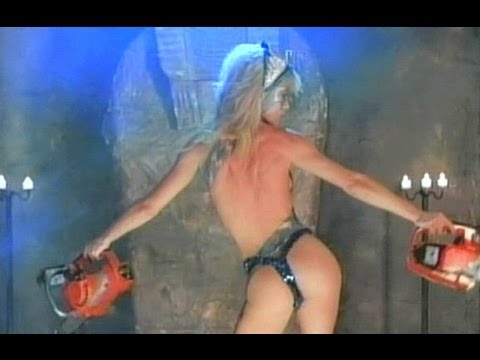
Nevertheless, the kitsch-titled HOLLYWOOD CHAINSAW HOOKERS probably ranks as Ray's best movie, just for the moxie it demanded to begin with an absurd premise and follow it to its semi-logical conclusion. Seedy and deadpan-ironic detective Jack Chandler (Jay Richardson) gets hired to scour the bowels of modern Los Angeles for a missing girl by the girl's worried mother, only to find that young Samantha (Linnea Quigley) has gotten involved in an ancient Egyptian cult devoted to sacrificing people with their holy chainsaws. Just to make sure no viewer missed that this was a partial spoof of the TEXAS CHAINSAW MASSACRE franchise (of which there had only been two in 1988), Ray cast as the cult's leader Gunnar Hansen, the same fellow who played MASSACRE's main monster Leatherface. On top of that, Ray has scream queens Michelle Bauer and Dawn Wildsmith serve as two of the "chainsaw hookers." 

For most of his investigation, Chandler is blissfully unaware that the chainsaw-murders, in which prostitutes carve up their would-be clients, are taking place at all (there doesn't seem to be much news coverage of these bizarre murders for that matter). But as the snarky sleuth trails Samantha to a strip bar, he's taken prisoner by the Chainsaw Hookers, just on general principle. Samantha helps Jack escape, and he learns that her only reason for hanging around the cult is that she has a vague plan to bring all of the killers down for having sacrificed one of Samantha's girlfriends. Jack falls for Samantha and ends up joining her crusade, though he's not much of a fighter. The film's one big combative scene presents what I assume to be cinema's first depiction of "dueling chainsaws," as Samantha battles one of the hookers (Bauer, if I'm not mistaken). 

One's enjoyment of the film's goofy, thoroughly profane humor will vary by individual: either you like lines like "you could have knocked me over with a pubic hair" or you don't. There's a bit of a quasi-feminist vibe here as the working girls labor to cut their johns into sausages (never shown in detail, of course), though one might point out that they still take their orders from a man they call "Master." Hansen arguably gives the best performance here. Sometimes he's portentous--  he claims that his cult was given "the chainsaws of the gods" by the god Horus. But other times he sounds like an ordinary cantankerous jerk, particularly when he can't get his chainsaw started to slice Jack into pieces. ("My dad used to get the same look on his face with his chainsaw," quips the detective.) That said, Linnea Quigley helped put the film on the trash-film map with her "virgin dance of the double chainsaws." The actress later claimed not only that she danced with fully running chainsaws, but also that she was completely nude and merely wore strategic paint to conceal certain areas.

Though the Master claims to reign over an ancient cult, there's no evidence that anyone has supernatural powers. The cult-leader apparently puts Samantha under hypnotic control, but he's no Svengali, since the feisty female breaks free and subjects the Master to his own sacrificial blade.


Thursday, January 20, 2022

THE UNHOLY NIGHT (1929)


PHENOMENALITY: *uncanny*
MYTHICITY: *poor*
FRYEAN MYTHOS: *drama*
CAMPBELLIAN FUNCTIONS: *psychological*

This early talkie is so statically filmed (by actor Lionel Barrymore, taking over from original assigned director Rupert "Phantom of the Opera" Julian) that I might've believed it was taken from some staid stage play. Instead, UNHOLY NIGHT was based on a short story by Ben Hecht, who would certainly craft many better known stories over his next thirty-plus years as a Hollywood scripter.  

The mystery gets a strong start, opening as a man is attacked in a dense London fog by a strangler. The man, Lord Montague (Roland Young), manages to escape, and when the police interview him they tell him that he's one of the few recent persons that the strangler didn't kill. The police let some of the names of earlier victims slip, and Montague recognizes that they're all former members of his regiment when it was stationed in Gallipoli. As it happens, the other members of the regiment are due to ring in the New Year at Montague's, and Scotland Yard attends the ceremony in hopes of finding out if the murderer will attend too.

After that opening, though, the film bogs down in lots of expository scenes. Two unexpected guests show up. One is Lady Cavender, an attractive young woman who just happens to be the daughter of a former regimental soldier who was executed for cheating at cards (not really, but the clumsy dialogue makes it sound like that). The other is Abdul (Boris Karloff), a Middle Eastern solicitor with a ghastly "where's that from" accent. Abdul reads the will of the late Cavender, who has left all the surviving members of the regiment a bequest, though each one will inherit more should any of the others pop off this mortal coil. In addition, Lady Cavender seems set on sowing dissension "in the ranks," as it were.

The murderer does strike again, and after some more victims die, he's revealed as the victim of a hypnotic spell by the true villain. A few lines of dialogue state that he might have dressed up like a "green ghost," but the viewer never sees this, just lots of talking heads. 

The only sources of entertainment here are Roland Young's comic stylings of the alcohol-loving Lord Montague and Karloff's terrible Eastern accent-- all the more remarkable in light of the very restrained voice he assumes for Ardath Bey in 1932's THE MUMMY. Karloff also had a small part in another Barrymore directorial work, THE SEA BAT, and had a much better role in a more well-known Hecht script for the original SCARFACE.


Wednesday, November 3, 2021

SON OF SAMSON (1960)


PHENOMENALITY: *uncanny*
MYTHICITY: *fair*
FRYEAN MYTHOS: *adventure*
CAMPBELLIAN FUNCTIONS: *sociological*


Maciste gets one of his chronologically earliest outings when he shows up (according to the dubbed voiceover) in Egypt in the eleventh century B.C., which is more or less the time-period during which the Biblical Samson lived. As in many such films, Maciste (Mark Forest) doesn’t actually know who he is or where he came from. But because he’s been adopted by a tribe of impoverished Egyptians, who are apparently conversant with the Hebrew story of Samson, he’s dubbed “the son of Samson.” I would imagine that the original Italian script did not involve the Samson reference at all, given that the simple plot makes no reference to Hebrews of any time period. The opposition between “good tribe” and “bad tribe,” so indispensable in most peplum-films, consists of native Egyptians being oppressed by Persian invaders and their Egyptian servitors.


The Persians’ chief representative is Queen Smedes (Chelo Alonso), the wife of the rightful Pharaoh. A voiceover asserts that her loyalty to the Persians is supposed to be a secret, but it’s hard to see how she could conceal her loyalty to the occupying forces, particularly after she has the old Pharaoh assassinated. She has a potential opponent in the Pharaoh’s handsome young son Kenamon, who hobnobs with the lower classes and even has a love connection with a poor girl. So Smedes uses drugs and an amulet-- possibly magical, or maybe a hypnotic aid--to brainwash Kenamon so that he marries his father’s former wife, ensuring that Smedes remains on the Egyptian throne.


Maciste naturally comes to the defense to the tormented lower classes, not least because Maciste like Kenamon has a girlfriend among their ranks. He plans to arrange a rebellion against the evil queen, but he catches Smedes’s eye when performing in the local arena (suggesting that the 11th-century Egyptians had their own version of the Roman “bread and circuses.”) Smedes brings Maciste into her palace, and from their G-rated lovemaking, it becomes increasingly ambivalent as to whether she’s subverting his will with drugs and if he’s just playing her to suss out the easiest way to overthrow her reign. Smedes is too smart for Maciste, slipping the hero a knockout drink him and having him flung to the crocodiles. However, Maciste is too tough for the crocs and ends up leading the good Egyptians against the bad collaborators and the Persian occupation—which is naturally all wrapped up in one big climactic battle.


This is a fairly ordinary muscleman-flick, without any outstanding stunts or fight-scenes. Chelo Alonso provides the strongest element in the film, particularly when she does a sexy dance to captivate the hero. Maciste and Kenamon are loose mirror-images, given that regal “bad girl” Smedes threatens both of their relationships with noble but poor “good girls,” even though the evil queen is interested only in Maciste and never makes any moves on her stepson/husband. Yet it’s Kenamon who gets his girl in the end, while out of the blue Maciste suddenly decides that he’s got to desert his lady love in order to go questing to help more people in trouble. Given that none of the Maciste films connect with one another, there should be no objection to the hero settling down with a wife in one era, given that he’s destined to pop up in some other timeframe. But maybe the scripter just thought the audience would like to see their immortal hero toss off the chains of matrimony in favor of having yet more never-ending adventures.    


Wednesday, June 23, 2021

REVENGE OF THE NINJA (1983)


PHENOMENALITY: *uncanny*
MYTHICITY: *fair*
FRYEAN MYTHOS: *adventure*
CAMPBELLIAN FUNCTIONS: *sociological*


Prior to REVENGE OF THE NINJA the Cannon group issued ENTER THE NINJA, which, while watchable, is mostly notable for introducing martial-artist-turned-actor Sho Kosugi to American audiences. Kosugi had made about three films prior to ENTER, but evidently he impressed Cannon with his performance as the villain in that film, for here he's the hero. Similarly, though this was not the very first directorial role for Sam Firstenberg, it was his first martial arts movie, made about two years before Firstenberg launched the popular AMERICAN NINJA series.

Without inflating the significance of REVENGE, it does actually have a fairly tight plot in comparison with the average Cannon schlock. Since most of writer Jim Silke's cinematic outings were not all that interesting, maybe he or one of his producers decided they really wanted to expand on the mythology of the cinematic ninjas. Here we have two ninjas for the price of one-- one bad and one good-- and both of them make heavy use of all the exotic weapons associated with the medieval clans: caltrops, blowdarts, and the ever popular shuriken.

Kosugi plays Cho Osaki, one of the last members of a modern-day ninja clan in Japan. He's befriended by Braden (Arthur Roberts), one of the few Caucasians trained in ninjutsu, but a clan-feud breaks out and costs the life of Osaki's wife. Distraught, Osaki takes his young son Kane to America. He starts up an art gallery devoted to Asian art, in partnership with Braden. Though Osaki forswears the way of the ninja, he and his son continue training in the various martial arts, and even Braden's associate Cathy (Ashley Ferrare) joins them in some bouts, though it appears that she'd like to have a "bout" of a different kind with Osaki.

Braden, however, is using the gallery as cover for a heroin smuggling ring, concealing the dope in some of the art-figurines. However, Braden butts heats with local Mafia boss Chifano, who wants to ace Braden out and deal directly with the suppliers. Braden dons his ninja gear and starts killing members of Chifano's family to make the mobster capitulate. Kane witnesses Braden kill Osaki's aged mother and the boy flees for his life, and Chifano sends men to steal the dope from the gallery, thus bringing about a fight between Osaki and Chifano's goons. This "turf war" plotline is reasonably efficient about bringing the two ninjas into conflict over the good ninja's son, while allowing for the slaughter of a lot of the bad ninja's gangster-enemies.

Now, although this isn't your average Cannon film, where all the action erupts without cause to keep the audience happy, there certainly are some oddball setups. In one, Osaki and a policeman buddy randomly go looking for the missing Kane, confront a group of scummy looking layabouts in a park, and get into a fight with them, though the bums really have nothing to do with the boy. More amusingly, Braden uses ninja hypnosis on Cathy to make her capture Kane when he shows up at the Osaki dojo-- and the duel between a very skilled grade-schooler and a semi-trained grown woman is certainly not something you see every day.

Overall, the fight-scenes in REVENGE are much better than the average American chopsocky, particularly the climactic contest between Osaki and Braden. On a minor point, the credits bill Kosugi as both Osaki and "the Black Ninja," though no one calls Osaki that, and both of the ninjas here wear the same ebony attire. "The Black Ninja" is also the name bestowed on the villain of the next collaboration between Firstenberg and Silke, NINJA III: THE DOMINATION, which makes REVENGE OF THE NINJA looks like a John Ford film by comparison. 

Friday, May 1, 2020

THE CABINET OF DOCTOR CALIGARI (1919)


PHENOMENALITY: *uncanny*
MYTHICITY: *superior*
FRYEAN MYTHOS: *irony*
CAMPBELLIAN FUNCTIONS: *sociological*


As long as I’ve been reading film criticism, I’ve been exposed to the prevalent notion that Robert Weine’s CABIINET OF DR. CALIGARI was primarily a political allegory about the state of authority in Weimar Germany. Had I never encountered the idea before, though, the Kino restoration of CALIGARI provides a commentary that cites all the basic propositions: that the titular doctor represents the same corrupt authority that would later turn one of Europe’s most cultured countries into a nation of Nai fanatics.

I would not question that sociological factors in Weimar culture had a tremendous effect upon CALIGARI’s genesis, to say nothing of wider European artistic trends like the cubist and futurist movements that ostensibly influence on the film’s unique set-design. Yet I don’t think CALIGARI lends itself to a strict allegorical interpretation. First and foremost, CALIGARI is one of the world’s first major horror-films, which means that it would’ve derived most of its horror-tropes not from other films, but from the horror genre as it existed at that time: mostly (a) recordings of folkloric horror-tales or (b) original prose works. I’ve never encountered any ruminations by either director Weine or scripters Mayer and Janowicz about CALIGARI’s origins. But since all of them were educated Europeans, I think it’s likely that one or more of them were familiar with the works that I think could have influenced that genesis—two major works published one year apart, E.T.A. Hoffmann’s short story “The Sandman” (1817) and Mary Shelley’s novel FRANKENSTEIN (1818).

Of the two, “The Sandman” bears the greater structural resemblance to Weine’s film. Both narratives, when seen in the entirety, concern the dooms of earnest young men who are undone by strange older men who control forces outside the realm of nature. In both narratives there’s initially a distancing factor. The doom of Hoffmann’s young man Nathaniel is related not by him but by a friend chronicling Nathaniel’s misfortunes via letters, while in Weine, young Francis lays out his own story to a listener, and the bulk of the film is told within this frame, before coming back to present-time Francis for a “twist ending.” In “Sandman,” Nathaniel meets his bizarre antagonist twice in his life, first when Nathaniel is a child, and then when he’s a young man on the cusp of marriage. Francis meets Caligari only once, when he Francis is seeking to make a young local woman his bride. Nathaniel’s antagonist assumes two somewhat separate identities, that of “Coppelius” and Coppola,” and only in the latter identity does he have access to a mysterious young woman, later proved to be an automaton. Francis encounters Caligari just once, when the doctor travels in the guise of a carnival mountebank, attended by a somnambulist whom the doctor controls like a robot. To be sure, within the context of the internal tale, the Caligari of 1919 also has a “double identity” of sorts, in that he’s based his nefarious deeds on those of a magus of the same name from the late 18th century. In “Sandman,” Nathaniel is so love-stricken by Coppola’s female companion Olympia that he throws over his real fiancée, and when he finds out how he’s been deceived, he kills himself. Throughout the internal story of CALIGARI, Francis seems to have triumphed, in that he exposes Caligari’s crimes and uncovers his identity as the manager of an insane asylum. However, when the frame-story finishes up, it’s revealed that Francis is actually insane himself, and has been telling his story to another occupant of the asylum where they both reside. Moreover, in the final “gotcha,” the head doctor of the institution is a real-world version of Caligari, and all of Francis’s delusions have been projections of evil upon a devoted healer who’s trying to help his patients.

One anecdote asserts that the original plan of the film’s producers was to tell the story “straight,” without the frame-story and its (rather modest) concessions to rationality. This may well be true, but had the frame-tale been omitted, the resulting film would in some ways bear a greater resemblance to Hoffmann’s story, in which Caligari and his somnambulistic servant existed, with all their bizarre aspects, within the real world. Unlike Nathaniel, Francis presumably would have triumphed over his antagonist, though said triumph would have been muted by his having lost his best friend to a fiend. So it’s not impossible that “the Sandman” was the structural model for the internal story, and that the quasi-rational frame-tale was injected to give the viewer some of the same sense of desolation that Hoffmann’s tale gave to its readers.

The influence of Shelley’s FRANKENSTEIN, if valid, would be confined entirely to the internal tale. Many commentaries have emphasized the influence of Weine’s Cesare upon later versions of the Frankenstein Monster, courtesy of James Whale’s cinematic borrowings. But the Monster of Shelley’s prose is not a lumbering engine of destruction. Rather, Shelley’s Monster has roots in Germanic stories about doppelgangers, some of whom are known for doing all the nasty things that their real-world originals would never do. The doppelganger template only roughly fits Shelley’s narrative, but at the very least the hideous Monster does on occasion murder people whose knowledge might be a threat to Victor Frankenstein.

Within the internal tale of CALIGARI, the viewer is told that Caligari has traveled to other cities before that of Francis, and that the mad doctor has used Cesare to murder other helpless victims. However, within the internal story, the viewer only witnesses two victims of Cesare's violence, both of whom have strong ties to Francis. It’s first established that Francis and Alan are best friends despite the fact that both of them are courting Jane. Then, when the two young men visit Caligari’s show, the doctor claims that Cesare possesses prophetic powers due to being in a continual state of sleep. Alan asks “How long will I live,” and Cesare predicts that he won’t live past that night. Then, for no particular reason, Caligari makes the prophecy come true by sending Cesare to Alan’s apartment, where the somnambulist knifes Alan to death. At no time does Francis realize that his best friend’s death leaves his way to Jane clear-- though he has another opponent of sorts. For equally obscure reasons, Caligari sends Cesare to kill Jane as well—but in a justly famous scene, Cesare more or less “wakes up” and tries to make Jane his own. The police, egged on by Francis, overtake Cesare before Jane is violated. The sleepwalker simply dies during the pursuit, and later Francis is able to expose Caligari’s true identity within the internal tale. But the salient point is that though Caligari has no real motives and thus does not sustain a doppelganger relationship with the mad doctor, everything the viewer sees Cesare do can be seen as a manifestation of Francis’s evil nature.

Given my view that CALIGARI is more strongly inspired by other horror-texts than by Weimar social forces, I find it further validation in the script’s few details about “the first Caligari.” Rather than imagining that the modern Caligari takes his model from some character out of preliterate folklore, “Original Caligari” is said to have appeared—complete with somnambulistic slave—in 1783. By my reckoning, this falls within the time-period when the rationality of the eighteenth century met its literary nemesis in the flowering of the Gothic story from 1760 to about 1796. The first phase of the Gothic gave way to the more generalized form of the prose horror story, ranging from the works of Hoffmann and Shelley to the equally consequential accomplishments of LeFanu, Stevenson, Stoker and many others. Modern-day Caligari’s horrific nature lies not in his vague emulation of the ways of tyrannical authority, but in his challenge to the forces of modernity in the dawning twentieth century. He appeals to the fear that, even with the supposed explanations of rational psychology, the worlds of the irrational yet endure.

Friday, February 7, 2020

BLACK MAGIC (1949)


PHENOMENALITY: *uncanny*
MYTHICITY: *fair*
FRYEAN MYTHOS: *adventure*
CAMPBELLIAN FUNCTIONS: *psychological, sociological*


"Orson Welles, superhero."

Okay, I just had to write that line, even though it's not literally true. To be sure, at least one intellectual, Antonio Gramsci claimed that the character Welles plays in BLACK MAGIC-- the character of Cagliostro, as fictionalized in Alexandre Dumas's 1846 JOSEPH BALSAMO-- to be an example of a 19th-century "superman." But Cagliostro, a.k.a. the gypsy hypnotist Joseph Balsamo, uses his unique gifts for evil, and thus BLACK MAGIC can be accurately described as--

"Orson Welles, supervillain."

BLACK MAGIC begins with half of a frame-story, not unlike that of 1935's BRIDE OF FRANKENSTEIN, in that the frame starts out with author Alexandre Dumas as talking about how his great creation Cagliostro seemed to escape him. However, the film ends without returning to Dumas.

Welles, then forty-four years old and not yet as heavyset as he would become in future decades, plays Joseph Balsamo as a crafty gypsy whose people have been perpetually mistreated by the non-gypsy populace of France. As a child Joseph saw both his mother and father executed by the will of a petty nobleman, Montagne, because Joseph's mother predicted a child's death and was therefore accused of being a witch. Child Joseph is spared when his fellow gypsies rescue him from the French soldiers, but vows vengeance on Montagne. Years later, when Joseph has become an adult, he develops a rude version of hypnotic skill, and the real-life French physician Doctor Mesmer (founder of "mesmerism") sees Joseph demonstrate his powers. Mesmer wants Joseph to hone his talents so that the two of them can use hypnotism in medical treatments. Joseph, who's never given his ability much thought, realizes that if he can impress this wealthy gadjo, he can impress others, and so he rejects Mesmer's offer.

Years later, Joseph has assumed the name of Cagliostro, and has garnered fame and wealth through alleviating people's ills with the power of suggestion. This fame brings Joseph back to his long deferred desire for vengeance, for the nobleman Montagne summons Cagliostro to treat a comatose young woman, Lorenza. Joseph represses his desire for immediate revenge, studies Lorenza and realizes that she's a dead ringer for Marie Antoinette, who will ascend to the rank of France's queen when her husband's father Louis XV passes on. Since Lorenza is useless to Montagne unless Joseph can release the woman from her coma, the ambitious gypsy deals himself in on the plot of Montagne and his co-conspirator Madame DuBarry, which involves a complicated scheme to defame the queen.

As part of the deal, Montagne has to get the famed "Cagliostro" an invitation to attend the court of Louis XV. Local Parisian doctors arrange a hoax to expose the supposed healer's fakery, by presenting Joseph with nobles dressed up like suffering wretches. But Joseph has the last laugh, for after the court's had a good guffaw at his expense, the hypnotist places one of the impostors under his mental control, forcing the unwilling nobleman to act like a dog. This impresses Louis XV and awes the court, though this doesn't help Joseph much when, some days later, the current king dies and Louis XVI ascends to the throne. Marie Antoinette doesn't like the alleged healer, so Joseph and Montagne initiate their plan to embarrass the queen, which in a roundabout way is supposed to bring them great temporal power.

On a side note, though Joseph does bring Lorenza out of her coma, he also falls in love with her, and keeps her under his psychic thrall. However, Lorenza has an age-appropriate love, Gilbert of the royal guards, and Joseph eventually hypnotizes the young woman into marrying him, the better to discourage the young swain.

Though the plot proceeds to some extent, Joseph and Montagne are both accused of conspiracy. Joseph easily escapes jail and for good measure forces his old enemy to commit suicide. However, eventually Joseph/Cagliostro is brought to trial, though the authors of the villain's downfall are both Gilbert and Joseph's short-lived mentor Mesmer.

I skimmed the ending of Dumas's BALSAMO-- which probably is no better a rendering of historical fact than BLACK MAGIC-- and I'm reasonably sure the book doesn't end in as combative a manner as the film, which boasts both a hypnotist-battle between the villain and Mesmer and a swordfight between Joseph and Gilbert. Wikipedia mentions that both Welles and director Gregory Ratoff rewrote the script credited to two other writers, and I would guess that someone behind the scenes wanted BLACK MAGIC to conform to the model of Dumas's best known work, THE THREE MUSKETEERS. Rumor has it that Welles directed parts of the film, but though MAGIC is a better-than-average swashbuckler, its direction isn't all that distinguished. The film's greatest significance may be as a possible inspiration to the Marvel supervillain Doctor Doom. Doom's origin, analyzed here, starts with Doom as a gypsy boy whose dead mother actually was a witch, after which the future supervillain grows to manhood, confounds the local nobles with his scientific wizardry, and eventually rules the country-- only to fall victim to a fate closer to that of Dumas's MAN IN THE IRON MASK.