Friday, October 7, 2022

SHADOW OF THE HAWK (1976)


PHENOMENALITY: *marvelous*
MYTHICITY: *fair*
FRYEAN MYTHOS: *adventure*
CAMPBELLIAN FUNCTION: *metaphysical*

This low-budget supernatural thriller, directed by George McCowan of FROGS fame, is significant for being one of the few commercial films up to that time to delve into the world of Native American magical practices. 

Jan-Michael Vincent plays Mike (no last name), a young, half-Indian computer tech living in the big city and dating a rich girl. He seems to be on his way up the corporate ladder, but he has a weird dream in which he sees a ghostly creature trying to reach him. At the same time, Mike gets a visit from a relative he hasn't seen in ten years: his grandfather Old Man Hawk (Chief Dan George). As a few establishing scenes demonstrate, Hawk seems to be bedeviled by mysterious forces as he walks all the way to the big city. There the old man collapses. He's succored by lady reporter Maureen (Marilyn Hassett), who helps Hawk reach his grandson. 

Hawk then spins a wild tale of being pursued by a vengeful witch. Though Mike has always known that his grandpa served as medicine man to his tribe, but the young man never believed in Indian sorcery, and in any case has entirely embraced the life of his white forbear. (There's no info given about either of Mike's parents.) Hawk foresees that he may not be able to conquer the witch's powers, and so he wants Mike to take up the mantle of the medicine man and defeat the witch.

Though Mike is reluctant to leave his prosperous life, Hawk and Maureen convince him to drive his grandpa back to his tribal lands, with Maureen ostensibly coming along for a possible human interest story (though both she and Mike are plainly interested in one another). Strange men in a black car pursue Mike's vehicle, and Hawk demonstrates the reality of Indian magic by conjuring up an invisible wall in the road, so that the pursuit car crashes into it. Soon the trio are forced to make their way on foot through the Canadian wilderness, as they are harassed by various spells from the witch and occasional human pawns (a man dressed up in a bird costume). Not surprisingly, Mike overcomes his reluctance, accepts his heroic duty and vanquishes the sorceress-- though he seems to learn magic with no more difficulty than taking up gardening.

SHADOW is mostly a chase-film, with some nice if not exceptional wilderness-scenes. I can't claim that the script is deeply insightful into Native American religion, but some scenes communicate the dominant Indian attitude toward the magical ways of seeing the supernatural as an outgrowth of the natural world. McGowan mostly worked in television, so his visual style is never more than efficient, but I found this simple thriller more entertaining than a great number of CGI-heavy movies. 

Thursday, October 6, 2022

THE GHOUL (1975)


PHENOMENALITY: *uncanny*
MYTHICITY: *poor*
FRYEAN MYTHOS: *drama*
CAMPBELLIAN FUNCTION: *sociological*


THE GHOUL, the third and last production of the British studio Tyburn, is one of those films whose behind-the-scenes complications are probably more interesting than the actual movie.

GHOUL's primary creators were both Hammer stalwarts-- writer Anthony Hinds and director Freddie Francis-- and its main star was the redoubtable Peter Cushing. I assume that none of them considered themselves "married" to Hammer at the time of GHOUL'S creation. At the same time, though Cushing does his utmost even with a horribly underwritten part, Francis and Hinds aren't bringing their A-game in the least. This is surprising since Tyburn was founded by Kevin Francis, son of Freddie.

For almost thirty minutes, the audience follows the antics of a group of young idle aristocrats (usually the type Hinds would have shown as deserving of doom). Two of the men stage an automobile race, with pretty Daphne (Veronica Carlson) as a passenger. One car crashes and Daphne gets pissed at the inconvenience, taking off on foot to find her way home. She ends up on the estate of Doctor Lawrence (Cushing), who has but two servants: a nasty groundskeeper named Tom (John Hurt) and a sinister Hindu maid named Aya (Gwen Watford). When Daphne encounters Tom out in the woods, Tom tries to get rid of the girl by roughing her up. When she meets Lawrence and reports Tom's behavior, Lawrence blows her off and invites her to stick around and take tea with him. However, Daphne overstays her welcome, for Aya releases a mysterious, savage man-- not seen on full-camera-- who kills the girl. Later Aya cooks the girl's flesh for the "ghoul," with no indication of whether Lawrence is aware of these proceedings. The groundskeeper also comes across one of the male racers and kills him, though Tom's motives for going along with all this is never clear.

Eventually the other two race-participants go looking for their friends, and they too meet the creepy residents of Lawrence's estate. In a blatant example of Hinds stealing from one of his previous scripts, the 1966 REPTILE, it's vaguely intimated that Lawrence went to India and somehow trespassed against Hindu customs, so that his son was cursed to become "The Ghoul." This is pretty much a reprise of the situation in REPTILE, right down to the Hindu servant, but the reasons for the monster were much clearer in the 1966 film.

The film's biggest problem is that its monster is largely confined to the rooms of the mansion, and the monster's "creator" is largely tragic and sympathetic. Tom the Groundskeeper is the only mobile agent, but I don't think anyone would have sought out a horror-film called THE NASTY SERVANT.

Monday, October 3, 2022

SHAOLIN VS. EVIL DEAD (2004), SHAOLIN VS. EVIL DEAD: ULTIMATE POWER (2006)


PHENOMENALITY: *marvelous*
MYTHICITY: (1) *poor, *(2) *fair*
FRYEAN MYTHOS: *adventure*
CAMPBELLIAN FUNCTIONS: *metaphysical, psychological*


It should go without saying that these films lack any similarity to either the style or content of Sam Raimi's "Evil Dead" films. The first film at least seems to be a loosey-goosey emulation of the successful 1980s "Mister Vampire" franchise. In place of a modern-day magician-hero, we have archaic Taoist (Buddhist?) priest Pak, played by the always appealing Gordon Liu. Pak is out to conquer the zombie legions of Zhao (Man Kit Cheung), a former fellow acolyte of Pak's order. Pak is accompanied by a younger priest, Hak (Terry Fan of STORY OF RICKY), and an annoying kid. Both are played for bad humor but at least the kid is gone in the sequel.

The first film doesn't give much background to the quarrel between Pak and Zhao, with the latter's motive sounding a bit like a Lex Luthor grudge ("you deprived me of my proper position in the order!") Hak gets a little more character development in that he falls for Zhao's student in Taoist kung fu, Grace (Shannon Yoh), and though the romance-plot is nothing special anything looks good next to the crappy humor. There's also no explanation as to why Pak keeps a small horde of hopping vampires around as a retinue of sorts. If he sought to pit his vampires against Zhao's zombies, that might have been worth watching, but neither type of "evil dead" plays a major role in the story. The film terminates without a clear climax, forcing the viewer to seek solace in the sequel.


Surprisingly, the sequel-- over half of which is a prequel-- is a good basic melodrama, with hardly any lame humor at all. 

In the prequel section, the audience learns much more about the backstories of Pak and Zhao (played of course by younger actors in the flashbacks). Zhao is conceived by two Taoist priests, father Dragon and mother Phoenix, both of whom are poisoned by contact with "evil dead." Phoenix is pregnant with Zhao at the time, and though a doctor tells her to abort to save herself, she brings Zhao to term and perishes. Dragon, master of a Taoist monastery, manages to keep the poison in his body under control, while at the same time trying to raise Zhao as a good monk. However, Pak joins the monkish ranks as well, and Dragon is forced to elevate Pak above his son. This turns Zhao to the Dark Side, which brings him up to the point of the modern-day story.

Though I'm reasonably sure no one in the first film mentioned magic swords, now we find out that two such weapons are vital to Zhao's ascension to demon-hood. Zhao has a really cool moment during a visit to the "Sword Graveyard," where he masters dozens of illusory swords blocking his way. (Yes, they're CGI, but they look damn good.) Cheung and Liu of course play their roles again, though Liu isn't in it much this time. Grace turns against her evil mentor, and he responds by making her one of his zombie minions, though Pak and Hak are able to win her back from the abyss. The upsurge of the "evil dead" becomes so pervasive that Zhao ends up redeeming himself by teaming with Pak to end the threat, allowing the romance of Hak and Grace to thrive in the end. Even though the FX do more heavy lifting than the stars, ULTIMATE POWER outshines the previous entry in terms of good basic entertainment.


NAKED GIRL MURDERED IN THE PARK (1972)


PHENOMENALITY: *uncanny*
MYTHICITY: *fair*
FRYEAN MYTHOS: *drama*
CAMPBELLIAN FUNCTION: *psychological*


SPOILERS SPOILERS SPOILERS


I'm discussing the solution to this murder-mystery because its psychological complexities behind the killer's motives are more interesting than the whodunnit reveal.

The film doesn't start out with the naked murdered girl; she comes in later. The initiating victim is an old fellow named Wallenberger, shot in the head and propped in the seat of a "tunnel of horrors" ride at an amusement park. Technically, though, this murder is given a prologue holding clues to the solution. During WWII a Nazi officer is seen setting a bomb to do away with a bound young woman and her boy. The bomb goes off but we don't know who was killed, or why. 

 Since Wallenberger had just signed a major insurance policy, the company suspects hanky-panky, and sends an investigator named Chris (Robert Hoffman) to ferret out the truth. The police are represented by Inspector Huber (Adolfo Celi, the only "name" in the cast that a fair quantity of Americans would recognize), and he has no answers, though he hints that they don't know exactly where Wallenberger was during WWII. (Hence the prologue...) Chris starts off his investigation by chatting up Catherine, the youngest daughter of the victim, who's being stalked by a mysterious figure, seen once through a window, his or her face concealed by a dark hood. Chris eventually sleeps with her in order to garner an invite to the family estate. There he meets Barbara and Magda, Catherine's sister and mother respectively. He encounters a few obvious red herrings, one of whom is played by Howard Ross, who essayed a muscleman-hero in SAMSON AND THE MIGHTY CHALLENGE. Then Chris sleeps with Barbara-- though she's proven innocent of her father's murder when the mystery killer slays her and leaves her naked in the park.

I guessed the killer's identity by the fact that Chris so callously bumped uglies with Barbara, and didn't even apologize when Catherine walked in on them-- though to be sure Catherine barely noticed, being freaked out about her stalker. And when Chris let Madga come on to him as well-- though it may be significant that he doesn't sleep with her-- I was sure that Chris was the mastermind. Sure enough, he's the grownup version of the little boy from the prologue. The officer setting the bomb was Wallenberg, who was playing stepfather to the woman's child until he decided to get rid of them both in what would look like just another war-death. The mother died, but the boy escaped and later designed this complicated plan of revenge on Wallenberg's house. But Inspector Huber has not been twiddling his thumbs, and Chris receives rough justice in the end.

Chris has a long rant in front of his late stepfather's portrait that qualifies the young fellow for the ranks of "perilous psycho," not least because he claims that his "hands are clean" because he got pawns to do his dirty work. His crimes are not bizarre, though, and he's seen in his black hood only for a second, so that it doesn't stand scrutiny as an "outre outfit." Chris's obsession carries a vibe suggestive of Freud's "Totem and Taboo" theory, in which young men slay the tribal chieftain so that they can gain access to the women he keeps to himself. 

The biggest surprise of the film is that it has a competent if not remarkable solution to its mystery. This is a little surprising since a lot of giallos prove careless about details of logic and motivation. However, it's even more startling that the director was Alfonso Brescia, known best to SF-fans for a series of nonsensical "Star Wars" flicks, of which STAR ODYSSEY may be the worst. NAKED at least demonstrates that Brescia wasn't utterly unable to make a decent genre film.


Friday, September 30, 2022

HOUSE OF THE BLACK DEATH (1965/ 1971)


PHENOMENALITY: *marvelous*
MYTHICITY: *poor*
FRYEAN MYTHOS: *drama*
CAMPBELLIAN FUNCTION: *metaphysical*


Some bad movies wear their influences on their sleeves. As the badness unfolds, one can imagine how the writer or director thought he was emulating something good, but that he just couldn't see how to make the parts connect. 

DEATH's scripter Richard Mahoney has but one writing credit, as his career revolved more around costuming. One imdb reviewer read the novel on which DEATH was based, and pronounced it much better than the movie-- which wouldn't be too hard. But I can't help wondering if Mahoney thought he was doing something along the lines of 1957's CURSE OF THE DEMON, where a skeptic gets converted to the reality of modern witchcraft the hard way.

Influence aside, CURSE provides a textbook example as to how to pursue the modern-witchcraft theme so that it has human appeal for the audience. In contrast, even though Mahoney's dialogue is competent enough-- at least, no worse than many forties B-films-- nothing his characters say seems to hook up with any emotion. Of course, maybe the film's three directors were responsible for the incoherence.

The hard-to-follow plot concerns the Desard family, located in the town of Widderburn, somewhere in rural England. The oldest Desards are ailing Andre (John Carradine), who has some unspecified occult history, and Belial (Lon Chaney Jr), a Satan-worshipper who now holds the village in the palm of his hand. The brothers have been feuding for years over the family fortune. There are two other Desards living on the estate, the much younger Paul and Valerie, and I assumed them to be cousins, though I don't think it was specified. There are references about a heritage of family madness but the script does nothing with these.

Belial usually appears in a cowl because he possesses real horns, about the size of a baby goat's, sprouting from his head, presumably a gift from his evil master. In order to break Andre's control of the family, Belial curses Andre's son Paul to become a werewolf-- whose lupine activities are almost entirely off-camera, (Given how bad the wolf-makeup is, this is a meager blessing.) Meanwhile a bunch of the members of Belial's coven (including Warren favorite Katherine Victor) lurk in the forests, performing rituals and reciting meaningless verbiage, doing nothing but burning time.

Into this familial quarrel come supernatural skeptic Eric Campion (Jerome Thor) and his acquaintance Katherine Malloy (Andrea King). Their professions are vague at best, but Eric lived in the village three years previous to the film's time, though it's not clear whether or not we was a native. Eric may or may not have some romantic relationship with Katherine, or he may have some past connection with Valerie, but the script is so filled with tedious exposition that any such affiliations get lost in the shuffle. To the extent Katherine fulfills any purpose, she's there to be a sounding board as Eric begins to believe in the occult powers of Belial.

Very little happens beyond actors standing around pontificating or watching sexy women perform ritual dances in the forest. (Sabrina, a celebrity model of the period, has a non-speaking role as one of the dancers.) Andre and Belial share no scenes together, though of the two actors, Carradine succeeds in making his rambling speeches more appealing to listen to than Chaney does. Chaney grimaces and postures, but he's only really menacing in one scene, putting the moves on Valerie. But even here the menace is undercut because the audience doesn't know the familial relationship. Niece? Cousin? In-law?

Toward the climax Andre tells Eric that his cross-- which is just an ordinary looking icon-- has the power to defeat Belial, though there's no real evidence of this. Then, while Belial is performing some ritual, Andre suddenly decides to settle their feud with a conjuration that kills Belial. End film. 

Since DEATH was filmed in black and white, it didn't get a release until 1971. It functions as nothing more than a footnote in the respective careers of Chaney and Carradine. I suppose the author of the source novel is indebted to the production people, since without this bad film no one would even remember the book.


Wednesday, September 28, 2022

BLOOD RAGE (1987)


PHENOMENALITY: *uncanny*
MYTHICITY: *good*
FRYEAN MYTHOS: *drama*
CAMPBELLIAN FUNCTION: *psychological*


BLOOD RAGE was released in 1987 but filmed in 1983, around the height of the slasher-subgenre. I imagine that director John Grissmer and writer Bruce Rubin-- neither of whom accrued many credits on IMDB-- structured their film with the slasher market in mind, given how many adolescents get slaughtered. However, the narrative's basic trope reminds me more of the many imitators of Hitchcock's PSYCHO in the sixties and seventies.

PSYCHO tells the story of a mother-dominated young man whose Oedipal fixations are only hinted at in the dialogue. RAGE doesn't hide the identity of its psycho, but one must wonder: what makes Terry kill? Freudian allusions appear, but I can't be sure if Rubin is playing his cards close to his vest or just doesn't know the game.

The story begins with an act of parental irresponsibility. Maddy (Louise Lasser) is a mother with two kids, twins Todd and Terry. She's either a widow or has been deserted by her husband, for in the opening scene she's so desperate to land a new man that she goes to a drive-in theater with her date to make out-- but because she can't find a babysitter, she takes both kids along. The boys look to be about seven, and they soon get bored sitting around the back of the car while their mother makes out with her date. So the twins leave the car unnoticed.

The two of them happen across another car in which a guy and girl are also making out. Todd is merely nonplussed, but Terry is suddenly seized by a lust for murder. He snatches up an axe from somewhere and slams it into the skull of the guy in the car. Is Terry diverting his hostility toward his mom's date to another target? One never knows, but when Terry realizes that he could get in trouble, he shoves the bloody axe into Todd's hands and lets his brother take the blame. Todd is too traumatized to protest, with the result that he goes to an asylum for many years. Maddy is confused but then extends all of her maternal care to Psycho Terry, so that Todd becomes the "bad son" for her.

It's Thanksgiving, and both twins (now played by Mark Soper) are in their twenties. Maddy has apparently put her love life on hold since the drive-in incident, and Terry shows no unseemly lust for his mother. Unlike Norman Bates Terry seems totally cool with a bunch of other teens, including his girlfriend Karen. However, Maddy announces that she's been seeing a real estate guy, and that they plan to marry. Suddenly the demons of the Id arise in Terry, and he's filled with a lust to kill not just his mother's boyfriend, but everyone in sight. Providentially, Todd breaks out of the asylum, having finally remembered the truth about the drive-in murder. Terry gives free rein to his taste for carnage, thinking that he can blame it all on his "psycho" brother. But as one might suspect, being a twin doesn't necessarily work to Terry's advantage in the end.

Rubin's script doesn't embellish anything but his three main characters. All of Terry's targets, including a helpful doctor from the asylum, are flat types, and Karen, who gets the most screen time of all the support-characters, isn't any better. Louise Lasser makes Maddy a little too crazy prior to learning that her bad son is killing people for Thanksgiving, and presumably the actress was allowed to go wild because she was the only "name" in the cast. Mark Soper is much better in his dual role, though he's working under a handicap, since the script doesn't give him consistent characters for either brother.

I had to ask myself whether or not Terry was a true Oedipal type, even within the context of fiction, since his attitude toward lust is not as easy to suss out as, say, that of the similarly crazy Ellie from BLOOD AND LACE. But I decided that, whereas Freud thought he was describing a scientific syndrome, Grissmer and Rubin are providing entertainment-- and so even a partial emulation of a psychological pattern is enough to boost the film into the realm of good mythicity.


Monday, September 26, 2022

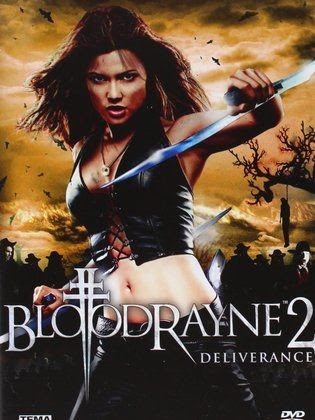
BLOODRAYNE: DELIVERANCE (2007), BLOODRAYNE: THE THIRD REICH (2011)


PHENOMENALITY: *marvelous*
MYTHICITY: *poor*
FRYEAN MYTHOS: *adventure*
CAMPBELLIAN FUNCTION: *metaphysical*


The financial failure of the 2005 BLOODRAYNE did not impair Boll from getting two more outings in the DTV market. Kristanna Loken did not return for either film, and Natassia Malthe took her place. Oddly, Michael Pare appeared in all three films in the series, though he played a different role each time.

Heroine Rayne, formerly ginger like her video-game source, now sports light brown hair, and though she was last seen in 18th-century Europe, DELIVERANCE has her show up in the American West of the 1880s, with not even a passing comment about what she was doing for the past hundred years. Maybe the writers didn't want to touch on the fact that during that time she's probably been preying on humans to drink their blood, though not necessarily with fatal consequences. Rayne, now wearing standard western attire and riding a horse, seems to be making her way to the town of Deliverance. There's a snatch of dialogue to suggest that she knows someone there, but the matter never comes up again.

Providentially, Deliverance is just where the outlaw Billy the Kid (Zack Ward), for some reason a full vampire, decides to bring his vampire gang. He plans to spread the disease of vampirism until he can raise a vampire army to conquer the country. However, he takes over Deliverance and its quavering citizens as an opening gambit. (Said citizens include Chris Coppola as a reporter and Michael Pare as Sheriff Pat Garrett.) Most impressively for a hateworthy villain, Billy abducts all the children in town, planning to use them as "cover" when he starts sending his agents around the country. Even before Rayne shows up to get in Billy's face, he shows his utter depravity by fanging one of the kids to death in full view of his other juvenile hostages.

The pacing of the action here is much better than in the first film. Before coming to grips with the main villain, Rayne works her way through Billy's henchmen and inspires the townspeople to take up arms against the fiends. There aren't as many anachronisms this time either, though at one point Rayne tricks a non-vampire outlaw into letting her tie him to a bed for sex-games. Malthe is not as charismatic as Loken but Zack Ward is such a juicy evildoer that the climax is much improved, for all that Boll's staging of action-scenes is still only average. Although this version of Billy the Kid has nothing in common with the real outlaw, I would count this film as the only crossover in the Bloodrayne series.


Another sixty years just races by for the immortal dhampire, and now she's part of a resistance movement in WWII Germany, to say nothing of having her hair turn jet-black. (An attempt to make the character resemble Selene of the UNDERWORLD series, perhaps?) She's the only dhampire helping the underground, and not very secretly (she's first seen fighting Nazi soldiers with a bo-staff). Yet the Nazi high command is aware that vampires and their kindred exist. Commander Brand (Michael Pare) is in charge of an attempt to study vampire powers to see how they can be used for the benefit of the Reich. To this end the head scientist (Clint Howard) keeps one female vampire of gypsy extraction in a cell, seeking to learn if it might be possible to confer vampiric immortality upon Der Fuhrer himself.

To Rayne's chagrin, she accidentally confers vampirism on Brand when some of her shed blood splatters on him and enters his system. The creepy scientist locates more of Rayne's blood, creates two vampire pawns and sends them after the rebel, though she cuts them down easily with her swords. (Hey, doesn't everyone carry twin swords in a Nazi-held city?)  Brant vampirizes an expert tracker in order to locate Rayne, but Rayne simply kills the bloodsucker. But she learns of Brand's plan to depart by train to Berlin, so she and her few allies must stop the train before the scientist's vampire-research can be placed in other hands. This leads to a big train-battle in which Rayne destroys Brand and prevents the vampire serum from reaching Hitler. 

Despite Pare's acting mojo, Brand is not that interesting a villain, and though Malthe seems more comfortable in her role this time, she's still just average in her delivery of badass lines. However, THIRD REICH-- surely the first time the phrase was ever used to denote a sequel-- has the best action-scenes of the three films, so that Malthe comes off as equal in that department to contemporaries like Beckinsale and Jovovich. Maybe Boll finally hired a fight coordinator worth his salt.