Thursday, March 16, 2023

THE GOLDEN ARROW (1962)


PHENOMENALITY: *marvelous*
MYTHICITY: *fair*
FRYEAN MYTHOS: *adventure*
CAMPBELLIAN FUNCTION: *metaphysical, sociological*


Almost of the magical elements of GOLDEN ARROW have strong antecedents in the 1924 THIEF OF BAGDAD, with the exception of the one for which ARROW is titled. There is a mystic bow-and-arrow in the 1940 THIEF OF BAGHDAD, with which the hero Abu slays the villainous Jaffar, but the one in this Italian-made fantasia has a very different function. To the credit of the five writers who produced the ARROW script, their magic bow provides an interesting variation on themes introduced by the 1924 Fairbanks fantasy.

In the 1924 film, the Thief of the title is a wily rascal whose career of thievery comes to an end when he falls in love with the caliph's daughter, and she with him. Since fabulously wealthy rulers have come to Baghdad to sue for the princess' hand, commoner Ahmed can only distinguish himself by seeking out a great treasure in a faraway domain. ARROW keeps this basic structure, in that its hero Hassan (the very un-Arabic American actor Tab Hunter) also competes with royal potentates for the hand of a princess, here named Jamila (Rosanna Podesta). However, unlike Ahmed, Hassan is a prince who doesn't know his true ancestry.

Hassan, who has been raised since childhood amid a bandit-tribe, comes to Damascus pretending to be yet another prince from a foreign land. His purpose is purely pecuniary: he intends to abduct Jamila and hold her for ransom. But before Hassan can put his plot into action, he has to submit to a test given to all of the suitors: to attempt drawing the great Black Bow and firing the sacred Golden Arrow. The drawing of the bow doesn't just demonstrate strength, as with a similar weapon in Homer's ODYSSEY; the one who can fire the arrow also shows his merit to be king of Damascus (currently ruled by a Grand Vizier, one Baktiar). None of the other suitors can draw the Black Bow, but Hassan, who only takes part in the contest to cover his real plans, surprisingly does so. Further, the golden arrow doesn't act like an ordinary arrow, for it zooms off into the distance, far out of Damascus. Later Hassan will learn that the bow and arrow worked for him because he really is the heir to the Damascus throne, though later the hero will have to seek the arrow (instead of treasure) to prove his right to kingship.

Hassan, being loyal only to his thief-tribe, signals his hidden allies to attack, and the surprise assault overpowers the Damascus guards. Hassan and his fellow bandits successfully escape the city and hole up at some desert oasis. However, once the hero sees Jamila without her veil, he falls hard for her. He ends up betraying his kindred and sending Jamila back to her royal palace.

This act of selflessness comes to the attention of Allah's heavenly minions, who are called "genii" in the English language translation, perhaps because "angels" might seem out of place in an Arabian fantasy. Three rather comical genii descend to earth and, after convincing Hassan of their true nature, inform him that he is the rightful heir to the Damascus throne, and that his father was slain by none other than evil Grand Vizier Baktiar. The genii want Hassan to secure his kingship by recovering the lost golden arrow. Hassan agrees, but only if they spirit him to Damascus so that he can see Jamila again. After the lovers plight their troth, the genii whisk the hero off to faraway lands to prove his mettle, which is generally in line with the course of Fairbanks' Ahmed. The genii aren't supposed to help Hassan, though the hero, being a bit of a rogue, manages to trick the genii into using their magic on his behalf a couple of times.

Meanwhile, following a subplot from the original THIEF, Jamila's other suitors clamor for her to decide between them. Like the original princess, this one tells the other rulers to compete for her hand by retrieving marvelous prizes. But in a related subplot, one of the rulers has his army stationed outside Damascus, planning to invade the city no matter who wins the contest.

Though Hassan's journey to a fantasy-domain serves roughly the same plot-purpose as Ahmed's quest, the writers and director Antonio Margheriti drop the ball here, at the very section that the film ought to be ramping up the fantasy-content. ARROW's budget was not on the same level as the American THIEF, but Hassan's adventures in fantasy-land-- meeting a queen with some subjects who can turn into flame-beings, or another queen in a land where time has stopped-- seem desultory at best. Hunter's Hassan is tempted by the beautiful women, but his exploits are low-energy and unable to sustain a sense of magical wonder. 

He does recover the golden arrow, so the genii obligingly whisk him back to Damascus (using a very comical method I'd rather not comment upon). Once Hassan is back in Damascus, he takes another leaf from the book of the 1940 THIEF, gaining access to a flying carpet (a gift supplied by one of the competing suitors). He then flies forth to attack the enemy troops with his bow, since the golden arrow can strike down opponents and then return to the bow to be fired again. The arrow doesn't kill anyone, though, and neither do Hassan's allies the three genii, who collect a bunch of pottery-jars from the city and drop said jars upon the heads of the troops. Amazingly, these limited assaults drive the whole army away, after which Hassan avenges himself upon the enemy commander and the Grand Vizier by hurling them into a pit of mud.

Though ARROW can't sustain a sense of wonder as well as the two classic THIEVES, or even the 1961 Steve Reeves remake, it's a diverting enough fantasy. Hunter occasionally manages to sell the audience on Hassan's roguish character, but not so much on the hero's passion for his lady, and the beautiful Podesta comes up short in that department as well. Again, the idea of the golden arrow that represents Hassan's kingship-- which I could loosely compare to the Persian idea of a movable kingship-glory, the Khvarenah-- is the most intriguing element in this very mixed bag of Arabian tricks.

Wednesday, March 15, 2023

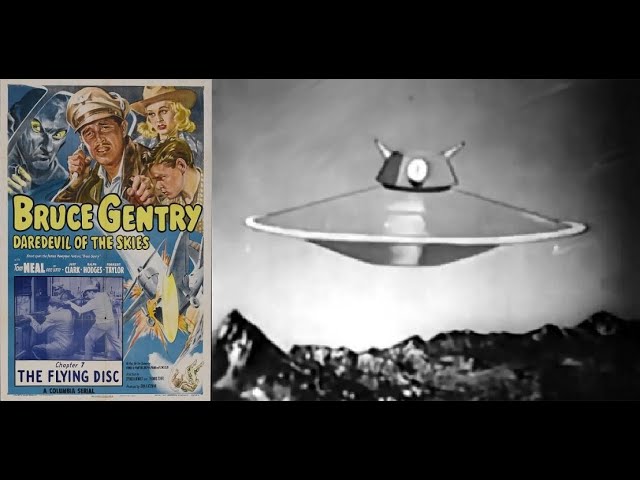
BRUCE GENTRY (1949)


PHENOMENALITY: *marvelous*
MYTHICITY: *fair*
FRYEAN MYTHOS: *adventure*
CAMPBELLIAN FUNCTION: *cosmological, sociological*


BRUCE GENTRY's is said to be the first American film to exploit the image of the flying saucer, which term became common parlance in the United States thanks to a highly publicized UFO sighting in 1947. But though one or two previous serials of the forties had included alien plotters, here the saucers are known to be created by a secret cabal in the U.S, believed to be working for a "foreign power." This means that the saucers-- which can cause planes to malfunction and fall from the sky, or can destroy things by ramming into them-- are the same kind of super-weapons over which serial heroes and villains had contended since the silent era. GENTRY's producer Sam Katzman even worked on such a super-weapon struggle in 1937's BLAKE OF SCOTLAND YARD. The great advantage of super-weapons for the serial format was that, even when the combatants weren't fighting over the weapon itself, they could spend time fighting over some resource needed to power the weapon-- and a lot of this sort of thing happens in GENTRY.

The serial was based on a 1945 comic strip about a troubleshooting aviator, done in the Milton Caniff style and published two years before Caniff himself unleashed his better known feature about a heroic pilot, STEVE CANYON. My impression is that the original strip, like CANYON, included some exotic adventure but no actual metaphenomenal elements. Since the GENTRY strip was not especially popular in its day, Columbia probably acquired the rights at minimal expense. Yet GENTRY the serial spends a lot more time on varied locations than Columbia's 1947 JACK ARMSTRONG, so maybe directors Spencer G. Bennett and Thomas Carr were given a little more money to work with.

The hero (Tom Neal, who did the heavy lifting in the serial JUNGLE GIRL) is chartered to take a government agent on a flight, but first has to rescue the agent from two assailants. During the flight, a mysterious disc draws near Bruce's plane and gives off heat waves that immobilize the plane's controls. Nevertheless, the skilled pilot lands the plane without harm to himself or his passenger. One might expect that the agent would then enlist Bruce against the plotters controlling the discs, but the agent simply disappears from the story. Instead, the head of a private company, name of Radcliffe, hires Bruce to investigate the discs. Radcliffe suspects that the saucers are powered by the rare element "platonium," and there's only one known source for the element. 

But just so Bruce isn't constantly fighting with bad guys over a rare element, the plotters also kidnap a famed scientist, Doctor Benson, to help them with their project. It's through Benson's eyes that viewers meet the men who operate the flying discs, though the leader, known as "The Recorder," only speaks to his men and his prisoner through the vehicle of tape recordings. (Not the most inspired choice; what if someone asks the evildoer a pertinent question?) To change things up, sometimes Benson sends the Recorder's thugs to retrieve items he needs from his laboratory, and that too eventuates fights between the thugs, the hero, and the hero's allies.

Though Bruce is a loner, he quickly befriends a pair of siblings who manage a ranch near the only known source of platonium, and thus is almost certainly the disc-makers' source of the element. Of this brother and sister duo, Frank proves an able fighting ally to Bruce. His sister Nita doesn't provide anything but a little spunky dialogue, but at least she doesn't just sit around making coffee for the guys. The villains are not very interesting characters, though the Number Two man is played by familiar serial-player Tristram Coffin, and unfortunately the revelation of the Record'r's true identity is lame beyond belief. The fight-scenes and cliffhangers are much better done than most of those in the Columbia chapterplays, though none are exceptional. Some serial-enthusiasts didn't like the cheap animation used for the flying discs, but I'd rather have a cheap effect than a super-weapon that remains conveniently offstage for the entire story.

The dialogue flows better than in most Columbia serials. I've mentioned some salty lines given to the Nita character, but there's a little more attention to individual character overall. In the opening chapter, Radcliffe's secretary Louise (unbilled) decides to bring Bruce to her employer by getting a couple of men to menace her so she can play damsel in distress for Bruce's benefit. This was a rather loopy plan, but at least it wasn't boring. Unfortunately Louise only appears a few more times in the serial, flirting with Bruce in the office but nothing more.

The oddest thing about the script is that various people are aware of Bruce's existence even though he's not famous for any great deeds that we know of, like, say, Flash Gordon. Louise seems to know his ladies' man reputation (though we see no evidence of it), a cop knows Bruce from his ID alone, and a newspaper headline addressing the flying discs proclaims that "Bruce Gentry is on the case" or words to that effect. Given that the comic strip wasn't all that well known in its day, maybe the writers were told to pump up the hero's reputation to enthrall audiences, even though viewers aren't told why he's so cool. But good locations, a strong performance by Tom Neal, and a few quirky moments put BRUCE GENTRY firmly in the range of the middle-range of quality serials.


PRINCESS WARRIOR (1989)


PHENOMENALITY: *marvelous*
MYTHICITY: *poor*
FRYEAN MYTHOS: *comedy*
CAMPBELLIAN FUNCTION: *sociological*


While PRINCESS WARRIOR is an unremarkable junk-film-- shot on limited locations with very limited funds, by people who never became well-known in the movie industry-- it does offer me the chance to talk about the criteria I use to designate an adventure-filled comedy from an adventure with comic elements.

I subscribe to the theory that comedy's appeal is that of "incongruity," as suggested by the philosopher Schopenhauer. Most of the time, comedies use either verbal wordplay or slapstick violence to engender a sense of an incongruous world. However, some stories with adventure-elements invoke the ludicrous just by the dominant look of the characters. Japan's gentleman-thief Lupin III oscillates between comic absurdities and straightforward daredevil action, but Lupin himself, with his angular body and monkey-like face, always evokes the ludicrous. Same thing with the DC comic book CAPTAIN CARROT, which hardly ever includes a real joke or a pratfall, but features a bunch of funny-animal superheroes fighting funny-animal villains.

And what's the dominant image of the kickass heroine of PRINCESS WARRIOR, who can clobber grown men with a few choice blows? Well, she spends most of the film clad in a wet T-shirt that reads "Better When Wet." From that image alone, I think her place in the annals of ludicrous cinema is secure. Of course, it also helps that her proper name is Ovule, which word means "an unfertilized ovum," while her main opponent, Curette, is named after a small knife used in biopsies. Oh, and other characters have names like Exzema, Bulemia, and Ricketsia.

The nub of the conflict between Ovule (Sharon Lee Jones) and Curette (Dana Fredsti) is played fairly straight, though, aside from the Ed Wood look of their alien homeworld. Ovule and Curette are sisters who stand to inherit the rulership of their planet when their ailing mother kicks the bucket. Since Curette is a cruel bitch whose every word sounds like she's auditioning for the part of Joan Crawford in a MOMMIE DEAREST revival, the current queen gives the much nicer Ovule the nod. I'm not sure if the Queen Mother passes away just then, but Curette, who has a gang of henchwomen, immediately decides that Ovule's got to die. Having no other recourse, Ovule uses a teleport device to hurl herself to another planet, which just happens to be 1989 Earth. Nothing daunted, Curette, Exzema and Bulemia use the same device to follow. The teleport-device must have been made by the same inventors as those that made the Terminator's time-portal, since the ladies all have to travel naked (which provides the film's only moments of live nude girls).

By the way, did I mention that the unnamed world is a matriarchy, in which all the residents seem to be hot young women? Even the Queen Mother, who's a little older, is a glamourpuss. Not till the film's end is it mentioned that there are men on the planet, but they're slaves of their feminine overlords.

Anyway, naked Ovule happens to manifest near a club holding a wet T-shirt contest, so the exiled princess snags a spare shirt and tries to take her leave. She gets pulled into the contest (which takes up a fair amount of time-- not complaining, though). Ovule clouts a grabby promoter and escapes. The club's deejay Bob takes a shine to the comely blonde and goes after her, eventually offering her a place to stay. For some reason Ovule won't consider Bob's offer, but she will flag down a passing automobile and appeal to an equally unknown (and not good looking) stranger for shelter. The latter guy tries to take Ovule to his place. Bob interferes and gets punched out, after which Ovule clobbers the clobberer. Did she have to see Bob play Galahad before trusting him? Maybe, since she does go with him.

Curette and her followers wind up at the club, and in the best Arnie S. fashion they beat up some locals and take their clothes. They learn from the promoter that Bob took Ovule to his place, and to save his own skin the sleaze guides the alien amazons to Bob's address. Curette thinks that Ovule and Bob are lovers and decides to torture Ovule mentally before killing her. In this lightweight flick's only gruesome moment, Curette orders a henchwoman to heat up a metal spoon, promising to stick it right in poor Bob's mouth. 

Up to this point, the film, while stupid, has at least been energetic. Bob is then saved when a couple of largely incompetent cops barge in and try to arrest everyone. Bob and Ovule escape, and the cops, instead of turning in their other prisoners to other cops, drive around with Curette and her minions in the back of the patrol car. I'd cut the filmmakers a tiny bit of slack here, though, because if Curette and company were taken to a precinct, that would be the end of the conflict. But there's no excuse for all the tedious chase-scenes that serve to pad the running time. Prior to the climax of the film, the only points of interest is that when Ovule explains her alien origins to Bob, he thinks she's nuts and tries to get her mental help, only to end up escaping with her again. At one point, the betrayed Ovule reveals her priorities re: good slave-keeping by uttering the deahtless line, "If I weren't so tired I would beat you." Nevertheless, all the fighting and running may have an effect on her adrenaline, since she finally makes love to her Galahad. At the conclusion the film ramps up its energy slightly when Ovule and Curette square off and have a fistfight in an abandoned warehouse. After the heroine wins, her allies from the homeworld send her a teleport-device, and she persuades Bob to be her co-ruler. Oh, and she promises to do away with slavery as soon as they get back, just to ensure a happy ending. 

As a last touch of not-funny comedy, the producers imitated a schtick from MST3K-- which had premiered three years previous-- in that at the very end of the credit sequence, a line of dialogue from the film is replayed.

Tuesday, March 14, 2023

DON DAREDEVIL RIDES AGAIN (1951)


PHENOMENALITY: *uncanny*
MYTHICITY: *poor*
FRYEAN MYTHOS: *adventure*
CAMPBELLIAN FUNCTION: *sociological*


As far as I know, DON DAREDEVIL is the first of two times that Republic Studios recycled footage from the 1944 ZORRO'S BLACK WHIP to cut costs on a new, equally western-themed serial. This was made possible by the writers devising a new hero with a costume very similar to that of an earlier one, so that clips from the earlier work could be repurposed. I made a comparison between the 1944 WHIP and the second clip-show serial, 1954's MAN WITH THE STEEL WHIP here. At the time I wrote that dual review, I was amused that sometimes I could see the male hero being "played" by a female stunt double for the heroine of ZORRO'S BLACK WHIP. DON DAREDEVIL came three years before STEEL WHIP, and on the whole the 1951 serial looks better, with less use of clips that make the male hero look as if the size of his body changes. 

Unfortunately, all the plot-elements of this 12-episode chapterplay suffer more "recycling" than any visual elements. In BLACK WHIP, the heroine took the place of her brother, the first Black Whip, who was slain by the outlaws whom the young woman then pursues. In the 1951 serial, the first Don Daredevil was a costumed vigilante who overcame some unspecified outlaws, but he's been deceased for some time. In order to battle a new set of criminals,the "Daredevil" mantle is then taken up by the original's descendant, which mirrors the developments of 1937's ZORRO RIDES AGAIN-- which gives DON DAREDEVIL more of a likeness to the Zorro-movies than ZORRO'S BLACK WHIP, where the name Zorro only appears in the 1944 serial's title. Presumably the original "Don Daredevil" was an actual Spanish "don," since it's a major point that the unnamed town where all the action happens was founded by Caucasians from a Spanish land-grant.

Doug Stratton (familiar heavy Roy Barcroft), prosperous town-citizen, has the courts invalidate the land-grant. Thus all the settlers have dubious ownership of their property, which will make it easier for Stratton to buy up all the land cheap. To make certain the settlers sell, Stratton secretly commands a passel of outlaws with whom he terrorizes people. Stratton sets his sights upon the ranch once owned by the man who was Don Daredevil (though Stratton does not know this), where the late hero's grand-niece Patricia (Aline Towne) lives. Stratton is thwarted when Patricia's cousin Lee (Ken Curtis) rides up and shows off his law-degree by blocking Stratton's acquisition. The villain rides away, planning new villainies.

Lee, Patricia, and Patricia's ranch-hand Buck (Hank "GREEN ACRES" Patterson) are the only ones who know that the former owner of the ranch was Don Daredevil. As they reflect on the threat Stratton poses, Lee gets the bright idea of becoming the new Don Daredevil, and the other two immediately agree with him. Unlike Diego de la Vega, Lee gets into fights almost as often as his masked alter ego, and sometimes receives assistance from other locals in contending with the raiders.

For the next eleven chapters, nearly all of the fights, stunts and cliffhangers in DON DAREDEVIL whether original material or clips, are re-iterations of previous fights, stunts and cliffhangers from earlier Republic serials. One chapter even swipes a schtick from a prose Zorro tale, in which the masked hero is visibly wounded by the evildoers, causing the bad guys to see if the man they suspect of being Zorro's alter ego has an identical wound. This is the closest this make-work serial comes to suspense, and Lee gets out of the difficulty the usual way: someone else dons the costume and diverts the villains' suspicions. As it happens, Patricia takes up the costume very briefly to provide this diversion, though unlike the heroine in ZORRO'S BLACK WHIP Aline Towne's character gets no action-scenes.

Aside from the presence of Barcroft as the main villain, DON DAREDEVIL's main asset for modern viewers is that Ken Curtis, the actor essaying the non-clip exploits of the titular hero, is today best known for playing the scruffy "Festus Hagen" of GUNSMOKE fame.

THE WHIP HAND (1952)


PHENOMENALITY: *uncanny*
MYTHICITY: *poor*
FRYEAN MYTHOS: *adventure*
CAMPBELLIAN FUNCTION: *sociological*

One online review claims that this is "borderline SF" because it includes an effort to unleash germ warfare upon 1951 America, but to my mind this just means that WHIP is all about the "uncanny" version of SF, in which the strange devices seem at least theoretically possible.

Aside from the bacterial menace, everything else seems like a mundane thriller. Journalist Matt (Elliott Reed) goes to an unexplored area of Wisconsin for some recreational fishing. He suffers a minor injury and drives to the nearest town he can find. To his surprise, he's warned off a section of private property by a surly man with a gun, rather than a friendly Middle American. Matt finds a real town and seeks out a doctor named Keller, and while getting tended he also meets the doctor's pretty sister Janet (Carla Balenda). But while he's recuperating, Matt gets the sense that everyone in town is strangely hostile to him, particularly when they find out he's a reporter. After he asks too many questions, Matt finds himself introduced to the puppet masters behind the hostile town: a nest of Communist spies, led by mad Commie scientist Bucholtz (Otto Waldis). Fortunately, before Matt's captured by the spies, he sends a message that summons an armed force of men to the spies' HQ, and the Communists fail to unleash devastation on complacent America.

WHIP was directed by William (THINGS TO COME) Cameron Menzies, and he makes ample use of closeups to give the film a cramped, noirish feel, even though all of the characters remain simple stick-figure types. A couple of years later, Menzies would further distinguish himself with a better chronicle of paranoia, 1953's INVADERS FROM MARS (which also concludes in part with a cadre of soldiers invading an enemy stronghold). But WHIP was a flop and lost money for producer Howard Hughes.

The film is most famous for Hughes' tinkering with the movie's political underpinnings. WHIP was derived from a book in which leftover Nazis had infiltrated America (though not in Wisconsin), and apparently even Adolf Hitler himself was among them. Though Menzies shot the film with this Nazi menace in mind-- he even has a scene in which Bucholz is attacked by the men on whom he's run experiments-- Hughes insisted on re-shoots to establish that the spies were in fact Communists. Probably even a recrudescent Hitler would not have made much difference, for WHIP was a film with no "name" stars in 1951, though a few years later one player, Raymond Burr, would ascend to national prominence for essaying PERRY MASON. Though WHIP spends a lot of time on Reporter Matt and his relationship with Janet, the mystery centers upon the disclosure of the main puppet-master's identity, and so I tend to think that the villain, the source of the heinous plot, is the main star of the tale.


FROM HELL (2001)


PHENOMENALITY: *marvelous*
MYTHICITY: *fair*
FRYEAN MYTHOS: *drama*
CAMPBELLIAN FUNCTIONS: *sociological*


I concluded my review of the Moore-Campbell graphic novel by writing:

In keeping with its title, FROM HELL is a profoundly pessimistic novel, drenched in a Spengleresque mood of historical futility. Perhaps its most depressing—albeit bracing—aspect is even though no reader is likely to believe that Gull can escape hell through his techniques of derangement, Moore offers no light at the end of the tunnel for anyone else, either.   


Now, the 2001 adaptation of the graphic novel is depressing as well, but without offering any bracing vision of human limitations. The FROM HELL movie was the first cinematic adaptation of one of Moore's key works, and though I don't agree with Moore's past statements that his works should not be cinematically adapted, the idea of wedging this sprawling, rococo narrative into a two-hour theatrical release was not a good one. Even the Hughes Brothers, who co-directed the film, admitted the difficulty of the task in a DVD extra.

One of the co-directors mentioned that they and co-scripters Terry Hayes and Rafael Ygliesias had made the decision to shift the graphic novel's narrative focus from William Gull, a.k.a, "Jack the Ripper," to the inspector assigned to the Ripper case, Frederick Abberline. I would imagine that the producers thought that in contrast to the Ripper, Abberline could be reworked into a "Hollywood leading man" type of character, and indeed that's what FROM HELL gives us, with handsome 38-year-old Johnny Depp standing in for the portly Abberline of the graphic novel, who was of course strongly modeled on the real-life policeman. In addition, Hayes and Ygliesias meld the movie's Abberline with another Moore-Campbell character, problematic spiritualist Robert James Lees, who began as yet another real-life figure tangentially involved in the Ripper case. Whereas the graphic novel's Lees is not a credible psychic, Movie-Abberline has authentic visions stemming partly from his use of opium. This makes him the source of all marvelous phenomenality within the span of the 2001 movie.

Is it possible to do a good film about Jack the Ripper in which the focus is the detective stalking the killer? Both 1965's A STUDY IN TERROR  and 1979's MURDER BY DECREE show that the feat can be accomplished. But although the writers of these movies were not the equals of Arthur Conan Doyle, those scribes used Doyle's famous (but public-domain) sleuth to combat their respective versions of "Saucy Jack." Even derivative versions of Sherlock Holmes have a complex model from which to draw. But Hayes and Yglesias don't make Movie-Abberline a character sufficient to stand on his own merits, for this detective exists to satisfy plot points. He gets addicted to opium while mourning his deceased wife. He's horrified by the grisly murders of the Whitechapel prostitutes and selflessly vows to bring down the killer, even when it brings him into conflict with England's Royal Family. He falls in love, in a rather bloodless manner, with the prostitute Mary Kelly (Heather Graham), which provides moviegoers with a romance between two Hollywood icons. Depp does his best with this unrewarding conglomeration, but he can't make a silk purse from this porcine material.

The writers of FROM HELL are able to reproduce many of the mundane horrors seen in the graphic novel with respect to the suffering of the poverty-stricken ladies of the evening, who are almost as often menaced by their male customers as by roving gangs forcing the women to pay protection money. In such a world, the depredations of Jack the Ripper are just a logical extension of all the sins men commit against "the gentle sex." Yet Graham and her fellow actresses provide FROM HELL's strongest scenes when dealing with daily indignities. Much less effective is the thriller-plotline, in which they become targeted by the Ripper because of their knowledge of royal improprieties. The actual Ripper-murders are handled by the movie's writers and directors with even less creativity than one sees in a FRIDAY THE 13TH sequel.

Like the movie's version of the graphic novel's Abberline, FROM HELL's version of William Gull (Ian Holm)-- the deranged, occult-obsessed physician who becomes a "royal hitman" to silence the five prostitutes-- exists only to serve plot points. It was to be expected that Hayes and Ygelsias would never have been able to duplicate the extremely complex Freemason philosophy given to the Gull of Alan Moore (who was, to be sure, drawing on the theories of various Ripperologists). Yet though Hayes and Ygelsias have their Gull portentously announce that he "gave birth to the 20th century," they have no idea how to make the character assume even a modicum of personal motive for his obsessions with occultism and the murder of women. Had they given Gull a "Norman Bates" persona-- i.e., the psycho kills women because his mommy issues make him impotent with the female of the species-- even that old chestnut would be some kind of motive. It's as if the writers, knowing they couldn't equal Moore on that characterizational plane, just threw up their hands and gave Ian Holm a bunch of cobbled-together high-falutin' lines and left him to do what he could with them.

I only grant this film a fair rating of sociological mythicity because the writers and directors did grapple somewhat the evils endured by the London underclass. However, a lot of Ripper-adaptations trade in the same wares, and FROM HELL is distinguished only by the amount of studio money thrown at this endeavor.


Monday, March 13, 2023

FUTURE KICK (1991)


PHENOMENALITY: *marvelous*
MYTHICITY: *poor*
FRYEAN MYTHOS: *adventure*
CAMPBELLIAN FUNCTION: *cosmological*


My fuzzy memories of this Roger Corman production didn't bode well for the re-viewing, but my main motivation wasn't entertainment. I decided that in the near future I ought to view one of the movies featuring kickboxing-champ-turned-actor Don "The Dragon" Wilson in order to represent him on THE GRAND SUPERHERO OPERA. Given that motive, I decided I might as well review Wilson's first "superhero-adjacent" movie.

In contrast to the majority of martial-arts prodigies who have taken a shot at acting, Wilson showed a natural charisma early on, when Corman featured him in two made-in-the-Philippines martial arts films, BLOODFIST and BLOODFIST II. Presumably Corman or someone in his organization was impressed enough by box-office returns to fast-track Wilson into a cheapjack SF-adventure, co-written by Catherine (BLOODFIST II) Cyran and the FUTURE KICK director Damian Klaus (his only movie credit to date).

The setting is a future-Earth in which the wealthiest people have committed the ultimate upper-class flight, emigrating to a moon colony. The script doesn't say why this move causes the rest of the world to fall apart, so that Earth consists mostly of titty bars, street-gangs and criminal businesses, one of which deals in illegally obtained body parts. But specifics aside, KICK is an obvious retread of every SF-tale involving "haves" and "have nots" since METROPOLIS.

Wilson plays Walker, a "Cyberon" (cyborg) who was originally designed to fight crime. However, in film-time Walker's the last of his kind, for the organization that created the Cyberons found them threatening, possibly because the cyborgs were a little too law-abiding to overlook corporate perfidy. Walker alone escaped destruction, and though there's the implication that his former masters would like him killed as well, this never becomes important to the story. Though there's no reflecting on Walker's day to day existence-- it's not even clear if he needs to eat-- he maintains his existence as a bounty hunter because that gets him involved in the principal conflict.

It's a pretty muddy conflict, though. On the moon a VR scientist named Howard, married to wife Nancy (Meg Foster), takes a shuttle to Earth to consult with his employers (who DIDN'T emigrate to the moon, I guess). He contacts bounty hunter Walker for some reason, but then Howard gets randomly killed by a thug who harvests organs for "New Body." (If this were an intelligent movie, some comment might've been made about the poor feeding on the rich for once.) When Nancy doesn't hear from her husband for a while, she comes to Earth to investigate. Facing indifference from overworked cops, she finds Walker and hires him to avenge her husband.

All of these badly edited scenarios exist just to set up kickboxing scenes between Walker and various gang-bangers, a martial artist played by Chris Penn, and the organ-stealer. The fights are watchable but aren't even the best from the oeuvre of Don Wilson, and there's no attempt to generate chemistry between Wilson and Meg Foster. There's a final "trick ending" suggesting that maybe the whole exploit was the creation of VR tech, though this too is sloppily delivered, so that it's confusing instead of arresting.

If FUTURE KICK was a bag of popcorn, it would be one where all the kernels either got burned or failed to pop. The only glimmer of quality appears when the taciturn Walker gets a little talkative with Nancy, reflecting on how the other Cyberons were his only family. Wilson puts some feeling into these lines, and his ability to convey simple but strong emotions may have more to do with his long B-movie career than his kickboxing skills.