Wednesday, June 7, 2023

DEATH RING (1992)


PHENOMENALITY: *uncanny*
MYTHICITY: *fair*
FRYEAN MYTHOS: *adventure*
CAMPBELLIAN FUNCTION: *sociological*

DEATH RING-- which by some indications might have been a DTV film-- appeared the year before John Woo's own take on THE MOST DANGEROUS GAME. However, RING's approach is so different from that of HARD TARGET that, whatever the earlier film's failings, it wasn't meant as a mockbuster. Given that RING places its human-hunting activities on a remote island under the control of a madman, it's more likely that the people behind it were simply doing another take on the original GAME story, or on the 1932 adaptation.

As for the creative personnel, I'd speculate that star Mike Norris, billed only as co-writer, was probably the mover and shaker behind the film, given that Norris' co-writer shows no other IMDB credits and the director's only earlier credit in that capacity was a co-directing credit on Donald Jackson's HELL COMES TO FROGTOWN. I don't think Norris himself had any great cachet before or after this movie, but he was almost certainly being sold as a successor to his famous father Chuck.

Former Green Beret Matt Collins (Norris) left the army because he wanted to fight in the field and the brass assigned him to be an instructor. Now he mopes around with his wealthy girlfriend Lauren (Isabelle Glasser), hanging out with his copter-pilot buddy "Skylord" (Chad McQueen, another son of a celebrated actor-dad) and seeking martial validation through survivalist trials. Then Matt and Lauren are kidnapped and transported to a remote island ruled over by sadistic millionaire Danton Vachs (Billy Drago), because Vachs plans to have Matt hunted by a team of wealthy guys who have paid for this privilege before. Drago and his aide-de-camp Ms. Ling (Elizabeth Fong Sung) hold Lauren captive to ensure Matt's cooperation with the competition for the Death Ring.

That's right; "for," not "in." Despite the many action-films that used "ring" to suggest a space in which combat would take place, Vachs not only promises Matt and Lauren freedom if Matt survives, they can also claim the ornate "death ring" from Vachs' hand.

The best thing about this derivative flick are its "comic book" aspects. In contrast to other human-hunting films, the script for RING goes out of its way to make all the hunters slightly weird types-- an Apache Indian, a Chinese gangster, a guy known only as "Iceman," and an American lawyer with a passion for both hunting and Taoist philosophy. Vachs himself hopes that Matt will beat all the men hunting him, so that he'll provide Vachs with a challenge. Like Count Zaroff in the GAME template, Vachs and Ling have a perverse fascination with death. The hunters are fitted with radio transmitters when they're out on the prowl, and at one point, when the two masterminds think a hunter has managed to kill Matt, the villains make out. 

Vachs is one of actor Drago's best silky-voiced villains, which is good because Mike Collins is as dull as dirt, both in terms of the script and in terms of Norris' performance. He also has only basic movie-fighting skills, in contrast to the showmanship of Daddy Chuck, though a couple of the battles with the hunters are better than average. But even the small attempt to give Mike characterization in the opening scenes falls by the wayside. Lauren has a nothing role, but Fong Sung does have a couple of scenes attacking Matt, and she shows some good basic moves. The copter-pal ends up coming to the rescue.

Despite how boring Norris is, I like DEATH RING for its exotic villains, which help usher the film into the uncanny domain.


HARD TARGET 2 (2016)


PHENOMENALITY: *naturalistic*
MYTHICITY: *poor*
FRYEAN MYTHOS: *adventure*
CAMPBELLIAN FUNCTION: *sociological*


This very belated (25 years!) sequel-in-name-only to 1993's HARD TARGET is an efficient if unremarkable action-opus built on the chopsocky skills of star Scott Adkins as the titular target. But my main interest in it is that its execution is one more demonstration of my trope-theory. 

Prior to this review, I've bracketed two other "hunting humans" films for comparison in order to show that this "bizarre crime" trope, like others in my other categories, can always have "naturalistic" as well as "uncanny" permutations. The distinction between each phenomenality-domain always depends on the absence or presence of narrative motifs that suggest an essential "strangeness" about the events depicted. 

The 1993 Van Damme film takes the concept of the DANGEROUS GAME short story, in which a madman hunts human beings for sport, and turns the practice into a business run by sane but ruthless mercenaries, who offer rich assholes the chance to hunt impoverished homeless people in big cities. The motif of the Promethean madman is gone, but in its place is the idea of transporting a perilous criminal activity to the streets of big cities, where the possibility of exposure is extremely high.

TARGET 2 duplicates the business practices of the first film in that villain Aldrich (Rob Knepper) also organizes hunts of human beings for the entertainment of rich assholes. However, Aldrich centers his operations in the wilds of Myanmar, paying off officials to look the other way while he preys upon poor locals. This is an atypical crime, but given the location the viewer is not as likely to be incredulous that something like this could happen, so there's nothing uncanny about it.

New hero Wes Baylor (Adkins) ends up appearing virtually on Aldrich's doorstep. Baylor, a MMA fighter, accidentally kills a fellow fighter in a tournament, and becomes so distraught that he gives up on life, traveling to Thailand and eking out a living in underground cage fights. Aldrich invites Baylor to Myanmar with the lure of a new fight, and when Adkins arrives, he learns that he's expected to run for his life from armed thrill-seekers.

Aldrich is a flat villain, though ably portrayed by Knepper, whom I knew only from a very different role in 1987's WILD THING, and the rest of his accomplices are no better, with one exception: Sofia (Rhona Mitra). She not only gets one of the most extensive fight-scenes with her quarry-- probably because the actress had established herself for her fake-fighting skills in movies like 2008's DOOMSDAY-- she even has a minor psychological motivation, in that she's hunting men because her despised father was a hunter. Not that motivation is very important in an American chopsocky, but one should acknowledge even small extra touches.

But action sells TARGET 2, and as I said, Adkins delivers on the fight-scenes, and his character gets some romantic support when he succors local native Tha (Ann Truong), whose brother escaped the last hunt. Tha gets a little action of her own, knife-killing a hunter who attempts to rape her, and later managing to kill Sofia, largely by dumb luck more than superior fighting-skill. There's another small arc with one of the hunters being a web-game designer seeking to use the experience for a "first-person shooter" game, but this comes to nothing special, any more than Baylor's predictable redemption.

If a viewer is not interested in sussing out the phenomenality of action flicks, one could probably get the best out of TARGET 2 by fast-forwarding through any scenes that don't involve either Adkins or Mitra fighting.

Monday, June 5, 2023

HARD TARGET (1993)


PHENOMENALITY: *uncanny*
MYTHICITY: *fair*
FRYEAN MYTHOS: *adventure*
CAMPBELLIAN FUNCTION: *sociological*


This Jean-Claude Van Damme vehicle was the first American effort by celebrated director John Woo, who had gained international fame for his Hong Kong-made action movies, whose operatic qualities earned them their own subgeneric name, that of "heroic bloodshed." But TARGET lacks any of those outstanding qualities, like the rest of Woo's American output from 1993 to 2008, after which time he returned to Asian shores. My general sense is that the failing was one of cultural dislocation; Woo was just someone so invested in the dynamics of his birth-culture that he wasn't able to adapt to American culture, particularly not with such simple fare as a modernized take on THE MOST DANGEROUS GAME chestnut. (Sidenote: such cultural adjustment is possible, as seen in the way former HK director Ronny Yu excelled with such genre products as BRIDE OF CHUCKY and FREDDY VS. JASON.)

Whereas the original short story concerned a human-hunting madman on a remote island, here we have a group of murderous thrill-seekers whose covert influence is spread throughout many nations. For a great deal of money, a mercenary named Fouchon (Lance Henriksen) and his nasty lieutenant Van Cleef (Arnold Vosloo) will engage homeless people to voluntarily gamble with their lives, trying to elude one or more armed hunters, on the promise of a big payoff if the hunted men can escape death long enough. The newest victim of this perverse game is a homeless man named Binder (played by Chuck Pfarrer, the sole credited writer of TARGET, as well as a former Navy Seal). 

Unfortunately for Fouchon and Van Cleef, Binder had a daughter, one Natasha (Yancy Butler), who investigates her father's problematic death. By chance she meets a man named Chance (Van Damme) who has formidable fighting-skills, and Natasha gets him to act as her bodyguard as she begins her investigation. Since Chance is a Cajun guy who knows well the ins and outs of New Orleans, he's soon on the trail of the man-hunting killers. Despite a few run-ins with the police, the Big Easy soon becomes a battleground, with Chance's kung-fu kicks and Cajun craftiness taking on the heavy firepower of Fouchon and his henchmen.

The sole metaphenomal aspect of TARGET is the uncanny practice of hunting humans as an organized sport; everything else is a fairly standard action-opus, with barely any characterization for Chance, Natasha or any of their allies, though the actors perform their roles credibly. Henriksen and Vosloo make an admirable team in that both are such smooth operators that they believe themselves above the law, as long as they only prey on those on the margins of society. Of course the action set-pieces are the real stars, but though they were intense enough to make TARGET a box-office winner, I can't say any particular scene resonated with me. In fact, SURVIVING THE GAME, issued the year after TARGET premiered, struck me as possessing the ideal sociological myths necessary to update THE MOST DANGEROUS GAME.

RAMPAGE (2018)


PHENOMENALITY: *marvelous*
MYTHICITY: *fair*
FRYEAN MYTHOS: *adventure*
CAMPBELLIAN FUNCTIONS: *cosmological*

I didn't have much to say about this 2018 Dwayne Johnson popcorn flick. I didn't know until reading up on it that it was an adaptation of an arcade game, which of course I have not seen, but whatever the source it just looks like a big-budget version of the many "colossal critter" films that litter the streaming services. 

Most colossal critters are spawned by hubris-filled experiments by either governmental entities or by private corporations. One interesting wrinkle here: though most space-oriented lab foulups have been linked to the government, the behemoths of RAMPAGE come about because a gene-splicing company conducts experiments aboard a private space station. This must be some sort of response to recent increased corporate presence in Earth's atmosphere. 

So a mutated rat tears up the private station of a gene-modification company and several cannisters of this animal-mutating "ooze" fall to Earth and begin turning regular critters into kaiju, such as a giant crocodile and giant wolf (neither of which, sadly, get kaiju-style cognomens). The third victim of the genetic pathogen in a gorilla named George, who will end up being something of a cross between King Kong and Mighty Joe Young. Prior to his infection George dwells at a San Diego wildlife sanctuary, supervised by his human buddy Davis Okoye (Johnson). Okoye being an environmentally sensitive tree-hugger, he's well and truly pissed when his ape-buddy (who can communicate through sign language) turns into a monster and gets sequestered by the U.S. government.

All three city-smashing monsters are brought together in Chicago, thanks to the CEOs of the gene-mutation company, Claire Wyden (Malin Akerman) and her brother Brett (Jake Lacy). They hope to harvest the pathogen from one of the monsters in order to sell it on the tech market. Okoye, accompanied by hot scientist Kate Caldwell (Naomie Harris), do their best to prevent the villains' triumph and to save the normally good-natured gorilla. In the midst of all the spectacle there's a paltry subplot about how Okoye doesn't get along as well with his fellow humans as with animals. 

The film was a modest success but I found it a little too predictable to register on the fun-meter, while I only give it fair mythicity because of all the various cosmological details about the animal kingdom. It did occur to me to wonder how much longer Johnson can successfully mine his "big cuddly muscleman" routine, though. Since his starring debut in 2002's SCORPION KING, Johnson seems as if he looked around at Arnold Schwarzenegger's success with his more comical, less hardcore roles and thus decided to go that route all the way. Not that many successful actors don't pick a popular film-persona and keep coming back to it, but Schwarzengger for one was able to vary his act more than Johnson ever has. 

Oh, yeah, and since George survives (not really worth a "spoiler," is it?) there's talk of a RAMPAGE sequel. I won't hold my breath waiting.


Sunday, June 4, 2023

RED SONJA (1985)


PHENOMENALITY: *marvelous*
MYTHICITY: *fair*
FRYEAN MYTHOS: *adventure*
CAMPBELLIAN FUNCTIONS: *psychological*


When I originally saw RED SONJA in a theater, I thought it one of the worst films of the sword-and-sorcery genre, given how ham-handedly the film dealt with Marvel's REH-derived "Red Sonja" character. Now that I've seen many more inferior films in that genre, though, SONJA just seems like a mild mediocrity with some good potential gender-play that went undeveloped.

In the comic book, Red Sonja's origin is purely male-phobic. In her youth Sonja lives a peaceful life with her family until a troop of mercenaries raid her dwelling, killing her family while the leader rapes Sonja. A mysterious goddess then appears to the brutalized woman, bestowing upon the girl superior strength and skill if she'll swear not to lay with any man "unless he has defeated you in fair combat." No reason for this requirement is given, and in the main it's simply a more mythic elaboration of a vow Sonja mentions in her two introductory tales in the CONAN THE BARBARIAN comic.

In contrast to today's politically correct culture, though, in the 1980s it was still conceivable to have a gay/lesbian character be evil, without that character being necessarily perceived as a representative of that sexual persuasion. The script by Clive Exton and George MacDonald Fraser keeps the broad outlines of the comic-book origin, but this time the bucolic Sonja (Brigitte Nielsen) is propositioned by an evil lesbian noblewoman, Queen Gedren (Sandahl Bergman). Not only does Sonja refuse the queen with "disgust," she gives Gedren a facial scar. The evil ruler retaliates by killing all of Sonja's family and letting her soldiers take turns with Sonja. Then she leaves Sonja for dead. Afterwards, a mysterious goddess again gives the girl martial prowess in order to accomplish her vengeance, but does NOT ask her to restrict herself from having sex with anyone but a man who can conquer her in fair fight.

Sonja then apparently goes off to a warrior-dojo to hone her swordplay for some years, which is the first time she references her general antipathy toward men. Unlike the comics-version, this Sonja still has a surviving sister, Varna. As it happens Varna is one of several priestesses in a temple dedicated to a talisman of power given to humankind by the gods. At this point in time, Varna's sisters plan to destroy the talisman because it's become dangerous. They're only waiting for Prince Kalidor (Arnold Schwarzengger) to arrive to oversee the operation-- though he can't very well be involved in the business, since only women can touch the glowing spherical talisman without being disintegrated. Queen Gedren and her warriors invade the temple, kill all the priestesses (except Varna, who escapes) and bear away the talisman.

Kalidor, en route to the temple, comes across Varna, but she's been fatally wounded. She directs the prince to find Sonja at the warrior-temple and bring her back. Kalidor does so, and once Varna has imparted to Sonja the bad news of the talisman's theft, Varna kicks off. Sonja duly thanks Kalidor but refuses any help from him in wreaking vengeance. The faux-Conan of course follows Sonja at a distance and they do end up teaming up, but he's motivated in part by the desire to seal away the talisman, not just a yen for Sonja's loins. It's during one of their exchanges that Sonja claims she took a vow not to lay with a man who couldn't conquer her, with the broad implication that this was her own decision, not an injunction from a deity.

While this is going on Gedren tries to conquer a rival city with the power of the talisman, and she ends up razing it to the ground, so that there isn't a lot of booty to be had there. In the wake of this death and destruction come the film's two comedy relief characters, the arrogant child-prince of the city Tarn (Ernie Reyes Jr) and his bulky bodyguard Falkon (Paul Snith). While I can admire the idea of Sonja and Kalidor being joined by two direct victims of Gedren's evil, neither character is funny or endearing. I suppose the writers thought it would be interesting to force male-phobic Sonja into a position where she had to be a punishing "mother" to a bratty kid, but whenever Tarn or Falkon are on screen, they drag the film to a crawl.

Not that the script would have been much better without them. After the initial setup Exton and Fraser merely put Sonja and her allies through a series of dull S&S exploits until they reach Gedren's hideaway. The only incident worth recording is that after Sonja tells Kalidor of her vow, he challenges her to a duel. The duel is adequate but nothing special, but if it had been handled better by director Richard Fleischer and his crew, the denouement-- in which Sonja and Kalidor fight to a draw, panting in post-coital exhaustion-- could have been the best part of the movie. As things are, the extended sword-duel between Sonja and Gedren is the film's best set-piece, though it's broken up by side-actions for Kalidor, Tarn and Falkon.

SONJA has a cheap look and Fleischer gives everything a bland direction that calls attention to the cheapness. The monotonous musical score is, amazingly, by the virtuoso Ennio Morricone, which only means that even great creators can have off days. In addition to the debits of the Tarn and Falkon duo, Kalidor is a flat good-guy and Schwarzenegger understandably does not seem engaged at all. In addition, he and Nielsen have no chemistry, though at least their sword-duels are somewhat credible because she's almost as tall as he is. 

Sadly, though Nielsen became a decent actress later on, she wasn't skilled enough to embody even the rather muddled Red Sonja character seen here. Whether she's vengeful or sexually titillated, Nielsen just looks dead serious all the time. Her sword-work is decent but it's hard to tell if she could have done better with superior fight coordinators. Sandahl Bergman is the only performer who really sinks her teeth in her role as a narcissistic crazy woman, as obsessed with unleashing destructive female power on the world as Sonja is with assimilating the male disciplines of the sword. (Also, Gedren spares Sonja a couple of times because the queen is still fixated on conquering Sonja sexually, though this is only implied in dialogue.) Still, going by Bergman's spirited performance as the warrior-thief Valeria in 1982's CONAN  THE BARBARIAN, SONJA would have been a much more enjoyable flick if Bergman and Nielsen had switched roles.

RETURN OF THE LEG FIGHTER (1976)


PHENOMENALITY: *marvelous*
MYTHICITY: *poor*
FRYEAN MYTHOS: *adventure*
CAMPBELLIAN FUNCTIONS: *sociological*

I don't think, as per the American title, that "leg fighter" Shan (Dorian Tan) actually returns from anywhere, and the original Taiwanese title doesn't even use any of the same words. What we do get is one of the many attempts to merge the kung-fu revenge drama with a detective tale.

The viewer gets to see the inciting murder of Shan's father and brother by a mysterious swordsman garbed in black robes and a black hood. Once Shan learns of the murder, he drops whatever he's doing-- actually, there's no indication that he has any existence beyond being related to the murdered duo--and he begins making the rounds of local kung-fu clans to track down the man known as "The Devil Swordsman."

He has a brief encounter with a character played by the celebrated Lo Lieh, who promptly disappears, but makes somewhat better allies in Ti Lung and Doris Lung, though he does have to fight Doris over the usual misunderstanding. Shan learns that years ago, a masked Devil Swordsman with a formidable (maybe magical) sword was conquered by a coterie of fighters from various clans. However, the masked man's body disappeared, so it's not certain that he perished.

While Shan investigates, he witnesses a couple of poison dart attacks, and he interviews a famous assassin, The Poison Scholar, but the assassin is slain without revealing any new clues. Nevertheless, eventually Shan and his allies uncover the villain, who I believe was impersonating the original Swordsman and pretending to be a cripple confined to a sedan.

Most of the metaphenomena are uncanny, such as the various poison darts and other weapons, such as knives that Doris's character can toss around like boomerangs. However, even if the villain's sword didn't suggest some vague magical power, the scene in which he somehow levitates his whole sedan several feet in the air indicates some serious marvelous mojo. Overall, LEG FIGHTER's major asset is half a dozen fight-scenes in which Doris Lung Chung-erh shows off her skills.


Wednesday, May 31, 2023

ZODIAC FIGHTERS (1978)


PHENOMENALITY: *marvelous*
MYTHICITY: *poor*
FRYEAN MYTHOS: *comedy*
CAMPBELLIAN FUNCTIONS: *metaphysical*

Funny how quickly one's priorities can change. I was all set to bomb this obscure old Polly Shang Kuan fantasy as being one of the worst chopsockies I'd ever seen. Then I saw DARK LADY OF KUNG FU, and FIGHTERS started looking at least a little better.

It's still not even decent formula, and the few positive online reviews seem focused on the film's "so bad it's good" qualities. I found FIGHTERS far too repetitive to tickle my funny bone, though.

So a poor woman (Kuan), whose name (according to one source) is East Sea Dragon, is called upon by Princess Heartbreak to take on the evildoer Tiger Shark (Lo Lieh, only seen in the final minutes of the flick) and his servants, the Five Elements. Heartbreak shows Dragon a cave, claiming that it used to be the repository of twelve scrolls which held the power of the Twelve Zodiac Animals. But eleven kung-fu practitioners found their way into the cave and transferred the zodiac-powers  to themselves. Now there's just one zodiac scroll, and Heartbreak talks Dragon into taking on that power, which just happens to be the power of the Zodiac Dragon. That means Dragon now wields authority over all the other animal-fighters, but she has to find them first.

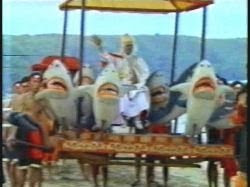
What follows is loads and loads of silly shit in which actors cavort about dressed in cheap animal-costumes-- rabbits, pigs, dogs, etc. After a lot of slapstick routines, Dragon finally assembles her warriors on a beach to battle Tiger Shark. He's a little bit cool, since he not only has henchmen with lobster-claws, but also a palanquin that can shoot sharks at his enemies. Alternately, the sharks can also shoot bear-traps from their mouths. This is the sort of inspired lunacy that would have upgraded the film to the wackiness level of, say, Kuan's FIGHT FOR SURVIVAL. Kuan doesn't have any decent battles, so FIGHTERS is not much more than a blip in her kung-fu diva career.