Showing posts with label superlative skills (n). Show all posts

Thursday, September 17, 2026

TYRANT OF LYDIA AGAINST THE SON OF HERCULES (1963)


PHENOMENALITY: *naturalistic* 
MYTHICITY: *poor*
FRYEAN MYTHOS: *adventure*
CAMPBELLIAN FUNCTION: *sociological*

TYRANT OF LYDIA, a TV-title, was actually the third peplum-film centered upon a hero named "Goliath," though none of the films were related to one another. But while it's true that there's no Hercules, or any son thereof, in this mundane historical flick, the Italian title isn't much better. First, not all markets kept the name "Goliath," since some christened Gordon Scott's hero with the name "Gordian," as in "the Gordian knot" solved by Alexander in a famous story. Second, it's not clear who "the rebel slave" is. One or two reviews thought it was female lead Princess Cori (Ombretta Colli). However, as her name indicates Cori is royalty, and though she's sometimes treated as a bone over which two national "dogs" are fighting, there's only a small part of the movie during which Cori is captured and sold in a slave market-- none of which action is important to the main plot.

The aforementioned "dogs" are Greece and Persia, who are at odds under the respective commands of Alexander and Darius. Both nations impinge upon the smaller kingdom of Lydia, typically an ally to Greece. The heroic Lydian soldier Gordian favors Greece, but Lydia's tyrant king (Massimo Serato) and his queen Zoe (Gloria Milland) plan to hand over the kingdom to the Persians for profit.


The setup could have made for some decent political intrigue, but TYRANT is slackly written, with lots of talking-heads who don't say much of anything, with occasional bouts of action whenever Gordian gets into a fight for some reason. There are no metaphenomenal elements, and even Gordian seems just slightly stronger than average, despite all his associations with myth-figures. There's a slightly interesting bit of stunt-casting in that Gordian receives a little aid from a Black muscleman, played by Serge Nubret, a bodybuilding competitor of some note in the day. Ombrella Colli holds up her end by looking stunning all the time, but the villains don't do anything all that dastardly. Really, Milland's Zoe doesn't do anything more than listen to the evil king's plots, so it's a bit surprising near the end when she's gratuitously speared to death during a battle-scene. TYRANT is a pretty ordinary peplum in every way, and only worth seeing for completists.

Incidentally, my dubbed copy came with a German title, "Goliath vs Hercules," but if Gordian was Goliath, I have no idea who some marketer thought Hercules might have been.       

Monday, June 2, 2025

THE BEAUTIFUL SWORDSWOMAN (1969)


PHENOMENALITY: *naturalistic* 
MYTHICITY: *fair*
FRYEAN MYTHOS: *drama*
CAMPBELLIAN FUNCTION: *psychological* 

*SPOILERS SPOILERS SPOILERS*

Getting the phenomenality of the film out of the way, the only "superlative skill" evinced by the titular heroine is that after a killer hurls a knife at her and misses, she throws a big cup at him, and it hits his forehead so hard it embeds itself and draws blood. Not sure if the guy collapses just from pain or from being killed outright. But she never does anything that quasi-superhuman again, so the feat doesn't weigh much in the scales.

Yuan-yuan (Wang Ling) is the daughter of a rich man, credited on HKMDB only as "Father." She, her father, and her brother Ching Tong (like Yuan, about twenty-something) live in apparent serenity together. However, Yuan and her governess (Ching-Hsia Chiang) have a secret. They take lessons in swordplay from a mysterious, unnamed tutor, and when so ordered, they go out and kill particular targets. The subtitles weren't very clear as to why this rich girl and her governess pursue this course of action, and they don't even seem to question why the tutor wants the men dead. But Father knows the men killed, calling them Yuan's "uncles," though this may just be an honorific, not a statement of literal relatedness.              


The fights-- mostly swordplay, though with a little hand-to-hand action mixed in-- don't serve to do anything but fill time until the Big Reveal in the last thirty minutes. Then Yuan finds out that her tutor and the governess know a hidden truth about Yuan's life: the man who raised Yuan is an impostor who killed Yuan's real father and forced Yuan's mother to become his wife, and the mother of Ching Tong. (I think the subs suggested that the impostor might be the murdered man's brother, but that could be a flub.) The film then builds up to its Big Dramatic Moment: to fulfill the duties of filial piety, Yuan must avenge her real father's death by killing the man she's called "Father" for twenty years-- which is the main reason I give SWORDSWOMAN a "fair" rating. There's a climactic swordfight, but like other parts of the film it too is more about dramatic torment than invigorating adventure-- and the brother figures into the tragic conclusion as well.

Wang Ling and her fellow swordswoman probably weren't martially trained, but Wang has good dramatic intensity. It looks like she didn't do much else in the chopsocky genre except a support-role in ZATOICHI AND THE ONE ARMED SWORDSMAN. Unlike many kung-fu films, this one doesn't drown the viewer in a parade of marvels, but the characters are underwritten, and that undermines even the film's best scenes.              

Thursday, January 16, 2025

WAGON TRAIN: "THE WAGON TRAIN MUTINY" (1962)


PHENOMENALITY: *naturalistic*
MYTHICITY: *good*
FRYEAN MYTHOS: *drama*
CAMPBELLIAN FUNCTION: *psychological*                                                                                                                                               It could be safely argued that because the teleseries WAGON TRAIN endured for eight seasons, the show must have tapped some of the audience's beliefs about the Manifest Destiny of all the settlers who traveled west by wagon trains, thus ensuring that the United States became a country "from sea to shining sea." However, of all the episodes I've seen, most are a little too rationally thought-out to allow for the imaginative flights of high mythicity. "The Wagon Train Mutiny," the first episode of the sixth season, is a rare exception.                                                                                                
On the surface of the script, the main concern seems to be one of a challenge to the masculine powers guiding the wagon train. The main representative of this power is wagonmaster Chris Hale (John McIntire), who for once finds himself at odds with some of his subordinates. In the course of a particular overland voyage, Hale's scouts find the remnants of a settlement wiped out by Comanchero raiders. A little later, the scouts receive intel as to the presence of a Comanchero camp. Hale makes the command decision to attack the camp, even though some of his aides-- and a troublemaking passenger (Dan Duryea) -- argue that this action will simply bring the wrath of other Comancheros down upon the wagons. These challenges to Hale's command occupy much of the episode's running-time, but since Hale is a main protagonist, there's no serious doubt that his decision will be proven to be the correct one. Toward the episode's end, the cavalry even shows up to announce that Hale's decision to attack the camp made it possible for the soldiers to chase down the other bandits. Thus, the sacrifice of Leland (and some non-entities) is justified as serving the Greater Good-- a message that might have resonated with American audiences in the early years of American involvement in Vietnam.                                                                           

   The episode's mythic resonance, however, gathers around the figures of two passengers and one intruder to the wagon train. The scouts find out about the hostile camp because they come across a wounded young Mexican, Renaldo (Jose de Vega). Several members of the wagon train think that Renaldo is a Judas goat who's supposed to lead them into peril. Among them is widow Hannah Barber (Jane Wyman), who's traveling with her twenty-something son Leland (Peter Helm). Despite one of the other cowboy's remarks that the Comancheros are a mixture of whites, Indians and Mexicans, Hannah immediately believes the worst of Renaldo because he's Mexican. And yet, because she's a woman and therefore a nurturing presence, she does give assistance in caring for the wounded young man. Renaldo later tells a sympathetic male that he's been a slave of the Comancheros for years after they slew his family, and that he was wounded while escaping the bandits.                                                   

 Hannah's already been through some ordeal in which she lost her husband in some unspecified violent conflict, and therefore she's overly protective of her son. Leland, of course, yearns to prove himself a man and escape Hannah's apron strings, so he volunteers to join the force attacking the Comanchero camp. Before anyone knows the outcome of the attack, Hannah seems to psychically sense her son's demise-- which is my only reason for tagging this story with the naturalistic "superlative skills" trope-- and sure enough, when the attack-party returns to the train, Leland is one of three killed in the assault. The myth-question then becomes, "will this frontier incarnation of maternality become a bloody-handed avenger? Will she kill the helpless Renaldo, whom she equates with her son's killers, as payback for her son's sacrifice?" Hannah does venture to the edge of that chasm, for she does intend to play Medea to the orphaned youth. But in the end, her mythic identity as a mother takes over, and the story ends with the implication that she will put aside her prejudices and become some sort of adoptive parent to the rootless young man. Renaldo, I'll note, played by an actor with a handsome face, which reinforces my impression that it's always easier to do nice things for put-upon people when the latter just happen to be good-looking.
      

Sunday, May 19, 2024

LADY WHIRLWIND (1972), THE FURIOUS KILLER (1973)


PHENOMENALITY: *naturalistic*
MYTHICITY: *poor*
FRYEAN MYTHOS: *adventure*
CAMPBELLIAN FUNCTION: *psychological*


This double review started out as a single, after I viewed a streaming copy of an extremely obscure chopsocky, THE FURIOUS KILLER. But in the process of trying to think of something interesting to say about this bit of ephemera, I realized that it bore a broad similarity to an earlier martial arts flick I'd recently re-watched, Angela Mao's LADY WHIRLWIND. (The above lobby card was produced in the U.S. to take some improbable advantage of the contemporaneous adult film DEEP THROAT.) LADY WHIRLWIND and FURIOUS KILLER share a similar trope (if not a direct influence of the former upon the latter): a female martial artist seeks revenge upon a man, or men, who have wronged her, with a touch of conflict about whether her revenge is the correct path. 

WHIRLWIND begins with the backstory of a Mister Ling (Chang Yu), who meets his future wife after thugs beat him and leave him for dead. Ling recovers but nurses the idea of getting revenge on the local thugs. Miss Tien (Mao) comes to town just when Ling is being attacked by the gangsters, and she saves him. But Tien only does this because she wants to use her kung fu to beat Ling to death, rather than allowing anyone else to do so. She allows Ling to recover from his wounds at his house, explaining her motives to the man and his wife. It seems Ling jilted Tien's sister some time back, and the sister killed herself. Tien blames Ling for this occurrence, and swears to kill him when he's able to defend himself.

However, Tien's basic decency is revealed when Ling pleads that she allow him to gain revenge on the gangsters before she kills him. Tien agrees, and after a false start or two Ling learns a new form of kung fu to battle his enemies. However, he's not up to the task alone, and ironically Tien ends up fighting the thugs with Ling in order to keep Ling for her own vengeance. But as a result of her having helped Ling and his wife, Tien finally decides to forgive him and leave the man in peace.


WHIRLWIND was one of the many strong films in Mao's popular seventies cinematic run. But if IMDB is correct, FURIOUS KILLER is the last of almost forty movies for Hung Lee. I recognize none of the other titles on Hung's resume, so for all that I know, KILLER may be the actress's only kung-fu film, or at least the only one of which she was the star.

In contrast to WHIRLWIND's script, the villains of KILLER are almost all completely bad. The gangsters of Boss Shang kill an old man and his granddaughter for some reason, but Tong, the sister of the granddaughter, is away at the time. She trains in kung fu for years to take vengeance. When Tong is ready, she does what most such heroes do, starting not with the head guy, but with his lieutenants, so that she can work up to a climactic duel with the main villain.

Tong fingers Shang's henchmen with ridiculous ease, challenges them and their minions, and eventually defeats all comers, implicitly killing her main targets with her assaults. A minor supporting character tells Tong that she should practice forgiveness, but she doesn't appear to be affected. However, when she goes after a third henchman, he pleads that he's tried to abandon crime and live virtuously with his family since being complicit in the murders. Tong won't listen, so the two of them fight and Tong defeats him. But before she can take fatal vengeance, the guy's wife pleads for him. Tong agrees to forgive the guy, but continues pursuing Shang himself. Shang finds out that she spared one victim and kills the guy, for no clear reason.

After Tong wades through some of Shang's minions, the heroine and the master villain contend, oddly enough, in the vicinity of a cattle pen. This leads to the movie's one modestly original touch: that the villain ends up dying by cattle stampede. The only other indicator that Tong may have modified her desire for vengeance is a line she speaks before fighting Shang, telling him that he can live if he'll go to the police and confess his crimes. But patently KILLER's writer didn't have the strong sense of dramatic progression as the one who wrote WHIRLWIND.

As for the action elements, Mao was at the peak of her form in the early seventies, but she also had the unique ability to really "act out" her feelings of rage or frustration while fighting. Hung does not show this particular ability. She does deliver a whole lotta ass-kickings, but I had the impression that she was new to the practice of fake-fighting; that maybe she had trained with the stunt doubles for a week or two before cameras rolled. 

A final "thrust" re WHIRLWIND: I never saw it in a U.S. theater, but I very much liked the above lobby card. But probably no one who has seen the film will be surprised that neither Angela Mao nor any other female performer shows the slightest bit of cleavage in it, nor is there any sort of arcane "death blow" involved.

Sunday, May 28, 2023

REVENGE OF THE IRON-FIST MAIDEN (1972)


PHENOMENALITY: *naturalistic*
MYTHICITY: *poor*
FRYEAN MYTHOS: *adventure*
CAMPBELLIAN FUNCTION: *psychological*


Often I don't review purely isophenomenal kung-fu movies. However, this one does feature a minor kung-fu diva unknown to me, and that touches on my interest in femmes formidables. Also, this flick has zero external reviews on IMDB, and it's not a bad enough film to deserve that fate.

It is, however, a simple revenge film, even though the plot wanders all over the place. Mountain girl Chi (Chia Lin Sun) finds her father dying, and with his last breath he names his killer as a bandit named Yuan. After a brief confab with an old monk-- implied to have been the person who taught Chi kung fu-- the iron-fist maiden goes looking for Yuan. She finds a bunch of his goons in some town and fights them. I note in passing that the film's fight-director eschews the old chestnut where a gang of thugs considerately make individual attacks on a single opponent. Instead, Chi, despite giving a good account of herself, is quickly hit from behind while dispatching another opponent. However, another kung-fu fighter comes to her rescue and they escape the minions of Yuan. However, the two of them must not talk very long, because the film then starts to follow the male fighter Lu (Pin Chiang) for a while, letting Chi go off to do whatever.

As it happens, Lu is also a target of Boss Yuan, because he has half of a treasure map, and Yuan stole the other half from Chi's father. But nobody makes any attacks on Lu, although he picks up a female servant, Shao (Chin-Feng Wang) after defending her against a nasty fellow who apparently bought Shao from her parents. Lu doesn't want a servant, but Shao follows him to his home, and apparently ingratiates herself with him sexually. No sex scenes are shown, but later on Shao will reveal that Lu made her pregnant.

Shao also has a darker secret: she's the daughter of Boss Yuan, and he specifically sent her to enter Lu's service so that she could spy on him and find the map. Of course during that association Shao falls in love with Lu and doesn't want to betray him, earning her a slap or two from Dad before he finds out she's pregnant. (This is one of the few memorable drama-scenes in the flick, in that the fellow playing Yuan is almost comic in his consternation at learning his daughter is pregnant by his enemy.) There's a confusing scene in which a woman in a face-mask saves Lu from some of Yuan's thugs. Presumably it's Shao, since Chi isn't around at the time, but she never evinces martial skills anywhere else.

Lu goes into hiding, possibly to hone his kung fu skills, and though Yuan's men search for him and his treasure-map, they fail to find him for the next nine months, during which time Shao gives birth. Maybe Chi does a lot of training too, for the film's next big action-scene shows her being ambushed at some construction camp, she manages to hold her own much better against a gang of male bandits than she did in her previous solo fight. Again, she's overcome, but Lu pops up and they drive off the thugs. This paves the way for Lu and Chi to square off respectively with Yuan and with his Number Two minion. To the film's credit, the setting of the construction camp makes a nice change, as Lu and Yuan take their fight atop a jam of cut logs floating in a river. Shao shows up to show Lu what she just brought out of the oven, but she dies when she's caught in one of her father's attacks. The film ends with Lu, Chi, and the motherless infant giving the complete map to the Cantonese government, just because.

Though I like dazzling kung fu choreography as much as anyone, I give REVENGE an extra star for depicting most of the fights by showing the opponents relentlessly surging into one another's spaces-- that is, like real fights-- rather than staging things for greater visual effect. Chi does have one "superlative" feat, when she grabs Lu, tucks him under her arm and runs up a ladder to make their escape, but it's the only such deviation from reality, and I judge that it doesn't move the film into the uncanny domain.


Sunday, March 26, 2023

CHIMES AT MIDNIGHT (1965)


PHENOMENALITY: *naturalistic*
MYTHICITY: *superior*
FRYEAN MYTHOS: *drama*
CAMPBELLIAN FUNCTIONS: *psychological, sociological*


I've never been a fan of Orson Welles. An admirer, sure. I've enjoyed almost everything I've seen from his repertoire. But most of his films have a remote, imperial quality, so though I've liked many of his works, I haven't loved many of them, But I finally got a chance to see the film that Welles himself considered his best work-- and CHIMES AT MIDNIGHT more than justifies his estimation. It's also one of the greatest cinematic adaptations of a Shakespeare play, perhaps precisely because Welles, a genius of cinema as the Bard was for theater, freely adapted parts of "The Henriad" in order to produce Welles' highly personal take on the character of Falstaff.

By the time he made CHIMES, Welles had long been dogged by a reputation for producing expensive flops. One of the commentaries on the CHIMES DVD argued that Welles was essentially an independent filmmaker who was seduced by the aesthetic of Hollywood. But Welles was no Cassavetes; he clearly loved the spectacle possible only in big-budget movies. To get funding for his exploration of the relationship between the reprobate Falstaff and his symbolic son Prince Hal, Welles told a producer that he was going to film an adaptation of TREASURE ISLAND in Spain. This might be viewed as justifiable larceny, for while the world didn't particularly need another version of the Stevenson classic, Welles' unique reworking of Shakespeare probably had only one shot at getting made. 

The continuity of CHIMES derives from the middle two of the Henriad, which plays are titled for the reigning Henry IV, the ruler who succeeded Richard II by virtue of covert assassination. Despite the title, the central character is really Prince Hal, the roguish heir apparent to the throne. Hal knows that someday he must succeed his father, but he seeks escape from the severe demands of his king-father, and takes refuge in escapades of ribaldry with minor lord Falstaff, who becomes a surrogate father who allows him the license Henry IV will not. 

In keeping with history, the randy Hal of CHIMES (Keith Bailey) must transition into a proper king, one capable of defending the realm from insurrectionists, particularly a Welsh faction that hopes to replace Henry IV (John Gielgud) with the rightful heir to Richard II. Even though Henry IV's claim to the throne may be spurious, Hal must defend his real father, who places endless conditions on showing love for his son, as against Falstaff (Welles), the image of the over-permissive parent. The DVD included considerable commentary, based in Welles' own observations, that Hal's transition to royalty marks the end of "Merry Old England." I don't know if I would have picked up on this theme without said commentary, but there's definitely the sense that the ruler who accepts the burden of sovereignty must in some sense put himself outside the boundaries of ordinary humanity, even if that humanity is represented by lustful, cowardly reprobates like Falstaff.

The original play-cycle is dominantly naturalistic, though two of the "Henry" plays include a character based on the historical Owen Glendower, and Shakespeare briefly suggests that Glendower may be some sort of wizard. Welles does not include Glendower or any other figures with metaphenomenal associations, though. Unlike the playwright, the film director needed to focus upon the role played in Hal's evolution by the Battle of Shrewsbury. During that contest, Prince Hal contends with an opponent his own age, the renowned English knight Hotspur. Welles excels in depicting the rough-and-tumble nature of primitive armed conflict-- indeed, the battles in CHIMES are among the best of their kind in cinema, even though the director had only about seventy extras to stage the action. The simultaneous triumph of Hal over Hotspur, and the forces of Henry IV over those of his rivals, contribute materially to Hal's eventual decision to renounce the self-indulgent world of Falstaff-- though, prior to Henry IV's death, Hal allows Falstaff to take credit for the death of Hotspur.

The death of Henry IV leads to the great end scene in which the newly crowned Henry V forswears Falstaff publicly. As in the play, this leads to Falstaff's death of a broken heart, though Welles implies that on some level Falstaff understands the necessity of the new king's sacrifice, and he approves of the rejection, in a loving manner impossible for Hal's real father. Though Welles' acting in his own films is not always the equal of his direction-- I frankly didn't think much of his character in TOUCH OF EVIL-- here he outdoes himself in both departments. CHIMES failed to become a major success in Welles' time, but thanks to the DVD market, this masterpiece at last has the chance to shine as the cornerstone of the great director's work.

Sunday, November 27, 2022

TERROR OF ROME AGAINST THE SON OF HERCULES (1964), SAMSON AGAINST THE SHEIK (1961)


PHENOMENALITY: *naturalistic*
MYTHICITY: *poor*
FRYEAN MYTHOS: *adventure*
CAMPBELLIAN FUNCTION: *sociological*


As noted elsewhere, most of the films that were marketed as "Son of Hercules" flicks had nothing to do with the Hercules legend, though at least one, ULYSSES AGAINST THE SON OF HERCULES, really seems to be a straightforward teamup of the Lord of Ithaca with the Son of Zeus. The Italian title of this film, MACISTE GLADIATOR OF SPARTA, would suggest that it was originally a Maciste story given the "Hercules" association. However, there's nothing about the main character that resembles any version of Maciste I've seen. The hero, Poseidon of Sparta (Mark Forest) and he never seems supernormal in any way, despite having a small quantity of strongman-feats to his name. His standout accomplishment, that of out-wrestling a gorilla, verges on the uncanny. And yet, I never felt that he was really anything but a really strong guy, who happened to be a gladiator for imperial Rome.

The plot could be fairly called "Quo Vadis Lite." Poseidon's apparently had a dalliance with courtesan Livia (Elisabetta Fani) who's also the main squeeze of the current Emperor, whose name, if given, I have forgotten. To keep the Emperor from catching on, Livia is mostly confined to sending smoldering glances at the gladiator. This leaves Poseidon up for conquest by another woman, the beautiful but more vacuous Olympia (Marilu Tolo), who just happens to be one of the Christians being persecuted by Emperor Whoever. Inevitably, Poseidon has to choose to defend the Christians from their tormentors, and to forswear the "bad woman" for the "good woman."


Aside from the fight with the ape and the two comely actresses, the most terrifying thing about ROME is its banality.


The dubbed English movie SAMSON AGAINST THE SHEIK calls its hero Maciste in both the Italian title and in the English dub, but this alleged Maciste (played by Ed Fury) also seems like nothing more than a man of his time in 16th-century Spain. Since the opening mentions the expulsion of Muslims from Spain within the last century, the writers may have been thinking of the fall of the Emirate of Granada in the 1400s-- though aside from that initial setup, the film tries to be as ahistorical as possible.

Despite the expulsion of Muslims from Spain, armed conflicts continue to break out between the two groups. In one battle, the forces of a Spanish Duke invade a North African city and topple a religious icon there, a Sacred Obelisk. This irritates the ruler of the city, the "sheik" of the title-- though "sultan" might've been a better term than "sheik," since the latter term connotes a leader of nomadic Arabs. The Muslim potentate seeks revenge by invading the Duke's city in Spain and abducting his daughter Isabella (Gisella Arden) for inclusion in the sheik's harem. The Spaniards decide to send a covert rescue mission into the sheik's city, consisting of Maciste and an aide, one Antonio.

As with Poseidon in TERROR, Maciste's feats are impressive-- breaking various chains, lifting the huge Obelisk back into place-- and yet somehow, this version of Maciste also doesn't seem to enter the domain of the marvelous. By the way he ends up married to Isabella, this hero doesn't even share the usual Maciste-motif of leaving the girl behind as he moves on to his next adventure.

Again there are two pivotal female characters, and the Muslim one is actually sympathetic, in that she's in love with the sheik and helps Maciste rescue Isabella, just to cut down her competition. But the ladies are not as much on display here as in many other peplum flicks, and only the so-so feats of this makeshift Maciste sustain any interest.

Tuesday, September 13, 2022

MARRIED WITH CHILDREN: "THE WEAKER SEX" (1995)


PHENOMENALITY: *naturalistic*
MYTHICITY: *good*
FRYEAN MYTHOS: *comedy*
CAMPBELLIAN FUNCTION: *psychological, sociological*


Though Peg Bundy is legendary for her skills in man-bashing, in most episodes she confines herself to verbal abuse. The tenth-season episode "The Weaker Sex" shows Peg getting her Tough Girl Side on.

Even before Peg signs up for self-defense classes, not surprisingly at the behest of Marcy, Al regales one of his co-workers with his contempt for the very idea of women being independent of male protection. Despite all of Al's carping at the humiliations of marriage, clearly he gets some validation from the idea that he can protect his family with his greater male strength.

Peg gets her way of course, and Al seethes while his wife and Marcy practice their kung fu on the hapless Jefferson. (Marcy also gets turned on by battering her husband, though he claims that he's been effectively neutered by the karate games.) Kelly tells Al to take Peg to a movie to defuse her enthusiasm for martial arts, and Al reluctantly escorts his wife to "The Bridges of Madison County." Al is spared that fate when a pickpocket tries to lift his wallet, but he suffers a worse blow to his ego when Peg cold-conks the thief in full view of many eyewitnesses-- including a TV news-crew. In no time, Al is scorned by all of Chicago as a wimp dominated by his wife, and even Jefferson gets in several shots at Al's manhood.

Jefferson offers a solution. He arranges for a stunt-guy friend to offer an insult to Peg at a local dive, giving Al the chance to vindicate himself by clobbering a masher. But after much byplay, Peg once again un-mans Al by clobbering the stunt-guy herself. Once again local news scorns Al's lack of manhood. 

Kelly gives Al his redemption by bringing over one of her worthless boyfriends, giving Al the chance to punch the dork out. We never see the media redeem Al, and it's possible that they ignore his manly deed. But for perpetual loser Al, an act of pointless violence is as close as he can get to a victory.


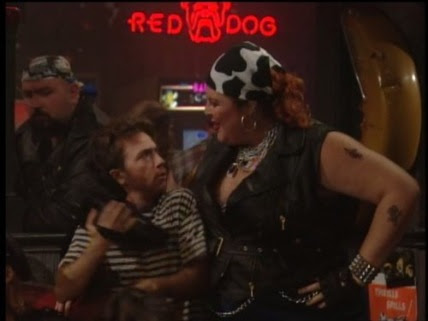
Prior to this episode, Peg Bundy was sometimes seen punching out other women, and she even clouted Al once or twice, but her transformation from couch potato to kung-fu kicker verges on being a fantasy (especially since it never comes up again). Al's embarrassment by his wife is prefigured by a scene wherein a burly woman throws Al around like a rag doll, and Al's son is similarly humiliated by a huge woman who implicitly ravishes him and carries him away to a fate worse than death-- one of the few times Bud gets tortured without either Peg or Kelly bringing the calamity about. Just to keep up MWC's quota of bodacious babes, though, the writers and director Amanda Bearse throw in a gratuitous scene at the dive where two hot girls beat up some scruffy bikers.


Wednesday, June 22, 2022

GOLDEN QUEENS COMMANDO (1982)


PHENOMENALITY: *naturalistic*
MYTHICITY: *poor*
FRYEAN MYTHOS: *adventure*
CAMPBELLIAN FUNCTION: *sociological*


This Hong Kong genre-mashup was one of the first teamups of director Chu Yen-Ping with writer-producer Geoffrey Ho, as well as one of the first "girls with guns" flicks from HK. Like most of the Ho-films, QUEENS is erratic in plot and confused in its characterization, not least because it supposedly takes place in World War Two even though all the characters (who aren't in military uniforms) have eighties hair and clothes.

Black Fox (Brigitte Lin) brings together a dirty half-dozen of criminal specialists, all women, whom she finds in a Manchurian women's prison. This works out well because Fox wants the specialists to help her destroy a weapons plant in that country, and it's not beyond doubt that Fox somehow gets all of the other women set up for jail just so Fox can recruit them. 

Like the original Dirty Dozen, the specialists only reluctantly join the team, though by the climax the ladies become more bonded than the male soldiers did. Most of the women have mundane talents-- expertise with guns or explosives-- but there's one character, Brandy (Hao-Yi Liu), who can perform various katana-stunts-- but only when she's drunk. But as if the script doesn't want to play her up too much, her stunts aren't wild enough to verge into the realm of the uncanny.

Similarly, there's only one other potential metaphenomenal content of QUEENS. During the nearly aimless progress of the commandos toward their target, they come across people dressed up like ghosts. Are they crazy priests, or bandits? The phony ghosts appear so briefly that I can't even consider them part of the main narrative.

Some of the music is also derivative of the eighties, with a few strains stolen from John Williams' "Raiders" theme. However, the main aesthetic influence (if one could call it that) is clearly Sergio Leone's spaghetti westerns, with many swipes from Morricone's "Ecstasy of Gold."

Given that it's such a wild devil-may-care adventure, I'm surprised that the stunts and fight-scenes are pretty mediocre for an eighties HK flick.


Wednesday, March 23, 2022

THE MIGHTY CRUSADERS (1957)


PHENOMENALITY: *naturalistic*
MYTHICITY: *poor*
FRYEAN MYTHOS: *adventure*
CAMPBELLIAN FUNCTIONS: *sociological*

This flick, predating the wave of peplum-films initiated by the two Steve Reeves HERCULES movies, falls into the bailiwick of the naturalistic historical adventure, for all that it's based on Tasso's poetic epic JERUSALEM DELIVERED, which includes a handful of supernatural events.

It's the tenth century, just prior to the Christian conquest of Jerusalem and their temporary ouster of the Muslim residents. The film does not attempt to argue either side's ethical position; the main point is to set up a romantic arc between Tancred (Francisco Rabal), the Christians' most formidable knight, and Clorinda (Sylva Koscina), a female knight of the Muslims. In contrast to later peplum, the romance is doomed to a tragic outcome, just as it is in the poem.

CRUSADERS is a cheap looking production, in which most of the run-time is spent in talking-head scenes, whose dubbed dialogue is extremely forgettable. Battles are unexceptional and dilatory. There's one okay scene of mounted combat between Tancred and a Muslim knight who also wants Clorinda. Clorinda gets one scene in which she manages to stab an enemy knight to death, but otherwise she doesn't do much better than the male characters. Still, combative female heroines are pretty rare in Italian cinema, especially those that share starring status with the main hero. Koscina, who would co-star in those Hercules films, seems far more comfortable in the traditional female role. At one point, she's somewhat contrasted with another woman, Armida (Gianna Maria Canale), who emphasizes conquering male warriors with seduction, but the contrast fails since Clorinda seems just as feminine as Armida. In the epic, BTW, Armida is a full-fledged witch, but here she's just a lady with enchanting amatory skills, seducing Rinaldo, the leader of the Christian crusaders.

Aside from providing glamorous scenes for Koscina and Canale, the film's main significance is providing a contrast to the many modestly-budgeted American swashbucklers in which women have central sword-fighting roles.


Wednesday, April 28, 2021

COME DRINK WITH ME (1966), THE FATE OF LEE KHAN (1973)


PHENOMENALITY: (1) *marvelous*, (2) *naturalistic*
MYTHICITY: (1) *fair,* (2) *poor*

FRYEAN MYTHOS: *adventure*

CAMPBELLIAN FUNCTION: *sociological*


 When I reviewed DRINK’s sequel GOLDEN SWALLOW in this 2016 review, I hadn’t watched DRINK of some years. In my SWALLOW review I observed, as others before me had, that the character of Golden Swallow was somewhat overshadowed by the two males fighting over her. Now, upon re-watching DRINK, I see a similar situation in that film, where a male support-character takes on such importance that he almost becomes a co-equal partner in the narrative. However, whereas the sequel may have shifted focus from the central heroine simply because its director Chang Cheh wasn’t fond of female protagonists, the first film’s director/co-writer King Hu seems to have just allowed his script to get somewhat disjointed. Yet in both films, I would still view the Golden Swallow to be the “engine” who keeps the narrative running, not unlike America’s two “Nyoka” serials, where male characters do a lot of heavy lifting in terms of fight-scenes, but the female hero is still the central presence.

A disjointed narrative is certainly not the only aspect of DRINK that got passed on to the hundreds of Hong Kong kung fu films to follow. Swallow, essayed by former dancer Cheng Pei Pei, seems to be one of the first kung-fu heroines, as well as one of the first to travel around masquerading as a man. Indeed, many of her enemies believes that Swallow is a man, known far and wide for carrying out the will of “his” magistrate-father. (Her imposture never seems convincing, and even less so when one finds out that Swallow has a small coterie of warriors, also female, and also presumably pretending to be men.) In any case, Swallow’s father sentences the chief of a bandit gang to death. The gang retaliates by kidnapping the judge’s other son and using him to ransom their leader. Swallow, knowing that her upstanding father will not deal with criminals, arranges a meeting with the gang, hoping to liberate her brother.

From then on, Swallow has various fights with the bandits, and at least one, in which she takes on a dozen foes with her sword, seems like the archetypal kung-fu scenario. That said, the heroine survives in part thanks to the help of a “guardian angel,” an apparent reprobate named Drunk Cat, who represents HK cinema’s abiding love of drunkard-heroes. Cat’s motives for helping Swallow are rather obscure. However, some scenes establish that he’s a former adherent of a kung-fu temple, where the bandits happen to be holed up. The abbot of the temple, Tiao Ching-tang, has allied himself to the bandits, and although Cat owes Tiao a debt of honor, the drunk-hero may have linked up with Swallow because he anticipates having it out with the abbot.


Another familiar trope is that of a sense of an almost-romance between the female hero and her male aide, though the script stays away from explicit eroticism. In the last third Swallow and her female soldiers lay waste to the bandits and rescue Swallow’s brother. However, the abbot becomes the final threat, and like a lot of older kung-fu masters throughout HK cinema, he has supernatural powers from his rigorous training. When Swallow stabs Tiao, her weapon simply won’t pierce his torso, though significantly he doesn’t allow her to strike as his head. When Tiao and Cat square off and start shooting at each other with blasts of compressed air, I wondered if they were using some anachronistic technology, only to realize that this was King Hu’s way of depicting two kung fu masters using blasts of “chi.” On a minor note, one of Swallow’s female warriors is played by Angela Pan, who went on a measure of fame for dismasting the One Armed Swordsman.


After the success of DRINK, Hu attempted a more ambitious project, A TOUCH OF ZEN, which failed at the Asian box office. His next two films were more standard kung-fu exploits, but the first, THE FATE OF LEE KHAN, was anything but a return to form.


Even a casual student of Chinese cinema should discern a cultural tendency to build plots so labyrinthine one often can’t follow who’s doing what to whom. KHAN is named for a 13th-century general who’s a major asset in the Mongol occupation of China. When the Chinese resistance movement learns that Khan and his sister plan to stay at a particular inn, a team of agents—one man and four women—masquerade as the owner of the inn and his four maids. The rebels hope to steal a map showing Khan’s battle plans, though they don’t seem all that careful about keeping the general from learning about their mission, which I would think would negate the whole project.


I suppose the five resistance fighters are the protagonists, but they’re all pretty boring, despite the fact that one of them is played by future kung-fu diva Angela Mao. But Mao doesn’t shine here, any more than the two villains, the sister being played by yet another diva, Hsu Feng. A DVD commentary asserts that this vehicle is notable for King Hu’s emphasis on “realism” in the kung-fu genre, but that only works if one accepts “tedium” as a definition of realism. To be sure, KHAN is an entirely naturalistic film, but there are many films in the genre that stay within that phenomenality but still deliver strong characters, as with the aforementioned ONE ARMED SWORDSMAN. It did occur to me that there might subtleties in KHAN’s depiction of archaic Chinese culture that had special value for Chinese viewers, but that possibility doesn’t make the film any more entertaining to an outsider. In the final analysis KHAN is interesting only for its place in the respective careers of King Hu, Angela Mao and Hsu Feng.      


Friday, June 26, 2020

KUNG FU: SEASON 3, EPISODES 22-24 (1975)


PHENOMENALITY: (1) *marvelous,* (2,3) *naturalistic*
MYTHICITY: *fair*
FRYEAN MYTHOS: *adventure*
CAMPBELLIAN FUNCTION: *psychological, sociological*


I’m sure that somewhere there exists a record of the order in which KUNG FU’s episodes were filmed, as opposed to the order of their airing (which is how they’re organized on the Warners DVD set). Since I don’t have access to such a record, I can’t fully substantiate my opinion that the last three episodes aired were probably not the last ones filmed. However, the next-to-last episode, “Ambush,” is clearly out of order, since in it Serenity Johnson references Caine’s search for his brother, whom the hero had located in the preceding four-part story. The DVD set includes commentary from David Carradine about the filming of “Full Circle,” the last section of the aforesaid four-parter. Carradine discusses a conversation with a producer as to how he, the actor, would like to end the series. Carradine thought it appropriate to end with Caine walking off into the distance, just as he does in the closing credits, but the producer said that the last scene had to be shot on a soundstage. Carradine does not expressly say that this was the end of the episode he’s discussing, but the description fits the somewhat awkward denouement of “Circle,” in which Caine stands apart from the happy families and bows to them with a closing remark. The last three broadcast episodes, in contrast, have nothing about them that would signify the series’ conclusion.

“The Thief of Chendo” is one of the few all-in-China stories to include both Young Caine listening to his master (though not for very long) and Mature Caine taking on another adventure. Master Po sends the hero to render aid to the Duke Li Yien, but when Caine reaches the noble’s fortress, he’s told Li Yien is dead. However, Po gave Caine an apparently magical ring that glows as long as the Duke is alive, and the ring shows that Li Yien has not yet joined his ancestors. While Caine investigates the situation, he becomes allied to a young master thief, Sing Tao, and the priest even demonstrates his bar-bending abilities when the two are briefly in prison. The upshot is that the Duke’s wicked cousin Chun Yen has imprisoned Li Yien while trying to wrest from him the location of some treasure. In addition, Chun is such a busy bee that he’s also forcing the Duke’s daughter Min Ming to make a political marriage. Some romance between her and the young thief, together with a big fight between Caine and a hefty bodyguard, make this a tolerable episode.

“Ambush,” the last outing for Serenity Johnson, doesn’t come close to his previous episodes. It’s another “find-the-treasure/loot” episode, and in this case the loot is money that an old girlfriend conned Serenity out of years ago. Anti-materialistic Caine is only persuaded to help the itinerant preacher because he wants to use the dough to build a new church, though not much regarding religion of any kind figures into the tale. Jenny (Rhonda Fleming) has her agenda about the money, but a greater danger looms when tough guy Bix Courtney (Timothy Carey) enters the picture. Naturally, Caine doesn’t even work up a sweat trouncing Bix and his fellow owlhoots.

“The Last Raid” in many ways is just as mediocre as “Ambush,” and as the next-to-last story brought back Serenity to scant effect, the last one has Caine pay a visit once more to the Brown family, last seen in the superior second-season episode “The Well.” When Caine visits, Daniel Brown is off fishing with his white friend Jimmy Cooper, but they’re waylaid by the villains, Major Bealson (L.Q. Jones) and his men, all attired in Confederate grey. Are these specters of America’s racism, appearing in response to the innocent union of black and white?


Ah, no, the Rebs don’t even care about Daniel, even though they take both boys captive, and send a note into the nearby town demanding ransom from Jimmy’s father Doctor Cooper. Both of the boys’ fathers are naturally worried as heck, though the female members of the Brown family aren’t let in on the news. Cooper organizes the ransom, while Caine tries to find the raiders. Eventually it’s revealed that Bealson cares less about money than about avenging an old grudge against Cooper, because the two of them were opponents during the Civil War. Bealson is easily the weakest villain in the whole series, and he presents no real threat against the Shaolin superman. The only redeeming facet of the script is the final scene, even though Caine has apparently moved on by then. The Coopers and the Browns, happy to have escaped tragedy, sit down to dinner together, laughing and joking together—and though there’s nothing extraordinary about the writing, the scene at least sums up one of the key themes of the program: the hope that people of all colors can learn to understand one another and find common bonds. This was the aspiration of Classical Liberals back in the seventies, and, though I suppose this ameliorative view would be anathema to modern Progressives, it’s an aspiration that can never be allowed to fade from the ethos of the American people.     

KUNG FU: SEASON 3, EPISODES 18-21 (1975)


PHENOMENALITY: *naturalistic*
MYTHICITY: *fair*
FRYEAN MYTHOS: *adventure*
CAMPBELLIAN FUNCTION: *psychological, sociological*


“Barbary House” begins a four-part serial in which Caine finally does catch up to his long-lost half-brother. Despite Caine’s having seen Danny’s portrait in “Vanishing Image,” the Shaolin doesn’t recognize his sibling when they pass one another, Danny leaving San Francisco even as Caine enters. Danny had to leave after inciting the wrath of saloon-owner Corbino (Leslie Nielsen), who now wants Danny dead. Caine’s inquiries lead him to Corbino’s saloon, where brutal boxing-bouts are held for the entertainment of the masses, and where Danny’s son Zeke works to assist Corbino’s own stable of fighters. Because Zeke knows nothing of the enmity between his father and his boss, Corbino hopes to con Zeke into making contact with Danny and then going after him. Caine is one of two elements that disturb Corbino’s plot, the other being a woman named Delonia, who in keeping with the story’s high melodrama, turns out to be Zeke’s long-lost mother. Caine fights one bout as “the Shanghai Kid” before he, Zeke and Delonia flee the city in search of Zeke’s father.

“Flight to Orion” largely functions to pad out the story’s running time. Though there’s a token attempt to form a bond between Zeke and his newfound mother, Delonia must have seemed something of a distraction from the main purpose: that of both uniting father and son and uniting two siblings. Thus Delonia dies. The tears on Zeke’s face hardly have time to dry thanks to another improbable twist. Caine, seeking food for his companions, filches some provender from a tribe of Indians, and though he leaves an item of trade, the Indians only want vengeance. Fortunately, they have a “trial-by-ordeal” custom that gives the priest an out, as well as allowing for a nice four-on-one dust-up. While this goes on, Zeke—whom Caine rather unwisely sends away—gets caught by Corbino, and the gambler tricks the boy into revealing Danny’s general locale.

“The Brothers Caine” brings the Shaolin and his nephew to Orion, but Danny isn’t in the town, having fled to an unknown refuge in the neighboring mountains. Caine and Zeke get a clue from a local lady named Lulu, another of Danny’s lady friends, who (just to really pile on the melodrama) turns out to be Zeke’s surrogate mother, in that Danny had Lulu raise Zeke during his infant years. Corbino brings another ally with him, for somehow he’s made contact with General Cantrell, the father of Zeke’s mother, who doesn’t seem nearly as interested in his daughter’s death as in having a chance to take control of Zeke, in effect stealing Danny Caine’s son as Danny stole the general’s daughter. Additional developments include Corbino employing an assassin who claims magical powers but demonstrates none in his battle with Caine. In addition, Corbino attempting to hoax Danny into killing the brother he didn’t know he had.

By the time “Full Circle” opens, Danny has accepted Caine’s claim of kinship. However, Zeke, in order to protect his father, agrees to return to Cantrell’s ranch as heir apparent to the general. In a complication that’s more or less rushed out, it turns out that Cantrell already a real son on his ranch, name of Tigre. Tigre was the son of another vanished mother, and the implication is that Cantrell could be an “Indian-lover” but not a “squaw man.” Nevertheless, Tigre craves his father’s approval and his name, in contrast to Zeke, who doesn’t want what Cantrell offers. Cantrell is also aware that Corbino plans to set a trap for Danny, but not until Zeke is placed in danger does the general pass that knowledge on to Caine. In the end Danny’s life is saved and Corbino is defeated. The episode’s ending looks as if it might’ve been intended as an ending for the whole series, but three more episodes remained to be aired.

Wednesday, February 19, 2020

COLOSSUS AND THE HEADHUNTERS (1963), COLOSSUS OF THE ARENA (1962)


PHENOMENALITY: (1) *uncanny,* (2) *naturalistic*
MYTHICITY: *poor*
FRYEAN MYTHOS: *adventure*
CAMPBELLIAN FUNCTIONS: *sociological*


Here we have two Italian "Maciste" films linked only by the idea of giving the hero the name "Colossus" in the titles. As was common for these films, Maciste appears at random in different time periods, with no connection between any of his adventures.

HEADHUNTERS' only virtue is that, because it's so dull, it made an above-average episode of MYSTERY SCIENCE THEATER 3000. Without the jokes, though, it's a dreary affair, though of minor interest in breaking with some of the standards of the template.

Usually, Maciste or one of his duplicates wanders into the midst of some dispute between two cities, takes the side of the righteous, and helps overcome the rulers of the unrighteous domain. Here, just as a volcano threatens to destroy the civilization of a more or less Greek-sounding island, Maciste shows up out of nowhere and leads the inhabitants to board a handy ship and escape annihilation.

Once Maciste and the island-people make landfall, they're almost enslaved by a nomad tribe, ruled by Queen Amoa (Laura Brown). However, Amoa's no standard "bad queen." She and her people are simply guilty of bad judgment, as they've been forced to flee Kermes, a renegade member of their tribe who enlisted the titular Headhunters as his henchmen. Maciste is tempted to help the sexy queen with her problems, but first he endeavors to get the islanders to safety. However, Kermes and his head-hunting buddies are aggressive enough to pick fights with both sets of good guys, thus solving Maciste's great moral quandary.

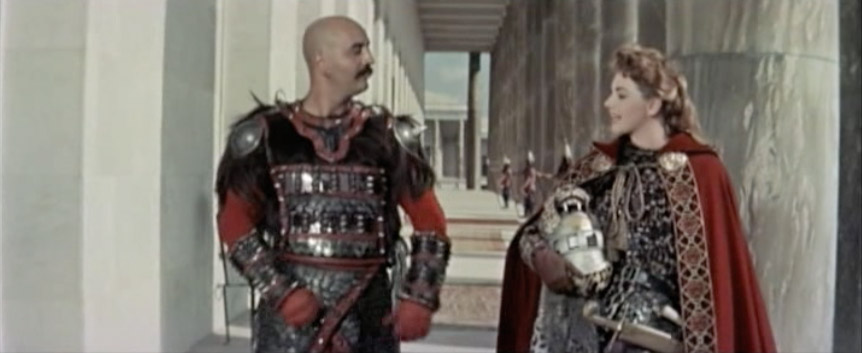
Both the photography and stunt-work here is tedious in the extreme, and although Kirk Morris made a good muscleman-hero in other peplum-films, he just barely performs enough strongman-feats to edge this flick into the realm of the uncanny. The Headhunters are no help here, since the film tells the viewer nothing about their weird society. The only other point of interest is that Amoa is one of the more active heroines, though she just has two or three short scenes of swordfighting.


COLOSSUS OF THE ARENA, set in ancient Rome in the period of the gladiators, is far more entertaining in every way, though Mark Forest's Colossus/Maciste seems here to be an ordinary muscleman. Indeed, ARENA sports a scene in which the main hero actually gets beat up by seven other boulder-shouldered bad guys. This in itself may be deemed a marker of the film's comparative naturalism, even though later on the hero gets to clobber five of his former foes in one big saloon-battle.

The main thrust of the plot involves a nasty plotter seducing Revia, sister of the reigning queen Thalima, so that he can overthrow the rightful ruler. This doesn't sound too much like any historical version of Rome, but I feel sure that the audience of the time allowed Maciste a lot of leeway. The plotter also enlists the seven gladiators-- including both an African and a Mongolian-- to do some of his dirty work. One gladiator (Dan Vadis) ends up siding with Maciste, though this subplot proves of less interest than the one involving the royal sisters. It's incredible that Revia thinks she can depose her sister without running the risk of Thalima's being killed, but putting that aside, the two actresses, Scilla Gabel and Jose Greci, provide a satisfactory helping of pulchritude.

Saturday, June 18, 2016

SON OF ALI BABA (1952), ALI BABA AND THE SEVEN SARACENS (1964)


PHENOMENALITY: *naturalistic*
MYTHICITY: *poor*
FRYEAN MYTHOS: *adventure*
CAMPBELLIAN FUNCTION: *sociological*


Here are two pieces of cheese: one American, one Italian, and both invoking the name of the Arabian character Ali Baba-- though it seems that the peplum originally used the name of "Sindbad."

SON OF ALI BABA presents Tony Curtis as Kashma Baba, whose dad was the original leader of the Forty Thieves-- and not, as in the Arabian Night, a fellow who ended up bringing doom to the thief-band. This bit of narrative confusion extends to every other aspect of this rather dull swashbuckler, for its script mingles aspects of DON Q SON OF ZORRO (hero is a member of a military guard, framed for wrongdoing) to Robin Hood. (One of the hero's prominent aides is a female archer, seen above with Curtis and another actor, who wears attire more befitting medieval England than medieval Araby).

In cinematic circles, the film became the source of a popular joke at the expense of Curtis' Bronx accent, in that he supposedly speaks the line "Yondah lies the palace of my faddah da king." Curtis' accent isn't the least convincing as an Arabian prince, but it's no worse than that of anyone else in the film, and he doesn't even speak the supposed line.

Though some Ali Baba tales invoke the one metaphenomenal aspect of the original tale-- the cave whose door magically opens to give the 40 thieves a hiding place-- there's no reference to that story-element. The original Ali and the thieves appear as old men, whose role is simply to advise the fierce young Kashma and his allies against their enemies. This is such a dull by-the-numbers swashbuckler that not even the presence of several sultry temptresses (among them Piper Laurie and Susan Cabot) can assuage the tedium.


According to IMDB director Emimmo Salvi-- perhaps best known for DAVID AND GOLIATH-- made a 1962 fantasy-film called THE SEVEN TASKS OF ALI BABA, though from descriptions it doesn't sound like it had much to do with the original Arabian Night. Then this film, originally SIMBAD CONTRO I SETTE SARACENI, was retitled, possibly because the 1964 shared some of the same cast as the earlier film. Certainly neither of the Arabian Nights characters inspired anything about this story, which is simply about medieval Arab warlords fighting one another for supremacy, with Ali Baba (Dan Harrison) as the good warrior and Omar (Gordon Mitchell, seen above) as the bad warrior.

The flick is just as formulaic as SON OF ALI BABA, but the action is better mounted and the costumes, while probably not accurate, don't look like they were recycled from films about other historical periods. The most interesting thing about SARACENS is that it's one of the few times that hostility between the film's "heroine" and "villainess" actually eventuated in a little hand-to-hand violence. Usually in this type of Italian film, the heroine's helplessness is emphasized, but the character of Fatima challenges bad-girl Farida at least twice to a fight, and the film delivers the claw-fest, though it's not a particularly good one. Another rarity is a scene in which the girls of Omar's harem rebel and beat up their guards, though this too is rather weak tea.

Though the original screenplay can't possibly have predicated on the story of Ali Baba, by sheer coincidence an unusual door plays a big part in the tale. But rather than a magical cave-entrance, it's a huge rock door in Omar's fortress that is raised and lowered by mechanical devices. Sometimes devices like this carry an "uncanny" vibe, but in this case it's a purely naturalistic contrivance.

Monday, February 10, 2014

THE WORLD'S GREATEST ATHLETE (1973), THE STRONGEST MAN IN THE WORLD (1975)


PHENOMENALITY: *marvelous*
MYTHICITY: *poor*
FRYEAN MYTHOS: *comedy*
CAMPBELLIAN FUNCTION: *sociological*


I saw THE WORLD'S GREATEST ATHLETE  many years ago but barely remembered it. Then I recently came across a reference to the film in the context of its titular character "Nanu," mentioning that the protagonist was patterned along the lines of Tarzan. So I decided to check out the film and see how much if at all it conformed to the uncanny phenomenality of the Tarzan films I've analyzed here.

As it turns out, ATHLETE turns out to use the "outré outfits skills and devices" trope all right, but in a thoroughly naturalistic fashion.  There's nothing unnatural about the unfortunately named Nanu, though this comedy turns out to be marvelous overall, because Nanu's main opponent, if one can call him that, is an African witch doctor who commands real magic.

The story commences in America, where Coach Archer (John Amos) and his dimwit assistant Milo (Tim Conway) continually fail to win any games for Merrivale College either in baseball, football, or basketball.  Depressed by these constant failures, Archer takes a vacation to the African realm of Zambia, telling Milo-- whom he brings along-- that he wants to explore his "roots."  (Curiously, this movie appeared in theaters three years prior to the publication of the famous Alex Haley book ROOTS.) But no sooner do Archer and Milo begin their tour of Zambia than they come across a young physical marvel named Nanu. They eventually trick him into returning with them to America to be Merrivale's new sports-star.

I should note that Tarzan is politically suspect for some readers, given that he seems to validate Euro-American imperialism in being a "white god" who can overpower the natives of Black Africa by his superior strength and agility, plus the occasional invocation of rampaging elephants.  Whatever validity this argument may have is in my mind mitigated by the unreality of Tarzan's "raised-by-apes" scenario.  However, ATHLETE puts aside the uncanny trope of the physical phenomenon raised by wild animals.  Though "white jungle guy" Nanu runs faster than a cheetah and swings through the trees on a vine, he is the child of deceased missionaries and was raised not by animals but by the people of his Zambian tribe.  Therefore his abilities are only those of a natural athlete, even if he does emulate other aspects of the Tarzan-legend-- i.e., he pals around with an imported tiger in place of Tarzan's lion-buddy, and he eventually acquires an American girlfriend named-- ah, you can guess what she's named. 

By concocting a less fantastic origin for Nanu, ATHLETE's script avoids some of the dodginess of the premise of a black American, Archer, going to Africa to pursue his roots and coming back to America with a white kid as his protege.  Some have argued that the superior athleticism of Tarzan is a marker of his racial superior to African natives.  But even if this verdict was true for Tarzan, Nanu is raised just like any other member of his tribe, and just happens to emerge as a great athlete.  Archer, in a way, has stepped into the role of the "white fortune hunter" who trespasses on African natives in order to rob or exploit them-- thus putting Jan-Michael Vincent's Nanu in the position of the exploited native.  To be sure, Archer is essentially a nice guy who only wants what any coach wants-- a winning protégé-- and tells his "white lie" (heh) only in his pursuit of athletic excellence, not to make humongous profits from his pupil.  When Nanu finds out that Archer tricked him, Nanu is offended, but the two of them finally make peace.  It's a pretty simplistic comedy, so the script doesn't attempt to foster any deep emotions between coach and student.  But given that the writers didn't do that well with the comic action, it's probably better than they didn't try for drama on top of that.

The marvelous content is supplied by Nanu's tribal godfather Gazenga (Raymond St. Jacques).  At one point he works a spell on doofus Milo, who seems to shrink to the height of three inches, all so that Tim Conway gets his chance to essay some Lilliputian slapstick.  Gazenga tells Milo that he hasn't really shrunk, that it's all in his mind.  This seems like a curious reservation, since several other times in the film Gazenga's magic-- referred to as "voodoo"-- is seen flinging people and things around, with no Mandrake-the-Magician caveats appended.  Gazenga resists the jungle-film characterization of the witch doctor in that he proves witty and highly educated. However, none of that helps him, any more than any other character, from the general lameness of the jokes.  At one point Gazenga-- having regretted his early decision to let his godson go to America-- comes to the States with the intention of bringing Nanu back to Africa.  He's greeted by a Merrivale official who expresses genuine happiness to meet "a real witch doctor."  It would have been easy for the script to make this sound snarky, but the line seems sincere-- so it's just puzzling when Gazenga sticks a bone in his nostrils, as if to mock the official for racism.  Possibly the writer meant it to be filmed one way and the director sabotaged it. Gazenga ends up as a nominal "villain," using his magic to make Nanu fail in the climactic competition, but he too ends up being reconciled.

The film's negotiations of sociological racial-makers are more interesting than the film itself.  Amos and Vincent have the best moments, as they try to imbue their simple roles with authority.  The closest the film gets to authenticity, though, is when Archer encourages Nanu to enter a big track meet with the ambition of winning all the events-- a feat that the original "world's greatest athlete," Native American Jim Thorpe, attempted but failed to execute.  Interestingly, though Nanu succeeds where Thorpe failed, he never internalizes the competitiveness of the American ethos.


ATHLETE isn't funny, but at least it's not boring. STRONGEST MAN IN THE WORLD is the last of Disney's "college comedies" featuring Kurt Russell as Dexter Riley, a college kid who is a magnet to weird scientific phenomena.  I haven't seen the first two in this series in many years, but decided to check out the last in the series-- THE STRONGEST MAN IN THE WORLD-- as a possible contrast to ATHLETE.

I remember the first two films in the series as being silly but at least lively.  Riley and his fellow clean-cut collegiate buddies would perform some experiment, and it would have some bizarre side-effect.  Older persons in authority would then goggle at Dexter's amazing new powers-- a computer-mind in the first film, invisibility in the second-- and then seek to profit thereby.  The two sides of this exploitation were represented in all three films by "dumb but benign authority," incarnated by Dean Higgins (Joe Flynn), and by "ruthless criminal authority," personified by crime-boss A.J. Arno (Cesar Romero).  The former authority was set up to be "accidentally" flummoxed by the teens' goofy adventures, while the latter was a genuine threat and could be attacked in self-defense, albeit only with slapstick devices.

My memory of the first two Dexter films is that they included a good basic mix of age-representation, with Russell and his "clean teens" balanced against the "elder statesmen" portrayed by well-known faces like Romero and Flynn.  STRONGEST, however, lacks this balance.  Though Russell is top billed, he and his teen buddies have little to do, with all the major comic scenes allotted to the older generation.  STRONGEST includes not only Flynn, Romero, and William Schallert-- the benign professor of the first film-- but also Eve Arden, Dick Van Patten, Harold Gould, Richard Bakalyan, Benson Fong, and James Gregory.  I like all of these performers, and I can hardly object to Joe Flynn getting a lot of screen time since STRONGEST was his last film.  But when the teen-heroes are nearly squeezed out of the story, I find myself wondering what was going on behind the cameras.

Not that it matters a lot.  STRONGEST is one of Disney's weakest comedies, showing actors like Silvers and Flynn to poor effect as they stand around trying to inject life in a pokey script.  Cesar Romero, who made a fine comic villain thanks to his dapper, cultured manner, ends up teaming with Bakalyan for a bit of scaffold-slapstick unworthy of the Three Stooges. 

Wednesday, May 15, 2013

THE TALE OF ZATOICHI CONTINUES (1962), BLIND RAGE (1978)


PHENOMENALITY: (1) *uncanny,* (2) *naturalistic*
MYTHICITY: (1) *fair,* (2) *poor*
FRYEAN MYTHOS: (1) *adventure,* (2) *drama*
CAMPBELLIAN FUNCTION: *psychological, sociological*

In my review of the original ZATOICHI film, I commented that the narrative thrust was that of the purgative drama rather than the invigorating adventure.  After my viewing of a later Zatoichi entry, I imagined that the bulk of the films about the blind swordsman/masseur probably tended more toward adventure in the later entries.  However, the second film in the series makes the transition more quickly than I expected, as the story places far more emphasis on spectacle than on dramatic agonies.

The central plot maintains the tone of sociological protest in the first film, in that low-class masseur Zatoichi falls into trouble through no fault of his own, but through the sins of the well-born.  While plying his masseur trade, Zatoichi becomes privy to the fact that a great lord is losing his marbles.  The lord's retainers don't want the masseur telling tales, so they attempt to kill him, demonstrating how little the life of a low-class human being has for them.  Zatoichi only survives because of his peerless swordsmanship, enabling him to slay six or seven opponents in one dust-up.

A secondary plotline has Zatoichi consorting with another profession of society's low rung, when he encounters a group of female prostitutes.  Zatoichi's temptation is handled realistically, in contrast to American heroes who would never sully their hands (or whatever).  But the main importance of this plot is to reveal an aspect of Zatoichi's past, that he once lost the love of his life to his own brother.  In fact, Setsu, the one prostitute who befriends the masseur, reminds Zatoichi of his lost wife.  However, a crippled samurai named Yoshio also covets Setsu-- and only after building some suspense as toYoshio's motives does the film reveal that Yoshio is Zatoichi's brother.  The sense that the two siblings are once again opposed due to their common lust for one woman produces a fine undertone of Japanese fatalism.

In the earlier reviews I've explained in detail my reasons for deeming Zatoichi's feats of blind swordmanship to be "uncanny," and I devoted one review to showing how certain types of blind hero failed to transcend the vale of the naturalistic.  However, just to provide one more such example, I watched the Phillipines-produced heist-flick BLIND RAGE, which deals with five blind men who conspire to rob a bank.


In a broad sense this idea of a "blind man's burglary" is just as improbable as Zatoichi's peerless feats However, RAGE never imparts the unique tonality of "the uncanny" to its improbable events; rather, the improbabilities are simply there, and the audience either accepts them or not.  However, there's not nearly as much one can say about BLIND RAGE. Though producer/writer Leo Fong can be credited with a smattering of "good dumb fun" action films, the pace of RAGE is plodding and its actors are uninspired.  Even Fred Williamson, who only appears for about ten minutes in the film to give it some cachet for American audiences, proves unable to inject RAGE with any charisma. There's a tiny amount of sociological content in the film, as the five blind men "rage" against "the Man" for marginalizing their handicapped status, but even this is forced and unimpressive.  The only amusing moment is when the five blind thieves employ "Braille watches" to synchronize their operation.