Monday, December 29, 2014
THE DEATH KISS (1932)
PHENOMENALITY: *naturalistic*
MYTHICITY: *poor*
FRYEAN MYTHOS: *drama*
CAMPBELLIAN FUNCTION: *psychological*
It would be easy to resent this minor mystery-thriller as a harbinger of Bela Lugosi's future marginalization in Hollywood. Lugosi is reunited with two co-performers from 1931's DRACULA, David Manners and Edward Van Sloan, but both actors are given much better lines. With Manners it's understandable, for he's the real star of the show. When a much-disliked actor is killed on a film, Manners' character, a smart screenwriter named Franklyn Drew, makes it his business to solve the crime in order to clear his actress-girlfriend.
DEATH KISS is pretty standard for this type of fast-paced murder mystery, and Manners is reasonably entertaining trading quips with the investigating cops, who of course are all idiots. Lugosi is merely a studio manager seeking to keep his place of employment from suffering bad press. I imagine the producers merely wanted to suggest a slight aura of horror by casting him in a minor role. But there's nothing horrific in the script as such, and I disagree with any concordances that deem this a "fantasy-film" simply because it has Bela Lugosi in it. The suggestive title also adds up to nothing, for "Death Kiss" is simply the title of the movie that's being filmed when the victim is killed. As a very slight irony, though the source of the "death kiss" is an evil temptress in the film's script, the actress playing her is entirely likeable, if dull.
The only slight claim DEATH KISS might have to metaphenomenal status is the method of the murder. I've rated some mystery-films, like THE JADE MASK,.as "uncanny" if the murder-devices suggests the quality I've frequently called "strangeness." But not every "infernal machine," as some authors call them, are automatically (heh) uncanny. In this essay I referenced one naturalistic "machine"-- a gun rigged to shoot a victim at a certain time. To make such a mundane device "strange," one needs some sense of its being given a peculiar tonality-- which I did find in one of the films reviewed here.
But KISS' murder-method-- a simple derringer loaded into a camera-- didn't suggest any strangeness for this viewer. I don't recall that anyone makes the obvious pun about finding a "shooting iron" in a device meant for "shooting actors" in a non-fatal manner.
Tuesday, December 23, 2014
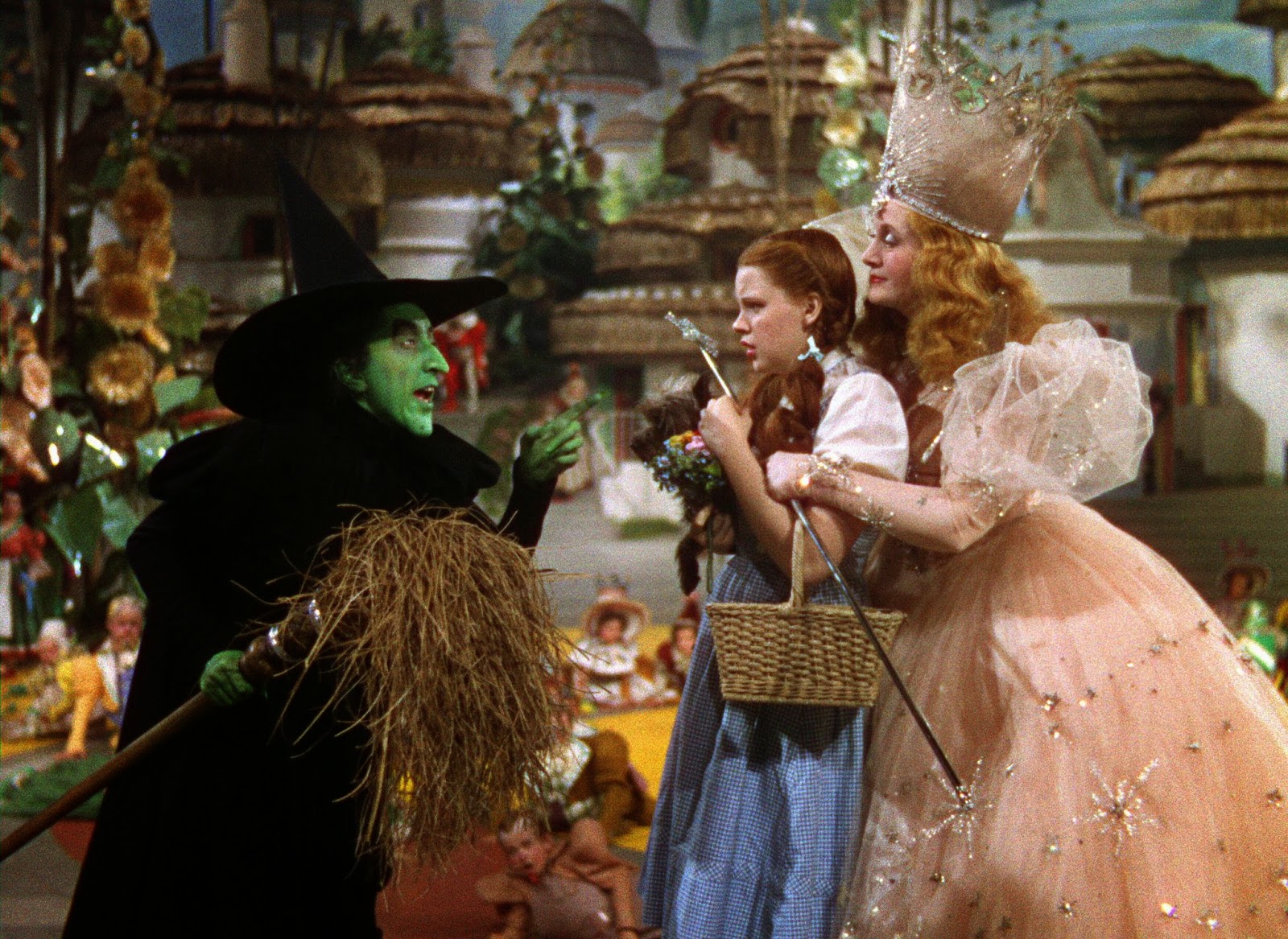
THE WIZARD OF OZ (1939)
PHENOMENALITY: *uncanny*
MYTHICITY: *superior*
FRYEAN MYTHOS: *drama*
CAMPBELLIAN FUNCTION: *psychological, metaphysical, sociological*
First, I consider both the book and the 1939 movie to belong to the category "drama." There are a lot of comic or adventurous sequences, as well as a handful of ironic touches, but both stories emphasize the pathos of Dorothy being separated from the life she's known. Her "separation anxiety," so to speak, is so great that even the endless fascinations of Oz's dream-world hold no attraction for her, except insofar as they help her get back home. However, it should be said that Baum doesn't spend as much time as the film does in delineating the simple charms of Kansas, and the success of the first book insured that Dorothy and other protagonists would make many more trips to Oz. In contrast, the 1939 film presents Dorothy's conflict as a completed journey, one that presumably will never be repeated.
According to the 1977 book MAKING OF THE WIZARD OF OZ, the first drafts of the film-script did not employ the device that Dorothy's trip to Oz was a dream. This development testified to the belief of MGM producers that general audiences would not give credence to the book's genuinely marvelous fantasy-world of Oz. I'd hypothesize some possible influence from Maurice Maeterlinck's 1908 play THE BLUE BIRD, which had seen adaptation into two silent films. The theme is certainly the same; that of the glorification of ordinary life as against childish fantasies. The play also presents its child-protagonists encountering humanized versions of homely house-pets and other phenomena, just as Dorothy's Oz-buddies are patterned on the farm-hands she knows from home. If there was such a behind-the-scenes influence, this would make it all the more ironic that the next year 20-Century Fox tried to steal MGM's fantasy-film thunder with an adaptation of BLUE BIRD-- an adaptation which flopped.
The 1939 Dorothy, then, embarks on her journey as a way of balancing her personal conflicts between "staying home on the farm" or venturing off into exotic lands. It's highly significant that long before Dorothy has a good reason to run away-- that is, before she knows that Mrs. Gulch is going to try to have her dog Toto put down-- she's already thinking about seeking out some other world where people won't treat her like a mere child, that paradisiacal place "where troubles melt like lemon drops." It's been fairly objected that Dorothy's single-minded drive to get back home overlooks the ways in which the real world sucks: that Mrs. Gulch, the richest woman in the area, may again try to exterminate the little girl's dog. On the other hand, it's possible that the dog-hating harridan may have perished in the cyclone, though the film would have lost its happy-ending feel had it presented Gulch's death as a real outcome, rather than a symbolic one confined to the world of dreams.
In Baum's fantasy, there are no evil male or female figures portrayed in the Kansas seen only briefly at the book's beginning and ending. Thus Oz's authority figures-- the good witches, the bad witches, and the "humbug" wizard-- are more archetypal visions of good and bad authority, not necessarily only of a parental nature. In both film and book Dorothy is presented as a mild spirit who has no overt forceful tendencies. Her three male companions definitely incarnate the forcefulness she does not normally show, though all three have defects that keep them from being invincible. In the book, Tin Man, Scarecrow and Lion all have moments of genuine violence. The film downplays this potential in favor of comic sequences of fear, so that they arguably become more vulnerable than their prose originals. This isn't to say that Dorothy lacks all initiative: in both book and film she intercedes to slap the Lion on the snout when he menaces Toto. Yet in Baum the mild-tempered little girl can be roused to real anger. In the book's middle section, after Dorothy has been forced to labor in the Wicked Witch's castle, the Witch succeeds in stealing one of Dorothy's slippers, and this makes the girl mad enough to hurl a pail of water at her tormentor-- albeit without knowing in advance that the water will destroy the evil sorceress. For the film-version, even this minor display of ire toward an authority-figure born of dreams may have seemed too chancy, and thus Dorothy only kills the Witch while trying to save the Scarecrow from a fiery doom.
The progress of Dorothy in WONDERFUL WIZARD is linear. She goes from the East, where her house has killed the Witch of the East, and she picks up allies on her way to Oz, in the center of the Land of Oz. Her errand for the Wizard sends her and her friends to the West. After the death of the Witch of the West, the heroes' return takes them back to Oz, but the return to the center doesn't finish the story. Although the Wizard has managed to empower the three allies in his humbug-ish manner, he fails to deliver on his promise to Dorothy. This forces the three allies to accompany her on a second quest to the South, which gives them the chance to show off their new fortitude. Still, the quest can only be finished when Dorothy-- essentially taking on the power of a witch-- must invoke magical power to get the group past the land of the Hammerheads-- and only after doing this does she come into contact with a being of genuine knowledge, the Witch of the South, who alone knows how Dorothy can get home.
The film favors the entirely circular path from East to Center to West and then back to Center, appropriately resembling the circularity of the dream in which all the action takes place. But to make this work, the script must conflate the Witch of the North, who first tells Dorothy to seek out the Wizard, with the genuinely wise Witch of the South. This has the unfortunate effect of making it look like the film's Glinda, Witch of the North, is primarily concerned with using Dorothy's predicament in order to knock off the Witch of the West. One might argue that she has recapitulated the Wizard's bargain, albeit in altered form. In the book and film the Wizard challenges Dorothy and her friends to kill the Witch even though he isn't entirely sure that he can grant their wishes afterward, but at least they have the option of simply not obeying the challenge, since the book's Witch of the West isn't ceaselessly chasing them around. Glinda of the North knows from the first that she has the power to send Dorothy back, but chooses to let Dorothy seek out the Wizard when Dorothy already has the power to go home. Glinda's clunky rationale is that Dorothy "wouldn't have believed" that she had the power, but it still seems like Glinda has forced upon Dorothy an unannounced "quid pro quo." At least the Wizard makes his bargain clear, even if he falsifies his own power of compensation. Of course, within the logic of a dream, one may argue that Glinda isn't an entity with real agency. Rather, Glinda is the agent of Dorothy's own desire to kill off an evil authority-figure who mirrors one in the real world-- and that, more than any "belief," seems to be the real reason Dorothy has to stay in Oz for a while. But in contrast to the book, film-Dorothy cannot be seen to assume any degree of real power, even temporarily-- so she goes back home, back to the life of a child surrounded by doting elders. The book's Dorothy returns to the bosom of family as well, but it's a family that has been so meagerly described that they can't help but seem more phantom-like than all the wonders of the Land of Oz. The book's last lines, unlike those of the film, place both the fantasy-land and the real world on a co-equal plane:
Aunt Em had just come out of the house to water the cabbages when she looked up and saw Dorothy running toward her.
"My darling child!" she cried, folding the little girl in her arms and covering her face with kisses. "Where in the world did you come from?"
"From the Land of Oz," said Dorothy gravely. "And here is Toto, too. And oh, Aunt Em! I'm so glad to be at home again!"
Monday, December 22, 2014
THE MISTS OF AVALON (2001)
PHENOMENALITY: *marvelous*
MYTHICITY: *fair*
FRYEAN MYTHOS: *drama*
CAMPBELLIAN FUNCTIONS: *psychological, sociological, metaphysical*
After I finished Marion Zimmer Bradley's mountainous, overwritten 1982 MISTS OF AVALON-- reviewed here-- I immediately got hold of a DVD of the 2001 TNT teleseries adaptation. I wasn't expecting a lot. The TNT Channel had turned out a significant number of telefilm adaptations in the early 2000s, but few if any garnered noteworthy reviews. At the same time, I thought that a pruned-down version of Bradley's story could have been an Arthurian masterpiece, at least on the level of Boorman's brilliant if eccentric 1981 EXCALIBUR.
TNT's MISTS isn't a masterpiece, but it did satisfy many of my wishes. It was inevitable that a film-adaptation would have to jettison most of Bradley's repetitive internal monologues, but there was a chance that it might have just descended into banal cliche. Ironically, scripter Gavin Scott's next finished project was just such a disaster: the 2004 teleseries adaptation of Ursula LeGuin's EARTHSEA books. Happily, the MISTS movie keeps the general rudiments of Bradley's main characters: Morgaine, Arthur, Igraine, Vivian, Morgause, Lancelot and Gwenhwyfar. The film does make substantial alterations in its latter half. For instance, the movie eliminates some of Morgaine's unheroic actions, such as the plot in which she uses her stepson Accolon against the King, but even in the novel this was no more than a side-plot. Morgaine is made more generally sympathetic, and as if in compensation her aunt Morgause is made more of a deep-dyed villain. Morgause has a much more central role in corrupting Mordred, so as to bring about the fall of Arthur's fortunes and of Camelot,
The film does adequately with the book's "Christian vs. pagan" theme, but as I noted in my review, Bradley's own handling of the theme was also just adequate, even though she devoted much, much more space to it. Both the book and movie conclude with Morgaine watching the passing of the pagan way of life in Britain, but although both are meant to give her some hope that the future may see some sort of revival, the film's script communicates this more concisely and therefore more effectively. As in the book, the only "magic" in this Arthurian universe is that of psychic talents channeled into superstitious practices. The film does unfortunately play down the rigors of Morgaine's training in becoming a priestess of Avalon, but this too would seem to be the consequence of moving from the print medium to a filmed medium.
For any viewer who wishes to see more of the standard Arthurian tropes, the film delivers them without vitiating the book's female-centric approach. For instance, when the Vivian of the book offers the sword Excalibur to Arthur, it's a long, talky scene that goes into excruciating detail about Arthur's loyalties to both Christians and pagans. The film puts across the same information but gives the ceremony some visual *oomph.* The film, while still concentrating on the female characters, allows for more visceral battle-scenes, and even Morgaine uses a sword to defend herself in one scene. Mordred's psychological motivations for destroying Camelot are more intense than those presented in the novel.
The novel's pervasive theme of incest is also diminished, though this may have been more for economy than for any other reason. Morgaine is still maneuvered into having sex with her half-brother, which in retrospect is not one of Vivian's better plots, given that it eventuates in the fall of Arthur's reign and the end of Avalon's influence. But there seems to have been no good reason to eliminate the sexual chemistry between Morgaine and her cousin Lancelot. Granted, the film doesn't have the space necessary to explore all the resultant jealousies of Morgaine toward Gwenhwyfar. But Bradley's scenario provides more narrative suspense, in that it leaves the reader wondering whether or not Morgaine might successfully divert Lancelot from his destined course.
The actors are generally impressive: Angelica Huston isn't given much to do with her Vivian, but Julianna Margulies delivers a fine sympathetic "Morgan LeFay Redux" and Hans Matheson excels as Mordred.
Saturday, December 20, 2014
WAXWORK (1988), WAXWORK II: LOST IN TIME (1992)
PHENOMENALITY: *marvelous*
MYTHICITY: *fair*
FRYEAN MYTHOS: *adventure *
CAMPBELLIAN FUNCTION: *metaphysical, psychological*
The two WAXWORKS films by writer-director Anthony Hickox are an anomaly within my Frye-influenced system of categorization-- a weighty sentence that shouldn't take away from how fun these adventure-horror films are, apart from their structural peculiarities.
I've designated most movies that can be easily identified as "horror" as "dramas" because most of the centric characters of these stories parallel the process of *pathos* that Frye finds characteristic of the dramatic work, as opposed to his other three literary *mythoi.* Whether that centric character is an obsessed mad scientist or a giant radioactive lizard, these type of stories parallel the structure of the literary drama, in that this story principally deals with the destruction, or at least the near-destruction of some great individual. On occasion there have been film-narratives in which the focus is upon not the pathetic monster but upon the hero who battles the monster, and this frequently shifts the balance of the conflict from the domain of drama to that of adventure. Examples of this shift would include both the teleseries BUFFY THE VAMPIRE SLAYER and the three-film series that began with the 1999 MUMMY. However, there have been a few times that a quasi-horror film keeps its narrative emphasis on its monster rather than upon the hero (or demihero), and yet still communicates the invigorating thrill of the adventure-mythos. As example, I noted that the first two films in the PROJECT SHADOWCHASER film-series emphasized this thrill, even though the third film in the series followed the dramatic mold of the ALIEN films.
The two WAXWORKS films are similar to the initial two SHADOWCHASER films, though with another exception. The latter two films oppose an android monster with two doughty heroes. In contrast, the various monster-mash entities of the WAXWORK films-- whom I'll call "Cartagrans"-- are opposed by two demiheroes, Mark and Sarah. These two characters are admirably resourceful in opposing the monsters, so much so that the WAXWORKS films do carry the thrill of the adventure-narrative-- yet the narrative's emphasis is still on the monsters, not on the heroes.
WAXWORK begins like many slasher-films of the period, with the interactions of a bunch of high-school teens-- Mark and Sarah among them-- looking for kicks. Sarah and a girlfriend encounter Lincoln (David Warner), a strange British fellow who's opening a waxworks in their suburban neighborhood. Neither of them seems to think that the suburbs are a strange place for such a display, but the girls agree to come to the show's advance opening that night.
Unbeknownst to the teens, Lincoln-- a sorcerer many decades older than he looks-- has constructed the waxworks as a series of sacrificial traps. Following principles that are supposedly derived from Haitian voodoo, each waxwork statue is capable of pulling a victim into a extradimensional world. There the statue becomes alive and kills the victim. If Lincoln can muster enough victims for his devilish display, he'll unleash a demonic apocalypse. Teens die in various horrible ways-- victims of a werewolf, a mummy, and a vampire. Despite the fact that these beings sound like refugees from the late night movie, Hickox's script states that all of these re-creations were once real entities, for Lincoln has collected tokens from the original beings in order to revive his wax-demons. Most of them are not really historical, like the werewolf, but the list of nasties does include such genuine entities as Vlad Tepes and the Marquis de Sade.
Most of the teens die as cannon-fodder, but Mark and Sarah escape. Their attempts to figure things out lead them to a Van Helsing-type scholar, Sir Wilfred (Patrick MacNee). Wilfred informs Mark that his own grandfather gathered some of the tokens. Further, Lincoln killed Mark's grandfather in order to use the tokens for evil. The big climax involves Wilfred and his allies helping Mark and Sarah storm the waxworks in a big, lusty battle-scene.
The story is longer on action than psychology, but Hickox does come up with one atypical trope. Sarah, like a lot of female leads in 1980s horror flicks, is hesitant to come across with her boyfriend. However, late in the film she falls into one of the waxwork-scenarios, and becomes an initially willing, entirely masochistic victim to the brutality of the Marquis de Sade. When Mark intrudes on the scene, the Marquis mocks the young man, telling him that his would-be lover achieved her first orgasm beneath a whip. However, Hickox doesn't intend to explore this kink in depth, for Mark is able to talk her out of the sadistic fantasy, and he even gets to duel de Sade to the "death."
Since the evil waxworks is destroyed at the end of the first film, Hickox goes in a different, and somewhat contradictory, direction with WAXWORK II. Because Sarah is accused of a murder because of one of the wax-demons, the teens must brave certain "time doors" beneath the ruined waxwork. Though the idea of time-travel implies staying within one's own cosmos, Hickox explains that the doors actually take the youngsters into the dimension of Cartagra, where evil beings assume the appearance of monsters and devise scenarios to lure their victims to destruction-- all as part of something the Ghost of Sir Wilfred calls "God's Nintendo game."
Behind this confusing rationale lies the likelihood that Hickox simply didn't want to bother with the voodoo-token-calls-up-deceased-evildoers schtick. When Mark and Sarah venture into Cartagra, they start meeting all manner of purely fictional villains, from Doctor Frankenstein to Doctor Jekyll to a version of Ridley Scott's Aliens. In other words, Hickox wanted to write a love-letter to the horror-genre by having his protagonists stumble through a number of tongue-in-cheek battles with famous monsters of filmland. After Mark and Sarah work their way through enough scenarios, this film too concludes with a long battle-sequence-- though, as a slight twist, Mark is temporarily left behind in Cartagra, and the film concludes with Sarah seeking a way to rescue him.
I leaped over the circumstances of Sarah's murder accusation because they seem like a rather piecemeal explanation for the character's sudden masochism in the first film. When Mark and Sarah leave the destroyed waxworks, they're followed by one last wax-demon, an animated severed hand. (No idea what historical entity this was supposed to be linked to.) The hand follows Sarah to her house. There Sarah is greeted by her stepfather, who not only doesn't like her staying out so late, he also doesn't like her wearing one of her deceased mother's dresses. When the exhausted teenager gives him some lip, the stepfather comes close to backhanding Sarah-- but restrains himself. Not long afterward, the animated hand kills the stepfather, and Sarah, though unable to rescue him, destroys the hand-- which, unfortunately, leaves her looking like the only viable culprit in the murder. And if this seems like a wonky set-up, even wonkier is the vague solution Mark and Sarah come up with-- to journey into Cartagra and come back with some magical item that will prove their crazy waxworks story. And even wonkier, Sarah succeeds-- though, as I mentioned, she isn't able to bring Mark with her too.
Did Hickox mean to suggest that Sarah, with both birth-parents dead and being saddled with a maybe-abusive stepfather, had formed some sort of masochistic and/or incestuous tendencies? Maybe not, but it can't entirely be coincidence that her last trial in Cartagra involves her merging with the persona of an innocent girl in a medieval Poe-esque setting. This girl is not only destined to marry an older monarch who is not related to her, she's also menaced by her evil sorcerer-brother, who wants to assume the monarch's form, so that he can conquer both a kingdom and a sister.
Ah, kink!-- Thy name was Hickox.
Friday, December 19, 2014
KUNG FU: SEASON 2, EPISODES 1-3 (1973)
PHENOMENALITY: (1) *naturalistic* (2) *uncanny* (3) *naturalistic*
MYTHICITY: (1, 3) *good,* (2) *fair*
FRYEAN MYTHOS: *adventure*
CAMPBELLIAN FUNCTIONS: *psychological, sociological, metaphysical*
KUNG FU's second season commences with one of its strongest dramatic exercises. Caine, sick from having drunk bad water, wanders into a town and is set upon by a bullying deputy and his buddies. Even sick, Caine floors them all, but is on the verge of collapse with a young boy, Daniel, who gives the traveler a ride in his wagon and takes him to his parents' small ranch.
Parents Caleb and Elizabeth are both ex-slaves, implicitly freed by emancipation, but Caleb remains bitter over his experiences and suspicious of any stranger who might bring trouble to his family. Because of his hostility, Caleb has concealed from his neighbors that his property has a hidden well, one that keeps him and his family well-watered at a time when most of the community suffers from a water shortage. Caine is pursued by the irresponsible deputy, but this doesn't develop into a major threat, given that the local sheriff soon becomes aware of his subordinate's shortcomings. The main focus of the story is upon Caleb's struggle to overcome the ghosts of his past. Since Caleb wears the brand of a slave, he's particularly affronted to learn that Caine branded himself as part of his Shaolin training-- and though the episode doesn't offer any easy solutions, the comparison does allow Caleb some understanding of the relative nature of the humiliation he's suffered. The conclusion is also cautious not to suggest that the black family should simply throw its bounty open to all its white neighbors, but still finds a way for them to extend charity to those neighbors while protecting themselves.
Though in previous episodes Caine was forced to duel other martial-arts masters, "The Assassin" provides his first martial adversary who qualifies as an uncanny threat. While on the road Caine witnesses the murder of a stagecoach-driver by a masked man clad in black. He soon learns that the owner of the stage-line, one Jones, has an ongoing feud with Swan, the owner of a trading-post-- a feud based in some past altercation that's never explained. When Caine meets Swan, he also meets his Japanese wife and half-Japanese daughter, both of whom maintain the priorities of their culture with regard to female deference to the male head of the family. Daughter Akiko is slightly rebellious, and though a local white boy shows a yen for her, she tries to talk Caine into marrying her and taking her away from the ongoing conflict. The scenes between Akiko and Carradine's Caine are handled with sensitivity, for while Caine respects her immensely, he doesn't have any romantic feelings for the young woman, and must discourage her as gently as possible. Meanwhile, Caine soon ferrets out that the killer is a Japanese ninja, imported by Swan to compensate for Jones' own hired henchmen. Caine senses that the only way to defuse the conflict is to provide a scapegoat-figure by bringing in the hired killer, which results in a very cool battle between the bare-handed Shaolin priest and the weapon-wielding ninja.
"The Chalice" is a more involved meditation on the problems of becoming owned by one's possessions. By his training, Caine exists with only the most rudimentary of possessions, and seeks not to become attached to any objects. He happens upon a robbery, four bandits stealing a golden chalice from Father Benito, a Mexican priest who lives in the nearby monastery of San Blas. Benito is fatally wounded, but as he dies he reveals to Caine that the reason he held the chalice with him was because he had formed a lustful attachment for the vessel. Benito himself crafted the chalice to be displayed in the church's tabernacle, but he conceived a desire to own the chalice himself, rather than letting the church keep it. He fears being doomed to hell for his sin-- a concept hard for Caine to understand-- but still he enjoins the Taoist priest to recover the chalice, to make indirect restitution for the Christian priest's sins. Caine remembers his own past indebtedness to other priests-- not only the Taoists who raised him, but a Christian missionary who helped Caine escape China-- and so of course he agrees.
The four bandits prove to be lesser opponents, even though they've stolen a gatling gun from Caine's main opponent, Captain Luther Staggers. Staggers is apparently an ex-cavalry officer who deals in weapons, and he's not too happy when Caine, in the midst of recovering the chalice and defeating the thieves, also wrecks the gatling gun. In an inversion of Benito's selfless desire for restitution, Staggers wants Caine to yield the chalice as compensation for the ruined weapon. Caine refuses, and this leads to a climactic battle. Since the show's producers obviously wanted to come up with ways to challenge Caine without resorting to martial-arts foemen, here the script has Staggers-- played by the huge actor William Smith-- devise a heavy chain-weapon, which he tries to use to smash open Caine's head. But the story's moral meditations are the main attraction. Even Caine, as we learn from a flashback, has had experiences in which he became enthralled by a particular possession. Thus when he exculpates Benito's sin of possessiveness, in a sense he does so for himself as well.
Tuesday, December 16, 2014
GOLD OF THE AMAZON WOMEN (1979)
PHENOMENALITY: *uncanny*
MYTHICITY: *poor*
FRYEAN MYTHOS: *adventure*
CAMPBELLIAN FUNCTION: *sociological*
Most of my entries with the trope "exotic lands and customs" stem from the era of Classic Hollywood, the period which probably enjoyed the greatest number of "exotica" films. Still, the 1979 film GOLD OF THE AMAZON WOMEN is interesting for its use of the same tropes in a much later context. Unfortunately, nothing but the time in which this telefilm was produced proves interesting.
Bo Svenson plays a character with a roughly sound-alike name, Tom Jenson, who gets roped into a search for the Seven Cities of El Dorado, somewhere in South America. He goes down with a couple of allies, one of whom is killed early in the adventure. Unbeknownst to Jenson, he's also pursued by a rogue treasure-hunter, played by Donald Pleasance. In looking for El Dorado, Jenson and his buddy meet a tribe of matriarchal Amazons, who keep their men in sexual thrall and are ruled by the middle-aged Na-Eela (Anita Ekberg).
I'd like to say that GOLD is a enjoyable cheesefest like WILD WOMEN, willing to have some fun with the notion of a matriarchy that demotes men to second-class citizens. However, the script for GOLD merely hits all the expected notes. Jenson, upon arriving in the Amazon village, has not one but two cutie-pie warriors fighting over him. Pleasance's goons attack, forcing the Amazons to join forces with Jenson and his surviving buddy. Over time the Amazons come to have a slightly more enlightened view of men, though it's not clear what caused their society to turn matriarchal in the first place.
The film is uncanny not only with regard to the Amazons, but also an illusion used by another tribe to defend El Dorado: an illusion in which a tribesman appears to have not just his head, but his whole body shrunken down to doll-size.
All in all, GOLD is a pleasant time-waster, but nothing beyond that.
Tuesday, December 9, 2014
SAMSON AND DELILAH (1949)
PHENOMENALITY: *marvelous*
MYTHICITY: *good*
FRYEAN MYTHOS: *drama*
CAMPBELLIAN FUNCTIONS: *psychological, sociological, metaphysical*
In contrast to 1953's SALOME. the scripters for Cecil B. DeMille's SAMSON AND DELILAH had a wealth of Biblical material to work with, for the Samson material in Judges is replete with all the spectacular incidents a Hollywood moviemaker could ever want. However, unlike many of the narratives in the Bible, that of Samson and Delilah is infused with the wild illogicality of myth and folklore. Not surprisingly, DeMille did not attempt to depict some of the more eyebrow-raising deeds of Samson, like tying torches to the tails of three hundred foxes in order to set fire to Philistine crops.
Male heroes in American-made religious epics tend to be depicted as either righteous men from beginning to end, or men who stray from righteousness but end by re-affirming the Judeo-Christian ethos. The script for SAMSON intends to portray its hero (Victor Mature) in this manner: an early scene has Samson's mother chastising the hero for wenching, roistering, and being too friendly with the Philistines who hold dominion over the Jewish tribe of Dan, Samson's own people. The mother urges the hero to settle down and marry Miriam, a nice Danite girl. His response is to chase after Philistine girl Semadar (Angela Lansbury).
Semadar is the name the script gives to the unnamed Biblical wife of Samson, but the script also throws in a few interesting myth-allusions. Semadar is first seen wearing Philistine armor and hurling a spear at a picture of a lion, preparing herself for an anticipated lion-hunt. Her father compares her to the Greek goddess Dictynna, an analogue of the "mistress of animals" Artemis. Perhaps the scriptwriters wished to make Semadar as different as possible from her younger sister Delilah (Hedy Lamarr), who has more in common with Aphrodite, and with feminine arts of persuasion rather than masculine arts of force. When Samson comes calling for Semadar, Delilah hangs around, clearly planning to steal the Danite muscleman from her sister.
I'll pass quickly over some of the "high intrigues" of the story-- how Samson's suit interferes with a Philistine general's desire for Semadar, how the Danite hero's famous bare-handed slaying of a lion impresses the Philistine king, the Saran (George Sanders). In short, the film takes the "bride story" from the Old Testament-- in which the bride's father gives Samson's bride to another man and then tries to convince the Danite to accept an unnamed younger daughter-- and converts the whole plot to the contrivances of Delilah, who wants her sister married to anyone else and herself wed to Samson. Delilah's plan backfires. Delilah convinces Semadar to betray Samson's confidence, bringing about a battle between Samson and his Philistine groomsmen, a battle that results in the deaths of Semadar and her father. In a strong "Scarlet O'Hara" moment, Delilah swears vengeance on Samson, and her words suggest that she experiences some guilt for her own role in causing her family's demise.
After the Philistines fail to capture Samson by force-- yielding the crowd-pleasing scene in which the hero slays dozens of soldiers with "the jawbone of an ass"-- Delilah offers her services to Saran's court. One courtier asks her if she plans to drive a stake through his head, as Jael did to Sisera (another nice mythic touch), but Delilah promises to conquer her enemy not through the "force of arms" but "the softness of arms."
I need not go into a lot of detail about the familiar conclusion, except to point out that Delilah regrets her betrayal of Samson to the Philistines, and allows herself to perish when the blind hero pulls down the pillars of Dagon's temple. One of the effects of Delilah's self-sacrifice, though, is that it works against the film's supposed theme, in which Judeo-Christian modesty is extolled over pagan glamor. The effect of Delilah choosing to join Samson in death, though, is just one of many scenes that impart a heroic, almost Hellenic glory to Delilah, as much as to her strongman lover.
Moreover, even though SAMSON AND DELILAH is plagued with dozens of unintentionally risible dialogue-lines-- often rendered funny simply because they're uttered with midwestern accents-- DeMille's scripters succeed in filling the movie a catalogue with so many sadistic, masochistic, and penis-envy references as to warm the cockles of any Freudian heart. I'm tempted to generalize that while most American Bible-films are all about Freud's "reality principle"-- i.e. learning to respect life and live within limits-- SAMSON AND DELILIAH is more about Freud's so-called "pleasure principle," in which the joy of transgression, of polymorphous sexuality, is the main attraction.
The scripters also show some realization that certain motifs from the original narrative aren't logical in the light of later Christian rationalization. When Samson does reveal his secret to the temptress, she doesn't believe it: "Do you really believe that this great god of yours gave you power through your hair?" When she clips him of his locks, what she's really doing is shearing away his confidence in God's gift. Thus the film, not wanting to imply that the God of the Fathers would mess about with folkloric gimmicks, strongly implies that Samson never really loses his strength; he merely *believes* that he has. Thus, when he regains his strength, it's not because the blinded hero's hair has time to grow back during his final captivity, as in the Bible narrative.
Yet, for what reason does Samson's strength return? It doesn't come back because Samson re-commits to the Lord of Hosts. Samson first realizes that his strength is back when Delilah approaches him in his confinement. Full of hatred, he grabs her and lifts her over his head, intending to kill her. However, in so doing breaks his chains-- which leads him to realize that he can spring one last surprise on his enemies-- as long as Delilah doesn't betray him again. And so we see that in this particular Gospel According to DeMille, that a man's strength can not only be drained by sexual love, it can also be restored by the passion of a lusty hatred. And that may be one reason why, for all its faults, SAMSON AND DELILAH is a helluva lot more fun to watch than most religious epics of this time-period.
Subscribe to:
Posts (Atom)